Wednesday, January 4, 2012

The Impending Execution of Charles Lorraine

Charles Lorraine sits on death row awaiting execution by the people of Ohio on 18 January. It is unlikely he will survive the day.

I frequently summarize the factual details of an impending execution by quoting from an appellate decision. For this case, however, I rely on the recommendation report prepared by Ohio's Adult Parole Authority. I have excluded some of the administrative sections entirely, and I have replaced substantial blocks of text with ellipses. I have changed each instance of "Appellant" or "the Appellant" with "Lorraine".

You can view the report in its unaltered format here, or you can read my redacted version that follows immediately.

APPLICANT'S STATEMENT:
On November 29, 2011, an interview was conducted by eight (8) Board Members with [Charles] Lorraine via video conference from the Ohio State Penitentiary. Lorraine shared with the Board that he was sorry for what he had done, takes responsibility for his crime and that he is guilty of the charges against him. He went on to state that he does not know why he killed the Montgomerys and shared that he had known them since he was 12 years of age. When he was younger, Lorraine stated, he used to assist them by cutting their grass and shoveling the snow in their driveway. When Lorraine became a teenager, he started to help the Montgomerys inside of their home and described his relationship with them as friends. Lorraine stated that 25 years later he still has no idea why he killed this couple, commented that they would always give him money when he asked for it, and that he did not have to kill them to get money.

Lorraine also shared that while he was under the influence of drugs and alcohol when he committed the offense, he does not blame the fact that he was under the influence of drugs for his actions. He also shared that he acted completely alone when he killed the Montgomerys, and that there are many aspects to the crime that he cannot recall. He does recall going to the home of Bill Medve, where he stole gloves and a butcher knife. Bill Medve then drove him to the Montgomery home because Lorraine led him to believe that he was going to the home to get some money.

When Lorraine arrived at the home, Doris Montgomery waved from her bed which was located in the living room for him to come inside. When Lorraine was inside the home, he said that he needed to go upstairs and look for a necklace that he had left in their home. It was at this time that Raymond Montgomery followed Lorraine upstairs and assisted Lorraine in looking for the necklace. Lorraine then stated he walked behind Raymond Montgomery and stabbed him multiple times until he fell down on the floor. After this, Lorraine stated he went back downstairs, and Doris Montgomery asked him what had fallen while he was upstairs and then asked for her husband. It was at this time that Lorraine walked behind Doris Montgomery's bed and stabbed her in the throat. He then took a pillow and put it on top of her face. After this, he went outside and saw that Bill Medve was gone so he ran home.

Lorraine also admits to going to the Montgomery home on two occasions on the night of the instant offense. He did not recall when he stole the money and readily admitted that he was fully aware that Doris Montgomery kept her money beside the bed. He knew this because he had stolen from her before.

Additionally, Lorraine admitted that he had originally stolen the gloves and the knife prior to the crime because he knew that he was going to kill the Montgomerys when he went to their home. He also admitted that he had victimized many elderly victims in the past.

Lorraine also stated that he and his friend, Perry Postlewaite, went to the home of another elderly victim and stole her car. Lorraine is not clear if this burglary occurred before or after he had killed the Montgomerys. He does recall going back to the Montgomery home with Perry Postlewaite to take additional items, such as guns and jewelry. Together, they attempted to pawn the jewelry. He sold the guns to his uncle. Lastly, he recalls eating shrimp with his friend Perry.

During his interview, Lorraine stated to the Board that he deserves life without parole because he "is not a killer." He stated that he is asking for clemency and that he would take the execution if he had to. He also pointed out that he felt that he had a fair trial and that his attorneys did what they could to save his life. Lorraine pointed out that he was willing to plead guilty and that he never tried to deny the crime.

In closing, Lorraine stated that he has turned his life over to God and that his pastor and a woman he calls "Grandma Pat" are the most positive people he has in his life. He also indicated that his sister who has cancer is able to visit him once a month. He made it clear again that he was sorry for what he had done and apologized to the niece of the victim, as well as to his own family.

ARGUMENTS IN SUPPORT OF CLEMENCY:
Defense counsel presented video testimony of Attorney Ken Murray. Attorney Murray was one of three individuals that represented Lorraine at his trial in 1986. He stated that Lorraine's case was the first capital case he had ever tried, and that he has always been struck with many negative memories surrounding this trial. Prior to this case, Attorney Murray had only represented clients in two murder trials, neither of which was a capital case. Additionally, he never had any formal training in the area of capital crimes. ... In closing he shared that not a day goes by that he does not think of this case and is overwhelmed with guilt for the job that he failed to do. He blames himself and feels that if he had more knowledge, resources, and time that he could have made a very strong case for Lorraine's life to be spared.

Reverend James Donnan was presented next and appeared in person before the Board. ... Pastor Donnan believes that Lorraine's religious conversion is authentic and asked the Board to show mercy and grant him clemency so he can spend the rest of his life within the general population of the prison system. He shared that Lorraine is very sorry for what he did and is unable to explain his actions. However he is prepared to meet God face- to- face if the scheduled execution goes forward.

Ms. Pat Livingston also appeared before the Board in person to offer testimony in support of Lorraine. She has been visiting him for the last five years and sees him approximately every six weeks when Pastor Donnan visits. She shared that she has seen many positive changes that Lorraine has made in his life.

Video testimony by Kathy Brewer, Lorraine's sister, was presented to the Board. She indicated that she was unable to appear in person because she was supposed to have surgery. Ms. Brewer stated that she was the oldest sister and that she lived with her grandparents until she reached 11 years of age. Ms. Brewer said that her grandparents were very good to her and would often "pay" her parents money not to beat her. ... Ms. Brewer described her mother as an evil person who would beat her on a regular basis. Additionally, her mother would play bingo five to six nights per week. She could never recall a time where her dad was not drinking. Her father became addicted to pain pills and he would have Lorraine and his brothers do whatever it took to get him more pills. ...

Richard Lorraine, brother to Lorraine, also made a videotaped statement that was presented to the Board. He indicated that their parents never said that they loved them. His mom played bingo all the time, and his dad was addicted to pain killers and would allow him to skip school if he got him pain medication. ...

Richard also stated that their parents did not care if they committed crimes as long as they gave the parents a portion of the money they obtained. He also recalls that his brother abused drugs morning, noon and night and would prostitute himself out to get money. In closing, Richard Lorraine shared with the Board that he spent a lot of time with his brother and that executing his brother would have a great impact on him.

Dr. Jeffrey Madden who is a neuropsychologist with Ohio State University evaluated Lorraine with respect to the presence of brain injuries. ... Dr. Madden concluded that Lorraine has damage to his pre-frontal lobe and meets criteria to be diagnosed with an organic brain disorder. Additionally, he has a well-established history of borderline intellectual functioning and is not mentally retarded.

Dr. Madden discussed incidents in Lorraine's past that could have cause the acquired brain injury. Dr. Madden stated that at two years of age, Lorraine fell out of the family car and hit his head as his mother turned the comer. The car was going about five to ten miles per hour at the time. When Lorraine was between the ages of six to eight years of age, he fell out of a tree which was approximately 10 to 12 feet high and hit his head. It is not clear ifhe lost consciousness. Finally, Lorraine's brother Rick reported that about one year prior to his incarceration, Lorraine was badly beaten by several men at an apartment, causing his eyes to be blackened and leaving his face bloodied and swollen. Lorraine also self reported that he took many beatings about his head and face from his mother and father. ...

Clinical and Forensic Psychologist Dr. Aracelis Rivera appeared in front of the Board to discuss the presence of risk factors in Lorraine's upbringing that may help explain his later criminal and violent actions. She met personally with Lorraine in prison and also reviewed third party information. ... In conclusion to her presentation, Dr. Rivera pointed out that Lorraine displayed 22 of the 25 risk factors that exist, and that he has limitations in all five of the domains listed above. The larger the number of risk factors that one has equates to the greater the propensity toward violence. Charles Lorraine was exploited by those who were to protect him, he was treated as an object, and he had no protective factors. ...

ARGUMENTS IN OPPOSITION TO CLEMENCY:
Dennis Watkins, Trumbull County Prosecutor, presented arguments in opposition to clemency. Additionally, he prosecuted Lorraine at his trial in 1986. This was also the second case he prosecuted where he had the advantage of having an interrogation that was videotaped.

Prosecutor Watkins stated that the evidence in this case is overwhelming, and it all points to the fact that Lorraine acted alone when he murdered the victims. He shared that death penalty cases are reviewed by the courts more than any other types of cases. This case was proven beyond a reasonable doubt, and 12 jurors properly found Lorraine guilty. Prosecutor Watkins believes that this was a well-tried case and that Lorraine was represented by three qualified attorneys who were from the Trumbull County Public Defender's Office. ...

Prosecutor Watkins also stated that 90% of what the Board heard by the defense was already known at the time this case was tried. Charles Lorraine had 12 witnesses that testified at the mitigation phase of his trial, and all of the information that was heard today was presented to the jury. The only new information is that which was self reported by Lorraine himself, when he recently claimed that he was sexually abused by a teacher and his school principal. ...

The Prosecutor described Lorraine as a psychopathic killer who has no conscience and is a con artist from beginning to end. Out of the six children that Lorraine family raised, he is the only one that turned out to be evil. Prosecutor Watkins does not believe that Lorraine's life was as bad as he describes. He came from a father who worked hard and was employed for 17 years with Trumbull County Metropolitan Housing Authority. His dad also coached baseball. The prosecutor also stated that Lorraine was no longer welcomed to visit with his grandmother, Catherine Lovash, because he had stolen her social security money. Additionally, Lorraine's pregnant wife kicked him out of the home prior to the murders because he stole money from her. The money he stole was designated to be used to pay for the family's utilities and purchase food.

Prosecutor Watkins encouraged the Board not to believe Lorraine when he stated during his recent interview that he shot up on drugs for the first time on the day he killed the victims, Rather, the Board was asked to refer back to the testimony of Lorraine's own brother, stating that he had shot up many times before and used drugs morning, noon, and night. ...

Lastly, Prosecutor Watkins summarized the evidence by stating that armed with a butcher knife and gloves, Lorraine appeared at the Montgomery home and lured 76-year old Raymond Montgomery upstairs under the ruse of a lost necklace. He then stabbed him five times with a butcher knife that was 10 inches long. Next, he carne downstairs and stabbed bedridden Doris Montgomery nine times as she lay totally helpless in her bed. Doris Montgomery was 80 years old and weighed 85 pounds.

Following the murders, Lorraine was in the partying mood, bragged to several people that he killed two old people, went drinking at a bar, sold his bloody pants for $20, went back to the Montgomery home to take more items, pawned jewelry, and sold the guns he had taken from the home. He also broke into the home of another elderly victim with the codefendant, stealing her car. After all of this, he had breakfast with his friend Perry Postlethwaite. ...

VICTIM'S REPRESENTATIVE:
Ms. Linda Couch, the niece of the victims, appeared before the Board. She indicated that her life was changed forever when she walked into the home of her aunt and uncle, finding them dead. She knew the moment she walked into the home and saw her aunt on the bed with a pillow over her face that something was drastically wrong. The home was ransacked, and her aunt's feet were hanging over the side of the bed. Ms. Couch was familiar with the home in that she would go there three times a week to assist her aunt in getting a bath.

Ms. Couch believes that Lorraine knew exactly what he was doing, and it hurts her to know that it has taken so long for his sentence to be carried out. When questioned by the police as to who would harm her aunt and uncle, Ms. Couch immediately told them Charles Lorraine because he had stolen money from her aunt in the past. Ms. Couch stated that she knows the victims suffered and that she wants closure to this chapter in her life.

The Board also received a letter from Alison Aleman, the victim's granddaughter. In the letter, she spoke of the many good memories she had of her grandparents. Ms. Aleman is retired from the California Attorney General's Office and spent 26 of her 30 years there prosecuting murder cases. She stated that she well knows the toll that capital cases have on the prosecutors, victims, and surviving family members. She and her sister plan on coming to Ohio to attend Lorraine's execution.

The Board also received a letter from John Montgomery, the brother of Raymond Montgomery. He shared that Raymond Montgomery was a Corporal in the United States Army in the 69th Tank Battalion and was awarded three Bronze Stars in World War II. He also pointed out that Raymond Montgomery still has a brother and two sisters that are living, are in their nineties, and are "waiting for justice" in this case.

PAROLE BOARD'S POSITION AND CONCLUSION:
The Board reviewed and considered all information submitted both in support of and in opposition to clemency. After an exhaustive review of all materials, exhibits, and arguments presented by both parties, and extensive deliberation, the Board reached a unanimous decision to make an unfavorable recommendation to the Governor regarding Lorraine's request for Life Without Parole, after concluding the following:

• There has never been a question of Lorraine's guilt in these offenses. While the prosecutor's statements during parts of the trial may have constituted misconduct, it is hard to imagine that the outcome of the trial would have been different had those statements not been made. All reviewing courts have concluded that Charles Lorraine received a fair trial. It further appears that significant mitigation was presented.

• While evidence supports that Lorraine suffered from a difficult childhood which increased his likelihood of violence, he had five siblings who were able to overcome this difficult upbringing and lead relatively crime free lives.

• It is obvious from the facts of this case that Lorraine targeted this elderly couple because they were vulnerable. He gained their trust and then used this same trust as a means to enter their home, only to slaughter them and steal their valuables. He shared with the Board during his interview that he knew in advance that he was going to kill the victims. Unfortunately, to this day, he cannot explain why he committed these violent acts.

• Lorraine had a history of crimes against the elderly in both the juvenile and adult criminal justice systems, and was awaiting sentencing on other burglary and robbery offenses when he murdered the victims in this case.

• Testimony presented at trial and during the post conviction and appellate processes demonstrate that Lorraine does not suffer from mental retardation. Additional testimony presented at the clemency hearing as to his dysfunctional childhood and brain injury, do not outweigh the aggravating factors in this case. This was a brutal slaying of two vulnerable victims in their own home. A sentence short of the jury's finding of death and the court's imposed death sentence would demean the seriousness of this offense.

RECOMMENDATION:
The Ohio Parole Board with eight (8) members participating, by a vote of eight (8) to zero (0) recommends to the Honorable John R. Kasich, Governor of the State of Ohio, that executive clemency be DENIED in the case of Charles Lorraine AI94-013.

**** End of Excerpt ***

With respect to the propriety of executing Charles Lorraine, I stand mute.

Tuesday, January 3, 2012

The Probably Not Impending Execution of Kenneth Hairston

Kenneth Hairston sits on death row awaiting execution by the people of Pennsylvania. His execution is currently scheduled for 18 January. Though it is likely his execution will be stayed, I will nonetheless review his case in this post. I offer the following summary of facts from the adverse appeal in Commonwealth of Pennsylvania v. Kenneth Hairston. To improve the readability, I have excluded the legal references and I have changed all instances of Appellant to Hairston.
On May 20, 2000, Hairston's stepdaughter, Chetia Hurtt, and her boyfriend, Jeffrey Johnson, returned to Hurtt's apartment from a movie to discover several voicemail messages left by Hairston, questioning where Hurtt was and when she would be home. Hurtt, 21, had known Hairston since he married her mother when Hurtt was five years old, and had lived under the same roof as Hairston, her mother (Katherine Hairston), Hairston's autistic son (Sean Hairston), and her grandmother (Goldie Hurtt), until Hurtt moved out approximately one month earlier. During Hurtt's adolescence, her relationship with Hairston deteriorated. Hairston prohibited Hurtt from socializing with males and frequently threatened that he would kill her and the rest of her family. 
Bothered by the phone messages that May evening, Hurtt asked Johnson to spend the night. The following morning, May 21, 2000, Hairston arrived at Hurtt's apartment with a handgun, which he was not licensed to carry. After being let into the apartment, Hairston instructed Hurtt to tell Johnson to leave. When Hurtt did not comply, Hairston threatened to kill Hurtt, Johnson, and himself, and stated that he would not go to jail. Despite Hurtt's protests that Johnson should stay -- for fear of what might happen should he leave -- Johnson left the apartment. Hairston pointed the gun at Hurtt's face and said, "If you're going to be F'ing anybody, it's going to be me." Hurtt pleaded with Hairston not to hurt her, but he took her into the bedroom. Hairston removed his clothes and tried to remove Hurtt's clothes, but she resisted. 
Meanwhile, Johnson stopped Sergeant William Gorman of the Pittsburgh Police Department and explained what was occurring. The police went to the apartment and announced their presence. Hairston pulled the ammunition clip out of the gun, threw it behind the door, and slid the gun underneath the bed. Hurtt escaped through the front door of the apartment. The police found a half-naked Hairston in the apartment. He claimed that he lived in the apartment with his daughter and came home to find her with Johnson. A Bryco-Arms 0.380 semi-automatic pistol was recovered from the bedroom. Hairston, yelling, "I can't go to jail," broke away from police as they were bringing him out of the apartment building. Hairston then jumped headfirst off a small roof to the ground fifteen-to-twenty feet below. Hairston got back on his feet and again began yelling, "I can't go to jail. I'm not going to jail." As a result of these events, criminal charges were filed against Hairston. 
One year later, in the morning hours of June 11, 2001, Hairston called the dispatcher at the school bus company that transported Sean Hairston, who was autistic, to school and requested that the bus not pick up Sean. Hairston spoke separately with two neighbors outside of his home that morning, each of whom noticed that Hairston smelled of alcohol and was very agitated. Hairston told both neighbors that he was upset about his stepdaughter's accusations, telling one neighbor that he would not go back to jail and that if he had to go to jail he "would probably do [him]self in." 
Shortly thereafter, thick black smoke was seen coming out of Hairston's home. Firefighters who reported to the scene found both the front and back doors locked and barricaded. Finally, the firefighters gained entry. They discovered that the house was covered in garbage bags and debris. They retrieved Sean, who was lying underneath bags and debris, on the living room couch. His face and head were covered with a blanket. He was brought outside alive to paramedics. However, he died while being treated at the hospital after suffering two cardiac arrests. The injuries leading to his death were two or three incidents of blunt force trauma to his head.
Firefighters re-entered the house and found Hairston inside the kitchen, at the top of the basement stairwell. Hairston had several puncture wounds to his chest and a laceration on the right side of his neck. He was extremely combative with paramedics, and had to be restrained with handcuffs and stretcher straps, then ultimately paralytic drugs, before being transported to the hospital. 
Firefighters also found Katherine in the kitchen. She was found with a hole in the side of her head, and was dead weight upon being brought out of the house. Toxicology screening showed no evidence of carbon monoxide or cyanide in her blood stream. Goldie Hurtt, who had previously suffered three strokes and a heart attack, was found incapacitated in an upstairs bedroom and was removed safely from the house.
In the kitchen, police found a large amount of blood in front of the refrigerator. Two knives were found in the kitchen. Sheets and bedding materials were found on the floors and counters. Four days after the fire, the Hairston family dog was found covered by debris in the basement and tied to a pole.
Police interviewed Hairston at the hospital where, because he was wearing an oxygen mask, he could communicate only by indicating simple yes or no responses. Hairston indicated that he knew who started the fire, that he killed his wife, and that his motivation for the killing and the fire were the impending charges against him. Hairston also indicated that those charges against him were untrue.
On June 19, 2001, police again interviewed Hairston. He gave both an oral and a taped statement. He explained that he wrapped a ten-pound sledgehammer in a pillowcase and intentionally struck his wife with it from behind as she sat on their bed. He struck her a second time, then dragged her from their first-floor sleeping area into the kitchen. Hairston also confessed that, minutes later, he struck his son Sean with the sledgehammer twice. After hearing moans in the kitchen, he struck Katherine again with the weapon. Hairston stated that he left the house with the weapon, drove to a local bar, where he consumed two double-shots and two beers, then discarded the sledgehammer in a wooded area. Hairston then drove home and poured gasoline over the basement floor. According to Hairston, flames from the water heater ignited the gasoline before he was ready to ignite them. He then got a knife, stabbed himself twice in the chest, and then lay down next to his wife's body. Hairston went on to explain that he intentionally piled items throughout the house to ensure that the fire indeed killed everyone: "I just wanted to make sure that we were gone." Transcript of Hairston's taped interview, dated June 19, 2001, at 6. Hairston then revealed to police the location of the sledgehammer, which tested positive for blood.
Hairston was charged with two counts of criminal homicide. He was appointed counsel, and his jury trial began on April 15, 2002. On April 17, 2002, the jury convicted Hairston on both counts of first-degree murder. At the close of the penalty phase, Hairston was sentenced to death for each murder conviction. The trial court formally imposed sentence on July 11, 2002.
I find no one, not even Kenneth Hairston, claiming that he is factually innocent of the crimes. While I vehemently oppose the execution of someone who might reasonably be factually innocent of the crime for which they are to die, I neither oppose nor support executions in which the person clearly committed the crime. In the case of Kenneth Hairston, I therefore stand mute with respect the propriety of his execution.

Sunday, January 1, 2012

The Probably Not Impending Execution of Ralph Birdsong

Ralph Birdsong sits on death row awaiting execution by the people of Pennsylvania. His execution is currently scheduled for 17 January. Though it is likely his execution will be stayed, I will nonetheless review his case in this post. I offer the following summary from the adverse appeal in Commonwealth of Pennsylvania v. Ralph Birdsong. To improve the readability, I have excluded the legal references and I have changed most instances of Appellant to Birdsong.
Appellant, Ralph Birdsong, was convicted of two counts of first degree murder, possession of an instrument of crime, six counts of aggravated assault, involuntary deviate sexual intercourse, rape, and criminal conspiracy on October 27, 1989, following a consolidated bench trial before the Honorable Juanita Kidd Stout. A separate penalty hearing was held, and the trial court found two aggravating circumstances: that Birdsong "ha[d] a significant history of felony convictions involving the use or threat of violence to the person" and that Birdsong "ha[d] been convicted of another murder, committed . . . at the time of the offense at issue." No mitigating circumstances were found, and ... the trial judge sentenced Birdsong to death for the first degree murder conviction. In addition, the trial judge sentenced Birdsong to a consecutive term of fifty-two and one-half (52½) to one hundred five (105) years of imprisonment for the other convictions stemming from the incident which occurred on July 17, 1988. Thereafter, the trial court heard and denied Birdsong's post-trial motions. 
Birdsong does not challenge the sufficiency of the evidence; however, we have independently reviewed the record to determine the sufficiency of the evidence supporting Birdsong's conviction consistent with our obligation in a case in which the death penalty has been imposed. ... The test for determining the sufficiency of the evidence is whether, viewing the evidence in the light most favorable to the Commonwealth as verdict winner and drawing all proper inferences favorable to the Commonwealth, the trier of fact could reasonably have determined all elements of the crime to have been established beyond a reasonable doubt. 
On July 17, 1988, Birdsong and his brother, Anthony Birdsong, went to a residence located at 5723 North 17th Street. Birdsong entered the residence while Anthony remained outside. The Commonwealth presented the testimony of several eyewitnesses who saw Birdsong commit the crimes on the day in question. 
Gregory Johnson, who lived at 5723 North 17th Street, testified that he was seated at the dining room table ingesting crack cocaine in the early morning hours of July 17, 1988. Hassan Holmes and Kim Glenn were also present. The doorbell rang, and Holmes arose and observed through a window that Birdsong, also known as "Hakeem," was at the front door. At that point, Johnson arose from the table to admit Birdsong, whom he had known for ten years. Birdsong then entered the house, walked by Johnson, turned around, and shot Johnson in the back of the head with a shotgun. Although the impact of the shotgun blast caused Johnson to fall to the floor, he was nevertheless able to get up and run out of the house. 
Hassan Holmes corroborated the testimony of Johnson by identifying Birdsong as the person who rang the doorbell on July 17, 1988. Holmes assumed that Birdsong wished to purchase drugs from Johnson, who was a dealer. After seeing Johnson shot, Holmes attempted to flee to the basement, but Birdsong intercepted him and shot him in the shoulder. Holmes then heard James Bagwell, who was sleeping on the living room couch, get off the couch and attempt to flee to the basement. However, Birdsong intercepted Bagwell and fatally wounded him as he ran down the stairs. Shortly thereafter, Holmes managed to flee from the house. 
Additionally, Andre Kinard testified that he saw Birdsong shoot Bagwell in the head as Bagwell was running down the basement stairs attempting to flee. Kinard then tried to flee, but Birdsong shot him as well. 
Kim Glenn also testified that Birdsong, whom she had known for one and one-half years, rang the doorbell that morning. Glenn was able to identify Birdsong because she had sold drugs for him in the past. Glenn hid under the dining room table as Birdsong proceeded to shoot Johnson, Holmes, and Bagwell. When Birdsong went upstairs, Glenn hid under a mattress in the front of the house. From there she heard a second man enter the house and warn Birdsong about the police. 
The Commonwealth presented the testimony of Monroe Clark, who testified that he was in the second floor bedroom with Gloria Pannell when Birdsong kicked in the bedroom door. Birdsong fired shots, but missed Clark. Birdsong's shots hit Pannell. After leaving the room for a brief instant, Birdsong reentered the room and fatally shot Pannell while standing over her as Clark hid in the bedroom closet.
Fifteen-year old Quinzell Pannell testified that he, his brother Albert, and his sister Yiana were in another bedroom when Birdsong entered and struck them repeatedly with the butt of his gun. After beating the children, Birdsong then directed them into another bedroom. On the way, Birdsong struck Quinzell in the back of the head causing Quinzell to fall to the floor. Next, Birdsong took Albert out of the room and shot him. Birdsong then returned, stated "I am going to rape you, bitch," and took Yiana out of the room. 
Yiana corroborated the testimony of Quinzell. She also testified that Birdsong forced her out of the house and across the street to a park where he proceeded to rape and sodomize her. By stipulation, the results of the rape kit taken at the hospital were admitted, showing the presence of sperm in Yiana's vagina and rectum. 
Albert Jones testified that Birdsong, whom he had known for sixteen years, showed up at Jones' apartment in the early morning hours of July 17, 1988, with blood on his hands and the back of his legs. Birdsong then requested a ride to pick up his car and Jones assented. When the two arrived at the driveway where Birdsong's truck was located, they were stopped by Detective Thomas Augustine. 
Detective Augustine testified that when he stopped Jones, the passenger in Jones' car, who was later identified as Birdsong, looked very nervous. Detective Augustine noticed a jacket under the passenger seat, picked it up, and felt a magazine from a gun. When Detective Augustine asked whose jacket it was, Birdsong admitted it was his, but fled the scene when Detective Augustine indicated that he would like the two men to come with him. Through continued questioning of the driver, Detective Augustine adduced that the passenger was Birdsong. Additionally, upon further investigation, the detective discerned that the jacket contained an empty magazine from a .45 caliber handgun. 
Birdsong disappeared from Philadelphia and was subsequently arrested in Fort Lauderdale, Florida, on November 14, 1988. 
The parties stipulated that the jacket recovered from Jones' automobile was stained with human blood. It was further stipulated that Gloria Pannell and James Bagwell died of multiple gunshot wounds. Finally, it was stipulated that Albert Pannell suffered a gunshot wound to the back of the head which rendered him permanently disabled and confined to a wheelchair. 
Clearly, the evidence introduced at trial, viewed in the light most favorable to the Commonwealth as verdict winner and drawing all proper inferences favorable to the Commonwealth, was sufficient for the trier of fact to reasonably have determined all elements of the crime beyond a reasonable doubt.
I find no one, not even Ralph Birdsong, claiming that he is factually innocent of the crimes. While I vehemently oppose the execution of someone who might reasonably be factually innocent of the crime for which they are to die, I neither oppose nor support executions in which the person clearly committed the crime. In the case of Ralph Birdsong, I therefore stand mute with respect the propriety of his execution.

Tuesday, December 27, 2011

The Compliant Juror: Part V

In Parts I, II, and III of this series, I argued that jurors tend to be compliant because they are (as all people)  loath to defy authority. In Part IV, I belatedly took the trouble to show that jurors are indeed compliant, and I then actually bothered to define the term.

In this post, I will present an alternate hypothesis for juror compliance, a hypothesis other than blind obedience to authority. I will support my alternative hypothesis by writing first and mostly of craniometry, the study of skull measurements and their significance (or lack thereof). I will then make an elegant and seamless segue to compliant jurors, and my case will be made.

From The Skeptic's Dictionary, I offer the following overview of craniometry. Forgive their use of "etc." They're skeptics, not grammarians.
Craniometry is the measurement of cranial features in order to classify people according to race, criminal temperament, intelligence, etc. The underlying assumption of craniometry is that skull size and shape determine brain size which determines such things as intelligence and capacity for moral behavior. Empirical evidence for this assumption is not very strong. This fact has not hindered small-headed people from claiming they are members of a superior race or gender because the head size of their racial or gender group is larger on average than the head size of some other racial or gender group. As members of superior races and gender, these small-headed people reason that they, too, must be superior to all members of races inferior to their own and of all members of the other gender. ... 
In the 19th century, the British used craniometry to justify its racist policies toward the Irish and black Africans, whom the British considered to be inferior races. Irish skulls were said to have the shape of Cro-Magnon men and were akin to that of apes, proof of their inferiority along with black Africans. In France, Paul Broca demonstrated that women are  inferior to men because of their smaller crania. He argued against higher education for women because their small brains couldn't handle the demands. 
In the 20th century, the Nazis used craniometry and anthropometry to distinguish Aryans from non-Aryans. The Belgians used these pseudosciences, among other things, to distinguish Hutus from Tutsis in Rwanda. "In the 1930s the Belgians required everybody [in Rwanda] to start carrying an identity card classifying themselves as Hutu or Tutsi, thereby markedly increasing the ethnic distinction that had already existed"
That Hutu / Tutsi thing worked out great, didn't it?

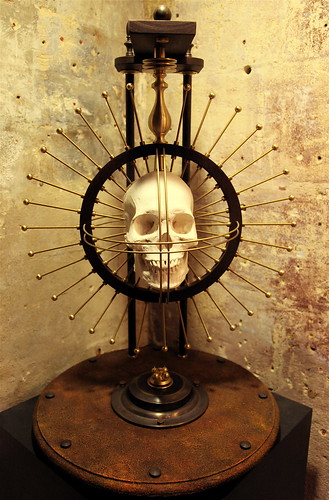
If you want to join the exciting world of craniometry, you're going to need some tools. Here a few tools of the trade.


Where people were really going with this nonsense was brain size. The craniometricians were almost exclusively Caucasian. In the golden era of craniometry, Caucasians dominated, and they sought to justify their dominant position. They weren't heartless, insensitive, or inhumane, you see. It was simply science, simply fact. One class of people had larger brains, were more intelligent, and meant to rule. Other classes had smaller brains, were less intelligent, and were fit only for a lesser station in life.

It was only natural, therefore, that scientists who studied craniometry came from the large-brained class. They were merely recording as scientific fact, in impassive fashion, the differences in brain size among different races. Samuel George Morton was one of those scientists. An American physician and naturalist, his tool of choice was the mustard seed.

By the time he died in 1851, Morton had collected more than 1000 skulls of people from around the world. He measured the brain volume of these skulls by seeing how much mustard seed they would hold. He attempted to conduct and document his work carefully, to be as unbiased as he could. From a book to be referenced below:
Morton a Philadelphia patrician with two medical degrees -- one from fashionable Edinburgh -- provided the "facts" that won worldwide respect ... Morton won his reputation as the great data-gatherer and objectivist of American science, the man who would raise an immature enterprise from the mires of fanciful speculation. Oliver Wendell Holmes praised Morton for "the severe and cautious character" of his works, which "from their very nature are permanent data for all future students of ethnology." ... When Morton died in 1851, the New York Tribune wrote that "probably no scientific man in America enjoyed a higher reputation among scholars throughout the world, than Dr. Morton."
Yet Morton gathered skulls neither from the dilettante's motive of abstract interest nor the taxonomist's zeal for complete representation. He had a hypothesis to test; that a ranking of races could be established objectively by physical characteristics of the brain, particularly by its size.
Morton took a special interest in native Americans, both north and south. He titled his first and largest work the Crania Americana. Perhaps as a European-American scientist, he was particularly interested in justifying the treatment of native Americans by European-Americans. Of Greenland's natives, for example, he wrote:
They are crafty, sensual, ungrateful, obstinate and unfeeling, and much of their affection for their children may be traced to purely selfish motives. They devour the most disgusting aliments uncooked and uncleaned, and seem to have no ideas beyond providing for the present moment. ... Their mental faculties, from infancy to old age, present a continued childhood. ... In gluttony, selfishness and ingratitude, they are perhaps unequalled by any other nation of people.
Of the Chinese, Morton wrote:
So versatile are their feelings and actions, that hey have been compared to the monkey race, whose attention is perpetually changing from one object to another.
Of Hottentots:
... the nearest approximation to the lower animals. ... The women are represented as even more repulsive than the men.

After Morton's work, there could no longer be any reasonable doubt as to the superiority of the races. It was no longer a matter of casual observation or cultural bias. The science was settled. 

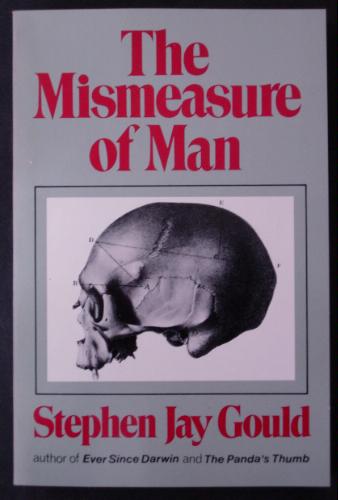
In 1977, however, science historian Stephen Jay Gould re-examined Morton's work. Gould reported his findings in several sources including one of my favorite books: The Mismeasure of Man.


I quoted previously from that book. I quote again below.
During the summer of 1977, I spent several weeks reanalyzing Morton's data. (Morton, the self-styled objectivist, published all his raw information. We can infer with little doubt how he moved from raw measurements to summary tables.) In short, and to put it bluntly, Morton's summaries are a patchwork of fudging and finagling in the clear interest of controlling a priori convictions. Yet -- and this is the most intriguing aspect of the case -- I find no evidence of conscious fraud; indeed, had Morton been a conscious fudger, he would not have published his data so openly. 
Conscious fraud is probably rare in science. It is also not very interesting, for it tells us little about the nature of scientific activity. Liars, if discovered, are excommunicated; scientists declare that their profession has properly policed itself, and they return to work, mythology unimpaired, and objectivity vindicated. The prevalence of unconscious finagling, on the other hand, suggests a general conclusion about the social context of science. For if scientists can be honestly self-deluded to Morton's extent, then prior prejudice may be found anywhere, even in the basics of measuring bones and toting sums.
Gould provided, in great detail, examples of the "unconscious finagling" that he claims littered Morton's work. Using Morton's own data, he recalculated the average brain size for Caucasians and native Americans. He found that Morton had made multiple errors and that the errors always favored Morton's pre-conceived notion about racial superiority. Morton's errors caused the Caucasian brain size to be overstated and the native American brain size to be understated. Instead of 87 versus 82 cubic inches, Gould calculated (using the same data) values of 84.45 and 83.79 cubic inches. In other words, using the same set of data, Morton found a significant difference where Gould found none at all. 

Gould categorized Morton's errors into three groups: procedural omissions, selectivity, and subjectivity. Regarding procedural omissions, Gould wrote:
Morton was convinced that the variation in the skull size recorded differential, innate mental ability. He never considered alternate hypotheses, though his own data almost cried out for a different interpretation. Morton never computed means by sex or stature, even when he recorded these data in his tabulations. Had he computed the effect of stature, he would presumably have recognized that it explained all important differences in brain size among his groups.
It is now well-recognized that body size is a first order determinant of brain size. As a scientist, Morton had the evidence for that conclusion, but failed to see or explore it. He was too focused finding proof of his preconceived notions to correct his data for effect of body size. Even today, there's no reason to believe that people the size of Bill Gates and Steve Jobs are inherently less intelligent that the average NBA player.

Regarding selectivity, Gould wrote:
Morton often choose to include or delete large subsamples in order to match group averages with prior expectations. He included Inca Peruvians to decrease the [American] Indian average, but deleted Hindus to raise the Caucasian mean.
Regarding subjectivity, Gould wrote:
Morton's measures with [mustard] seed were sufficiently imprecise to permit a wide range of influence by subjective bias; later measurements with [lead] shot, on the other hand, were repeatable, and presumably objective. In skulls measured by both methods, values for shot always exceed values for the light, poorly packed seed. But degrees of discrepancy match a priori assumptions; an average of 5.4, 2.2, and 1.8 cubic inches for blacks, Indians, and whites, respectively. In other words, blacks fared poorest when the results could be biased toward an expected result. ... Plausible scenarios are easy to construct. Morton, measuring by seed, picks up a threateningly large black skull, fills it lightly and gives it a few desultory shakes. Next, he takes a distressingly small Caucasian skull, shakes hard, and pushes mightily at the foramen magnum with his thumb. It is easily done, without conscious motivation; expectation is a powerful guide to action.
And now for promised elegant and seamless segue.

Just as Samuel George Morton was unable to recognize and control the effect of his pre-conceived notions on his science, I suggest that jurors are unable to recognize and control the effect of their preconceived notions on their jury verdicts.

Morton believed that the non-white races were mentally inferior to Caucasians. Jurors (i.e. the American public) believe that we generally don't arrest and prosecute, much less imprison, people for doing nothing wrong. After my last stint as a juror, my mother asked me what the case was about. I said it had to do with child molestation. She said: "Oh, my. I hope you convicted him." I said nothing. I let he comment hang there, uncomfortable to us both. Then she said quietly, but not convincingly: "I guess I should wait to hear the evidence."

Morton knew that, as a man of science, he was not supposed to anticipate the answer. He was supposed to allow the data to speak for itself. Jurors know that they are not supposed to anticipate a verdict. They are instructed to presume the defendant innocent, and not render a guilty verdict unless the State proves guilt beyond a reasonable doubt. All jurors take an oath to do just that, but many of them, far too many of them do not.

Morton's bias made its way into his results and was later discovered because Morton did not recognize his own bias. He published all his work, including his raw data and his methods. Gould argued that Morton's openness spoke to both his integrity and his failure to see his own bias. Similarly, when polled, jurors will freely admit they voted guilty even when the evidence failed to support such a verdict.  Once again, I repeat the critical plot below.
My alternative theory for juror compliance (and for Morton's behavior) has a name. It's called confirmation bias. I've written of it before. I'll write of it again sometime. For now, I'll turn as I frequently do to the fine folks at Wikipedia:
Confirmation bias ... is a tendency for people to favor information that confirms their preconceptions or hypotheses regardless of whether the information is true. As a result, people gather evidence and recall information from memory selectively, and interpret it in a biased way. The biases appear in particular for emotionally significant issues and for established beliefs. For example, in reading about gun control, people usually prefer sources that affirm their existing attitudes. They also tend to interpret ambiguous evidence as supporting their existing position. Biased search, interpretation and/or recall have been invoked to explain attitude polarization (when a disagreement becomes more extreme even though the different parties are exposed to the same evidence), belief perseverance (when beliefs persist after the evidence for them is shown to be false), the irrational primacy effect (a stronger weighting for data encountered early in an arbitrary series) and illusory correlation (in which people falsely perceive an association between two events or situations).
In summary, I argue that jurors presume the defendant must have done something or he would not be on trial. I argue that confirmation bias then takes over. Every bit of evidence and every mannerism of the defendant is distorted by the overpowering lens of confirmation bias.

As evidence of the overpowering nature of confirmation bias, I offer a footnote on the work of Stephen Jay Gould, the noted Harvard professor who so skillfully took Samuel George Morton to task for his confirmation bias. Just this year, in June 2011, six anthropolgists reviewed Gould's review of Morton. They presented their findings in The Mismeasure of Science: Steven Jay Gould versus Samuel George Morton on Skulls and Bias. They too make all their work available for your review. If instead you trust me to summarize, press on.

Jason Lewis, et. al. find that Stephen Jay Gould suffered more seriously from confirmation bias than did Samuel George Morton, and that Gould made several of the same mistakes of which he wrongfully accused Morton. They make a compelling case that one of my intellectual paragons was just as human as the rest of us. I caution you that Lewis effectively refutes some of the very Gould quotes I used in this very post. I refer you to their article for specifics.

Who then should you trust to tell you the unvarnished, unbiased truth? Morton? Gould? Lewis? Me?

How about the judge, the police, or the prosecutor?

How about your preconceived notions?

How will you ever function again?

Friday, December 23, 2011

The Compliant Juror: Part IV

Despite three previous posts regarding compliant juries (here, here, and here) I have yet to establish that juries are compliant. I haven't even defined what I mean by a compliant jury.  I realize that I claimed a compliant juror is the opposite of a skeptical juror, but that merely sidestepped the issue: I didn't define a skeptical juror.

In this post, I hope to ameliorate those shortcomings. I'll begin by establishing that juries do tend to be compliant. Then, I'll actually define the term.

To establish that juries tend to be compliant, I'll borrow heavily from an earlier post in this august blog: Burden of Proof as a Legal Fiction

I hereby intend to prove to you, beyond a reasonable doubt, that the concept of "proof beyond a reasonable doubt" is nothing more than a legal fiction. This shouldn't take too long.

Consider first the alleged burden of proof in a civil case. That burden is usually described as the "preponderance of the evidence."  It's a 50-50 type decision. If the evidence favors the plaintiff even by a  teensy weensy bit, the jury is to find in favor of the plaintiff. If, on the other hand, the evidence favors the defense even by a smidgeon, then the jury is to find in favor of the defense. It's so simple.

I present the idealized concept of preponderance of the evidence in the figure below.
Matters are a little more confusing for jurors in a criminal case. They are asked to decide if the evidence proves the State's case beyond a reasonable doubt. The jurors must figure out how heavily the evidence favors the prosecution AND they must figure out what the hell the term reasonable doubt means AND they must decide whether the weight of the evidence provided by the prosecution exceeds the reasonable doubt threshold.

Courts are of almost no help in determining the meaning of reasonable doubt. One thing they absolutely will not do is apply any numeric value to reasonable doubt. They never suggest anything such as "you must be 90% certain."

Instead, they give you a reasonable doubt instruction something along the line of:
The question naturally is what is a reasonable doubt. The words almost define themselves. It is a doubt based upon reason and common sense. It is a doubt that a reasonable person has after carefully weighing all of the evidence. It is a doubt which would cause a reasonable person to hesitate to act in a matter of importance in his or her personal life. Proof beyond a reasonable doubt must be proof of such a convincing character that a reasonable person would not hesitate to rely and act upon it in the most important of his own affairs.
Legal scholars recognized that if you are to quantify the number, it should certainly be greater than 50%. That is, after all, the standard for civil cases. The burden of proof in criminal cases is supposed to be substantially greater. Legal scholars tend to throw out a value of 90% as a starting point. This corresponds roughly to William Blackstone's 250 year old claim that it is "better that ten guilty persons escape than that one innocent suffer."

That traditional view is portrayed in the figure below.
When Rita Simon and Linda Mahon asked 106 judges to put a non-legally-binding number to proof beyond a reasonable doubt, those judges gave a number (presumably on average) of 89%.

Simon and Mahon also asked 25 jurors to put a number to the concept. Those jurors put the number at 79%. That number is not far from a couple other studies I've seen where jurors put the number around 75%, assuming they are asked before they deliberate in a mock trial. If they are asked after they deliberate, the put the number closer to 55%. The suggestion is that they wanted to convict, the evidence didn't support conviction at even a 75% standard, so they reduced the standard. That smells of compliance.

As part of a NCSC (National Center for State Courts) study in 2000 and 2001, judges and jurors were asked to provide their estimate of the strength of the evidence used to convict (or acquit) a defendant. I've converted the results into the summary plot below. Prepare to be disturbed.
The results reek of compliance. Even when the evidence favors neither the prosecution nor the defense, both judge and jury are voting two out of three times to convict. Even when the evidence heavily favors the defense, the juries are voting to convict one out of three times.

Now, finally, I'm prepared to provide a definition of a compliant juror. A compliant juror is one who relieves the State of its burden of proof, either willfully or carelessly.

And ...

Since I've declared compliant jurors and skeptical jurors to be opposites, I'm ready to define a skeptical juror. A skeptical juror is one who does not relieve the State of its burden of proof, either willfully or carelessly.

With the amelioration out of the way, the series will continue. Next, I'll discuss alternative hypothesis regarding the compliant nature of jurors.