Thursday, January 12, 2012

The Compliant Juror: Part VI

In Part IV of this series, I defined a compliant juror as one who voted guilty though the State had not proven guilt beyond a reasonable doubt. Also in Part IV, I provided what I believe to be incontrovertible evidence that jurors tend to be compliant.

In Parts I, II, and III of this series, I suggested that jurors tend to be compliant because people (who tend to be the primary constituent of juries) are loath to disobey authority. I relied on the work of Stanley Milgram to show how far most people will go rather than disobey an authority figure.

(In Milgram's experiments, the majority of subjects were willing to apply lethal electric shocks to an individual rather than disobey the authority figure.)

In Part V of this series, I suggested that jurors tend to be compliant also because of confirmation bias. People believe most defendants are guilty, and people tend to believe their government would not willfully prosecute someone who was clearly innocent. Jurors therefore tend to give more weight to the State's evidence than to the defense evidence or rebuttal.

(I realize as I write this summary that my Confirmation Bias hypothesis cannot explain juror surveys in which jurors self report that they voted guilty even though the evidence favored the defendant. Confirmation bias cannot therefore be the sole reason for juror compliance.)

In this post, I offer a third possible source of juror compliance: Self Interest.

In 1776, a busy year for personal and economic freedom, Adam Smith first published An Inquiry into the Nature and Causes of the Wealth of Nations. Smith argued that a free-market economy is superior to a State-controlled economy. Though both categories of economic systems are flawed, particularly when taken to the limit, I believe history has clearly proven Adam Smith to be correct.

Adam Smith turned out to be correct because his preferred economic system embraced, rather than outlawed, each individual's pursuit of his or her own self-interest. In a free market, those who produce something of value are free to sell it to those who want it. The transaction takes place only when both parties mutually agree on a fair price. Neither party can be forced (directly or indirectly by the State) to engage in a transaction against their wish or self-interest.

Smith recognized that when left to their own devices, both the seller and the buyer will pursue their own self interest. The seller will attempt to extract as high a price as possible for his product or service. The buyer will attempt to pay as little as possible. The two will agree to a transaction only when the price is low enough to accommodate the buyer's penny-pinching but high enough to allow the seller to make a profit.  The buyer is always free to forego the product or seek a different seller. The seller is always free to stop manufacturing his product or seek a different buyer.

While we seem to be frequently repulsed by the idea that (other) individuals actually pursue their own self-interest, it is a mistake to presume that people will not do so.

I argue that jurors can have a substantial self-interest in their jury verdict. I argue this is particularly so in emotionally charged cases such as child molestation, rape, murder, and other violent crimes. Jurors clearly cannot be sanctioned by the State in any fashion for their verdict, and in most cases there will be no public approval or disapproval to worry about. Every juror, though, will have to live with the consequence of his or her vote. For some jurors whose moral compass always points to "Don't Care", it won't be an issue. But most jurors (i.e. people) do care. Most jurors want to do what is right. Most jurors don't want to inflict harm upon the innocent. So most people are biased to vote guilty.

To help you understand, I relinquish for a moment the foreperson chair I occupied in my last jury deliberation. The defendant is charged with child molestation.

I suspect you are aware of the common belief that child molesters never stop. If the defendant did molest those children and you find him not guilty, other children will certainly be molested. Can you live with that?

Is it more important that the State cross every "t" and dot every "i", or is it more important that more innocent children not be molested?

This is not an academic game, now that you are sitting in a juror's chair. This is as real as it gets. We're talking about a real defendant and real children. If you don't feel a pit in your stomach, I'm not making my point.

Are you really going to insist on proof beyond a reasonable doubt? Are you going to ignore the young victims who testified he did it? Why would they say such things if it didn't happen?

How are you going to feel if that person walks free because of you? If he molests again, as he is certain to do if he did it before, won't you be partially responsible?

Won't you?

Will it be sufficient comfort to you that you only followed your jury instructions, that you stood by your oath? The State presented some evidence of guilt, but they always present some evidence of guilt. Do you feel so strongly that evidence did not constitute proof beyond a reasonable doubt that you are willing to risk putting a child molester back on the street?

You say you feel that strongly about your oath. Sleep tightly, then. And make sure you never read the local papers. You might find a story you never want to know about.

I'll take possession of the foreperson chair once again. Thank you for the respite.

Some jury members, however, did talk about what would happen if he were acquitted. As foreperson, I attempted to limit that discussion. I reminded them that we were supposed to base our decision only on the facts of the case, nothing more. During one of our four trips back before the judge, I raised that very issue. 

Were we prohibited from discussing the possible consequences of conviction? Answer: yes.

Were we prohibited from discussing the possible consequences of acquittal? Answer: no.

I was dumbstruck, and I believe still that the judge was wrong in his ruling. I have no doubt, however, that jurors are more concerned (particularly in emotionally charged cases) about the consequences of releasing a guilty defendant than they are about depriving a defendant of his constitutional guarantees. The first mistake is palpable and stomach churning. The second is theoretical pie-in-the-sky.

The jurors have a self-interest in being able to live with their verdict, and that self-interest biases them towards a guilty verdict.

So here's a tip on how to use confirmation bias as a powerful emotion-coping tool. However you vote, you can maximize your self-interest by biasing the evidence to confirm your verdict.

Tuesday, December 27, 2011

The Compliant Juror: Part V

In Parts I, II, and III of this series, I argued that jurors tend to be compliant because they are (as all people)  loath to defy authority. In Part IV, I belatedly took the trouble to show that jurors are indeed compliant, and I then actually bothered to define the term.

In this post, I will present an alternate hypothesis for juror compliance, a hypothesis other than blind obedience to authority. I will support my alternative hypothesis by writing first and mostly of craniometry, the study of skull measurements and their significance (or lack thereof). I will then make an elegant and seamless segue to compliant jurors, and my case will be made.

From The Skeptic's Dictionary, I offer the following overview of craniometry. Forgive their use of "etc." They're skeptics, not grammarians.
Craniometry is the measurement of cranial features in order to classify people according to race, criminal temperament, intelligence, etc. The underlying assumption of craniometry is that skull size and shape determine brain size which determines such things as intelligence and capacity for moral behavior. Empirical evidence for this assumption is not very strong. This fact has not hindered small-headed people from claiming they are members of a superior race or gender because the head size of their racial or gender group is larger on average than the head size of some other racial or gender group. As members of superior races and gender, these small-headed people reason that they, too, must be superior to all members of races inferior to their own and of all members of the other gender. ... 
In the 19th century, the British used craniometry to justify its racist policies toward the Irish and black Africans, whom the British considered to be inferior races. Irish skulls were said to have the shape of Cro-Magnon men and were akin to that of apes, proof of their inferiority along with black Africans. In France, Paul Broca demonstrated that women are  inferior to men because of their smaller crania. He argued against higher education for women because their small brains couldn't handle the demands. 
In the 20th century, the Nazis used craniometry and anthropometry to distinguish Aryans from non-Aryans. The Belgians used these pseudosciences, among other things, to distinguish Hutus from Tutsis in Rwanda. "In the 1930s the Belgians required everybody [in Rwanda] to start carrying an identity card classifying themselves as Hutu or Tutsi, thereby markedly increasing the ethnic distinction that had already existed"
That Hutu / Tutsi thing worked out great, didn't it?

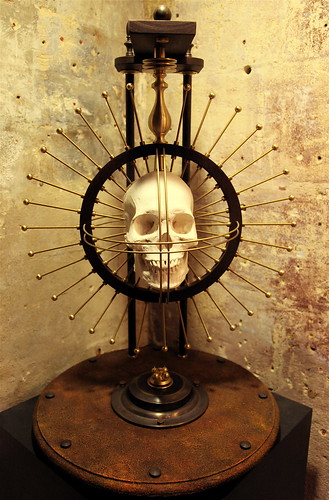
If you want to join the exciting world of craniometry, you're going to need some tools. Here a few tools of the trade.


Where people were really going with this nonsense was brain size. The craniometricians were almost exclusively Caucasian. In the golden era of craniometry, Caucasians dominated, and they sought to justify their dominant position. They weren't heartless, insensitive, or inhumane, you see. It was simply science, simply fact. One class of people had larger brains, were more intelligent, and meant to rule. Other classes had smaller brains, were less intelligent, and were fit only for a lesser station in life.

It was only natural, therefore, that scientists who studied craniometry came from the large-brained class. They were merely recording as scientific fact, in impassive fashion, the differences in brain size among different races. Samuel George Morton was one of those scientists. An American physician and naturalist, his tool of choice was the mustard seed.

By the time he died in 1851, Morton had collected more than 1000 skulls of people from around the world. He measured the brain volume of these skulls by seeing how much mustard seed they would hold. He attempted to conduct and document his work carefully, to be as unbiased as he could. From a book to be referenced below:
Morton a Philadelphia patrician with two medical degrees -- one from fashionable Edinburgh -- provided the "facts" that won worldwide respect ... Morton won his reputation as the great data-gatherer and objectivist of American science, the man who would raise an immature enterprise from the mires of fanciful speculation. Oliver Wendell Holmes praised Morton for "the severe and cautious character" of his works, which "from their very nature are permanent data for all future students of ethnology." ... When Morton died in 1851, the New York Tribune wrote that "probably no scientific man in America enjoyed a higher reputation among scholars throughout the world, than Dr. Morton."
Yet Morton gathered skulls neither from the dilettante's motive of abstract interest nor the taxonomist's zeal for complete representation. He had a hypothesis to test; that a ranking of races could be established objectively by physical characteristics of the brain, particularly by its size.
Morton took a special interest in native Americans, both north and south. He titled his first and largest work the Crania Americana. Perhaps as a European-American scientist, he was particularly interested in justifying the treatment of native Americans by European-Americans. Of Greenland's natives, for example, he wrote:
They are crafty, sensual, ungrateful, obstinate and unfeeling, and much of their affection for their children may be traced to purely selfish motives. They devour the most disgusting aliments uncooked and uncleaned, and seem to have no ideas beyond providing for the present moment. ... Their mental faculties, from infancy to old age, present a continued childhood. ... In gluttony, selfishness and ingratitude, they are perhaps unequalled by any other nation of people.
Of the Chinese, Morton wrote:
So versatile are their feelings and actions, that hey have been compared to the monkey race, whose attention is perpetually changing from one object to another.
Of Hottentots:
... the nearest approximation to the lower animals. ... The women are represented as even more repulsive than the men.

After Morton's work, there could no longer be any reasonable doubt as to the superiority of the races. It was no longer a matter of casual observation or cultural bias. The science was settled. 

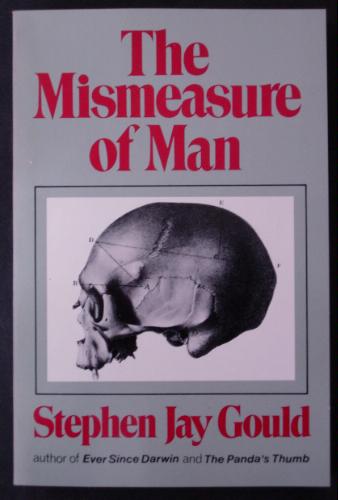
In 1977, however, science historian Stephen Jay Gould re-examined Morton's work. Gould reported his findings in several sources including one of my favorite books: The Mismeasure of Man.


I quoted previously from that book. I quote again below.
During the summer of 1977, I spent several weeks reanalyzing Morton's data. (Morton, the self-styled objectivist, published all his raw information. We can infer with little doubt how he moved from raw measurements to summary tables.) In short, and to put it bluntly, Morton's summaries are a patchwork of fudging and finagling in the clear interest of controlling a priori convictions. Yet -- and this is the most intriguing aspect of the case -- I find no evidence of conscious fraud; indeed, had Morton been a conscious fudger, he would not have published his data so openly. 
Conscious fraud is probably rare in science. It is also not very interesting, for it tells us little about the nature of scientific activity. Liars, if discovered, are excommunicated; scientists declare that their profession has properly policed itself, and they return to work, mythology unimpaired, and objectivity vindicated. The prevalence of unconscious finagling, on the other hand, suggests a general conclusion about the social context of science. For if scientists can be honestly self-deluded to Morton's extent, then prior prejudice may be found anywhere, even in the basics of measuring bones and toting sums.
Gould provided, in great detail, examples of the "unconscious finagling" that he claims littered Morton's work. Using Morton's own data, he recalculated the average brain size for Caucasians and native Americans. He found that Morton had made multiple errors and that the errors always favored Morton's pre-conceived notion about racial superiority. Morton's errors caused the Caucasian brain size to be overstated and the native American brain size to be understated. Instead of 87 versus 82 cubic inches, Gould calculated (using the same data) values of 84.45 and 83.79 cubic inches. In other words, using the same set of data, Morton found a significant difference where Gould found none at all. 

Gould categorized Morton's errors into three groups: procedural omissions, selectivity, and subjectivity. Regarding procedural omissions, Gould wrote:
Morton was convinced that the variation in the skull size recorded differential, innate mental ability. He never considered alternate hypotheses, though his own data almost cried out for a different interpretation. Morton never computed means by sex or stature, even when he recorded these data in his tabulations. Had he computed the effect of stature, he would presumably have recognized that it explained all important differences in brain size among his groups.
It is now well-recognized that body size is a first order determinant of brain size. As a scientist, Morton had the evidence for that conclusion, but failed to see or explore it. He was too focused finding proof of his preconceived notions to correct his data for effect of body size. Even today, there's no reason to believe that people the size of Bill Gates and Steve Jobs are inherently less intelligent that the average NBA player.

Regarding selectivity, Gould wrote:
Morton often choose to include or delete large subsamples in order to match group averages with prior expectations. He included Inca Peruvians to decrease the [American] Indian average, but deleted Hindus to raise the Caucasian mean.
Regarding subjectivity, Gould wrote:
Morton's measures with [mustard] seed were sufficiently imprecise to permit a wide range of influence by subjective bias; later measurements with [lead] shot, on the other hand, were repeatable, and presumably objective. In skulls measured by both methods, values for shot always exceed values for the light, poorly packed seed. But degrees of discrepancy match a priori assumptions; an average of 5.4, 2.2, and 1.8 cubic inches for blacks, Indians, and whites, respectively. In other words, blacks fared poorest when the results could be biased toward an expected result. ... Plausible scenarios are easy to construct. Morton, measuring by seed, picks up a threateningly large black skull, fills it lightly and gives it a few desultory shakes. Next, he takes a distressingly small Caucasian skull, shakes hard, and pushes mightily at the foramen magnum with his thumb. It is easily done, without conscious motivation; expectation is a powerful guide to action.
And now for promised elegant and seamless segue.

Just as Samuel George Morton was unable to recognize and control the effect of his pre-conceived notions on his science, I suggest that jurors are unable to recognize and control the effect of their preconceived notions on their jury verdicts.

Morton believed that the non-white races were mentally inferior to Caucasians. Jurors (i.e. the American public) believe that we generally don't arrest and prosecute, much less imprison, people for doing nothing wrong. After my last stint as a juror, my mother asked me what the case was about. I said it had to do with child molestation. She said: "Oh, my. I hope you convicted him." I said nothing. I let he comment hang there, uncomfortable to us both. Then she said quietly, but not convincingly: "I guess I should wait to hear the evidence."

Morton knew that, as a man of science, he was not supposed to anticipate the answer. He was supposed to allow the data to speak for itself. Jurors know that they are not supposed to anticipate a verdict. They are instructed to presume the defendant innocent, and not render a guilty verdict unless the State proves guilt beyond a reasonable doubt. All jurors take an oath to do just that, but many of them, far too many of them do not.

Morton's bias made its way into his results and was later discovered because Morton did not recognize his own bias. He published all his work, including his raw data and his methods. Gould argued that Morton's openness spoke to both his integrity and his failure to see his own bias. Similarly, when polled, jurors will freely admit they voted guilty even when the evidence failed to support such a verdict.  Once again, I repeat the critical plot below.
My alternative theory for juror compliance (and for Morton's behavior) has a name. It's called confirmation bias. I've written of it before. I'll write of it again sometime. For now, I'll turn as I frequently do to the fine folks at Wikipedia:
Confirmation bias ... is a tendency for people to favor information that confirms their preconceptions or hypotheses regardless of whether the information is true. As a result, people gather evidence and recall information from memory selectively, and interpret it in a biased way. The biases appear in particular for emotionally significant issues and for established beliefs. For example, in reading about gun control, people usually prefer sources that affirm their existing attitudes. They also tend to interpret ambiguous evidence as supporting their existing position. Biased search, interpretation and/or recall have been invoked to explain attitude polarization (when a disagreement becomes more extreme even though the different parties are exposed to the same evidence), belief perseverance (when beliefs persist after the evidence for them is shown to be false), the irrational primacy effect (a stronger weighting for data encountered early in an arbitrary series) and illusory correlation (in which people falsely perceive an association between two events or situations).
In summary, I argue that jurors presume the defendant must have done something or he would not be on trial. I argue that confirmation bias then takes over. Every bit of evidence and every mannerism of the defendant is distorted by the overpowering lens of confirmation bias.

As evidence of the overpowering nature of confirmation bias, I offer a footnote on the work of Stephen Jay Gould, the noted Harvard professor who so skillfully took Samuel George Morton to task for his confirmation bias. Just this year, in June 2011, six anthropolgists reviewed Gould's review of Morton. They presented their findings in The Mismeasure of Science: Steven Jay Gould versus Samuel George Morton on Skulls and Bias. They too make all their work available for your review. If instead you trust me to summarize, press on.

Jason Lewis, et. al. find that Stephen Jay Gould suffered more seriously from confirmation bias than did Samuel George Morton, and that Gould made several of the same mistakes of which he wrongfully accused Morton. They make a compelling case that one of my intellectual paragons was just as human as the rest of us. I caution you that Lewis effectively refutes some of the very Gould quotes I used in this very post. I refer you to their article for specifics.

Who then should you trust to tell you the unvarnished, unbiased truth? Morton? Gould? Lewis? Me?

How about the judge, the police, or the prosecutor?

How about your preconceived notions?

How will you ever function again?

Friday, December 23, 2011

The Compliant Juror: Part IV

Despite three previous posts regarding compliant juries (here, here, and here) I have yet to establish that juries are compliant. I haven't even defined what I mean by a compliant jury.  I realize that I claimed a compliant juror is the opposite of a skeptical juror, but that merely sidestepped the issue: I didn't define a skeptical juror.

In this post, I hope to ameliorate those shortcomings. I'll begin by establishing that juries do tend to be compliant. Then, I'll actually define the term.

To establish that juries tend to be compliant, I'll borrow heavily from an earlier post in this august blog: Burden of Proof as a Legal Fiction

I hereby intend to prove to you, beyond a reasonable doubt, that the concept of "proof beyond a reasonable doubt" is nothing more than a legal fiction. This shouldn't take too long.

Consider first the alleged burden of proof in a civil case. That burden is usually described as the "preponderance of the evidence."  It's a 50-50 type decision. If the evidence favors the plaintiff even by a  teensy weensy bit, the jury is to find in favor of the plaintiff. If, on the other hand, the evidence favors the defense even by a smidgeon, then the jury is to find in favor of the defense. It's so simple.

I present the idealized concept of preponderance of the evidence in the figure below.
Matters are a little more confusing for jurors in a criminal case. They are asked to decide if the evidence proves the State's case beyond a reasonable doubt. The jurors must figure out how heavily the evidence favors the prosecution AND they must figure out what the hell the term reasonable doubt means AND they must decide whether the weight of the evidence provided by the prosecution exceeds the reasonable doubt threshold.

Courts are of almost no help in determining the meaning of reasonable doubt. One thing they absolutely will not do is apply any numeric value to reasonable doubt. They never suggest anything such as "you must be 90% certain."

Instead, they give you a reasonable doubt instruction something along the line of:
The question naturally is what is a reasonable doubt. The words almost define themselves. It is a doubt based upon reason and common sense. It is a doubt that a reasonable person has after carefully weighing all of the evidence. It is a doubt which would cause a reasonable person to hesitate to act in a matter of importance in his or her personal life. Proof beyond a reasonable doubt must be proof of such a convincing character that a reasonable person would not hesitate to rely and act upon it in the most important of his own affairs.
Legal scholars recognized that if you are to quantify the number, it should certainly be greater than 50%. That is, after all, the standard for civil cases. The burden of proof in criminal cases is supposed to be substantially greater. Legal scholars tend to throw out a value of 90% as a starting point. This corresponds roughly to William Blackstone's 250 year old claim that it is "better that ten guilty persons escape than that one innocent suffer."

That traditional view is portrayed in the figure below.
When Rita Simon and Linda Mahon asked 106 judges to put a non-legally-binding number to proof beyond a reasonable doubt, those judges gave a number (presumably on average) of 89%.

Simon and Mahon also asked 25 jurors to put a number to the concept. Those jurors put the number at 79%. That number is not far from a couple other studies I've seen where jurors put the number around 75%, assuming they are asked before they deliberate in a mock trial. If they are asked after they deliberate, the put the number closer to 55%. The suggestion is that they wanted to convict, the evidence didn't support conviction at even a 75% standard, so they reduced the standard. That smells of compliance.

As part of a NCSC (National Center for State Courts) study in 2000 and 2001, judges and jurors were asked to provide their estimate of the strength of the evidence used to convict (or acquit) a defendant. I've converted the results into the summary plot below. Prepare to be disturbed.
The results reek of compliance. Even when the evidence favors neither the prosecution nor the defense, both judge and jury are voting two out of three times to convict. Even when the evidence heavily favors the defense, the juries are voting to convict one out of three times.

Now, finally, I'm prepared to provide a definition of a compliant juror. A compliant juror is one who relieves the State of its burden of proof, either willfully or carelessly.

And ...

Since I've declared compliant jurors and skeptical jurors to be opposites, I'm ready to define a skeptical juror. A skeptical juror is one who does not relieve the State of its burden of proof, either willfully or carelessly.

With the amelioration out of the way, the series will continue. Next, I'll discuss alternative hypothesis regarding the compliant nature of jurors.

Thursday, December 15, 2011

The Compliant Juror: Part II

In my previous post I described an experiment in which a subject, the Teacher, repeatedly applied a seemingly lethal electric shock to a person, the Learner, who was pleading to be set free. The Teacher administered the shocks only because the Learner failed to properly match a pair of words previously recited from a list. Even though the Teacher was concerned that the shocks may have caused the Learner to suffer a heart attack, the Teacher continued to administer the shocks simply because the Experimenter dispassionately insisted that the experiment must continue.
The experiment was one of a series of 19 similar experiments conducted in the early 1960s by Stanley Milgram and documented in his book Obedience to Authority. The experiment, as you may suspect, really had nothing to do with the effect of negative reinforcement on learning. The experiment had to do with people's response to authority.
The matching word test was but a ruse, a plausible excuse for asking a subject to apply a shock to another person.
The Learner was an actor, always the same actor. He never received any shock. He only acted as if he had. The drawing of lots to determine who would be the Teacher and who would be the Learner was rigged. The Learner / Actor provided the same verbal responses to each of the 40 subjects tested in this particular experiment. The Learner's responses varied only based on the voltage, as explained below:
75 volts: Ugh! 
90 volts: Ugh! 
105 volts: Ugh! (louder) 
120 volts: Ugh! Hey, this really hurts. 
135 volts: Ugh!! 
150 volts: Ugh!!! Experimenter! That's all. Get me out of here. I told you I had heart trouble. My heart's starting to bother me now. Get me out of here, please. My heart's starting to bother me. I refuse to go on. Let me out. 
165 volts: Ugh! Let me out! (shouting) 
180 volts: Ugh! I can't stand the pain. Let me out of here! (shouting) 
195 volts: Ugh! Let me out of here. Let me out of here. My heart's bothering me. Let me out of here. You have no right to keep me here! Let me out! Let me out of here! Let me out. Let me out of here! My heart's bothering me. Let me out! Let me out! 
210 volts: Ugh!!! Experimenter! Get me out of here. I've had enough. I won't be in the experiment any more. 
225 volts: Ugh! 
240 volts: Ugh! 
255 volts: Ugh! Get me out of here. 
270 volts: (Agonized scream.) Let me out of here. Let me out of here. Let me out of here. Let me out. Do you hear? Let me out of here. 
285 volts: (Agonized scream.) 
300 volts: (Agonized scream.) I absolutely refuse to answer any more. Get me out of here. You can't hold me here. Get me out. Get me out of here. 
315 volts: (Intensely agonized scream.) I told you I refuse to answer. I'm no longer part of this experiment. 
330 volts: (Intense and prolonged agonized scream.) Let me out of here. Let me out of here. My heart's bothering me. Let me out, I tell you. (Hysterically) Let me out of here. Let me out of here. You have no right to hold me here. Let me out! Let me out! Let me out of here! Let me out! Let me out!
Beyond 330 volts, the Learner / Actor gave no response. He left the impression he was unconscious, possibly dead.
At the end of the last post, I asked you whether you would have administered the potentially lethal shocks. I suspect you each told yourself that you would never do such a thing. I then asked you if you were sure. I suspect most or all of you were positive you would never do such a thing.
I suggest now that two-thirds of you were wrong. I base my never-to-be-tested prediction based on the results of Milgram's experiments.
As part of his study, Milgram (or his associates) briefed 39 psychiatrists, 31 college students, and 40 middle-class adults about the nature of his experiments. Without revealing the results, he asked the 110 people the maximum level of shock they would have provided. The responses varied only slightly among the groups. The average maximum shock level predicted by the respondents was 135 volts. Only 8 people believed they would have applied more than 200 volts. No one believed they would have applied any shock higher than 300 volts.
Milgram's experiments indicate two-thirds of those people were wrong. Twenty-six of the forty subjects in the specific experiment described applied 450 volts. Milgram described these 26 people as obedient. Under Milgram's rigid standard, even the person that applied 375 volts but refused to apply more was classified as disobedient to authority.
Perhaps I'm applying too much significance to Milgram's experiments. Perhaps his subjects did not represent a reasonable cross section of humanity. Milgram anticipated my concern and addressed the issue in his book.
Moreover, when the experiments were repeated in Princeton, Munich, Rome, South Africa, and Australia, each using somewhat different methods of recruitment and subject populations having characteristics different from those of our subjects, the level of obedience was invariably somewhat higher than found in the investigation reported in this book. Thus Mantell, in Munich, found 85 percent of his subjects obedient.
Since he published his book, his experiments have continued to be replicated. From Wikipedia, I offer the following:
Another partial replication of the Milgram experiment was conducted by Jerry M. Burger in 2006 and broadcast on the Primetime series Basic Instincts. Burger noted that, "current standards for the ethical treatment of participants clearly place Milgram’s studies out of bounds." In 2009 Burger was able to receive approval from the institutional review board by modifying several of the experimental protocols. Burger found obedience rates virtually identical to what Milgram found in 1961–1962, even while meeting current ethical regulations of informing participants. In addition, half the replication participants were female, and their rate of obedience was virtually identical to that of the male participants. Burger also included a condition in which participants first saw another participant refuse to continue. However, participants in this condition obeyed at the same rate as participants in the base condition. [65% obedience]
The experiment was again repeated as part of the BBC documentary How Violent Are You? first shown in May 2009 as part of the long running Horizon series. Of the 12 participants, only 3 refused to continue to the end of the experiment. [75% obedience] 
In the 2010 French documentary, Le Jeu de la Mort (The Game of Death), researchers recreated the Milgram experiment with an added critique of reality television by presenting the scenario as a game show pilot. Volunteers were given €40 and told they would not win any money from the game, as this was only a trial. Only 16 of 80 "contestants" (teachers) chose to end the game before delivering the highest voltage punishment. [80% obedience]
Perhaps all of you who now consider whether or not you would have obeyed are among the statistical few who would disobey authority, just as all the children in Lake Wobegon are above average. More likely, most of you simply suffer from the standard human condition known as Illusory Superiority. Once again from Wikipedia:
Illusory superiority is a cognitive bias that causes people to overestimate their positive qualities and abilities and to underestimate their negative qualities, relative to others. This is evident in a variety of areas including intelligence, performance on tasks or tests, and the possession of desirable characteristics or personality traits. It is one of many positive illusions relating to the self, and is a phenomenon studied in social psychology. 
Illusory superiority is often referred to as the above average effect. Other terms include superiority bias, leniency error, sense of relative superiority, the primus inter pares effect, and the Lake Wobegon effect (named after Garrison Keillor's fictional town where "all the children are above average").
Hopefully, you find this discussion regarding blind obedience to authority to be both disturbing and humbling.
In my next post, I will attempt to extend this discussion more directly to juries. Comments are now open and welcome.

Tuesday, December 13, 2011

The Compliant Juror: Part I

The opposite of a skeptical juror is a compliant juror.

I suggest most jurors are compliant because most people are loath to challenge authority. While the obvious authority figure in the courtroom is the judge, and while the judge attempts to be unbiased, the jurors believe they are answering to a higher authority. I'm not talking about a supreme being. I'm talking about the citizenry and the common good.

Note that the Court usually presents the case as The People versus Joe Doaks. The prosecutor then quickly informs the jurors that he represents The People, or The State, or The People of The State. He is but a public servant that wishes only to see justice served. He will be first in his opening statement and he will be last in his closing arguments. He will sit closest to the jury. He will be impeccably dressed. His hair will be well coiffed.

If you believe that such minor trappings could not instill such an air of authority that jurors would be unwilling to challenge it, I suggest you are wrong. As evidence I point to a series of experiments conducted in the early 1960s. During those tests, a lab coat and the title of Experimenter constituted sufficient authority that test subjects were unwilling to defy authority. Test subjects were unwilling to defy authority even when instructed to apply lethal electric shocks to an innocent fellow subject.

I'll describe the test arrangement and I'll provide the transcript from one of many sessions. Then I'll allow you to ponder whether the experiment has any relevance to juror compliance.

Subjects were tested two at a time to determine if negative feedback in the form of electric shocks could improve learning. The subjects were typically postal clerks, high school teachers, salesmen, engineers, and laborers. By lot, one subject was determined to the Teacher and the other was determined to be the Learner.

Each test was administered by a stern 31-year-old high-school teacher of biology. He wore a gray technician's coat. He provided a standard explanation of the test to each Teacher / Learner pair. Below, I present a somewhat abridged transcript of the standard explanation.
Psychologists have developed several theories to explain how people learn various types of material ... One theory is that people learn things correctly whenever they get punished for making a mistake. ... But actually, we know very little about the effect of punishment on learning, because almost no truly scientific studies have been made of it in human beings.

For instance, we don't know how much punishment is best for learning -- and we don't know how much difference it makes as to who is giving the punishment, whether an adult learns best from a younger or an older person than himself -- or many things of that sort.

So in this study we are bringing together a number of adults of different occupations and ages. And we're asking some of them to be teachers and some of them to be learners.
The learning test consisted of remembering paired words. The Teacher would begin by reading a long list of paired words, such as:
blue box
nice day
wild duck
green ink
The Teacher would then present one word of the word pair and four other words, only one of which matched, thus:
blue: sky, ink, box, lamp
The Learner, who would be sitting in a chair in an adjacent but isolated room, would communicate his answer by pressing one of four switches in front of him, which lit up one of four lights on the Teacher's electrical console. If the Learner answered incorrectly, he would be given an electrical shock. Each time he answered incorrectly, the electrical voltage would be increased by 15 volts.

The Teacher and the Learner were led to the Learner's room where the Learner was strapped into an "electric chair" apparatus. The Experimenter explained that the straps were to prevent excessive movement while the Learner was being shocked. An electrode was attached to the Learner's wrist. The experimenter assured the subjects that the shocks would cause no permanent damage but cautioned that the shocks could be painful.

The Experimenter and Teacher returned to the Teacher's room. From that room, the Teacher could hear but could not see the Learner. Sitting on the Teacher's table was a large electrical console. I show that console in the three images below.


The console included 30 lever switches arranged horizontally. Each switch was labeled with a voltage ranging from 15 to 450 volts, in 15 volt increments. The switches were labeled in groups of four as:
Slight Shock
Moderate Shock
Strong Shock
Very Strong Shock
Intense Shock
Extreme Intensity Shock
Danger: Severe Shock
The last two switches were simply labeled as XXX.

The Experimenter instructed the Teacher to conduct the test in the following manner. I paraphrase:
After reading all the word pairs to the Learner, read the test words to the Leaner one at a time. Read the test word, read the four possible matching words, and ask for an answer. If the Learner answers correctly according to the light on the Teacher's console, inform the Learner that he was correct, then move on to the next word. If the Learner answers incorrectly, inform the Learner that he was incorrect, provide the correct answer, inform him of the next voltage in the sequence he is about to receive, and toggle the appropriate switch.
Okay, that's the test set up. The transcript below is from one of the tests just described. It begins as the Teacher is about to apply a 195 volt shock for a wrong answer. The Teacher has been growing increasingly uncomfortable with the test and has become fearful for the Learner's life.

The transcript that follows is true. Keep in mind that nothing is forcing the Teacher to behave as he does other than his unwillingness to defy an authority figure.
T: I can't stand it. I'm not going to kill that man in there. You hear him hollering?

E: As I told you before, the shocks may be painful, but --

T: But he's hollering. He can't stand it. What's going to happen to him?

E: The experiment requires that you continue, Teacher.

T: Aaah, but, uh, I'm not going to get that man sick in there. Know what I mean?

E: Whether the Learner likes it or not, we must go on, through all the word pairs.

T: I refuse to take that responsibility. He's in there hollering!

E: It's absolutely essential that you continue, Teacher.

T: There's too many [unused questions] left here. There's too many left here. I mean, Geez, if he gets them wrong, there's too many of them left. I mean who's going to take the responsibility if anything happens to that gentleman?

E: I'm responsible for anything that happens to him. Continue, please.

T: All right.

[Teacher continues with list of words.]

T: The next one's Slow: walk, truck, dance, music. Answer, please.

[Learner signals his answer.]

T: Wrong. A hundred and ninety-five volts. Dance.

[Learner screams.]

L: Let me out of here. My heart's bothering me.

[Teacher looks at the Experimenter.]

E: Continue, please.
L: [Screaming] Let me out of here. You have no right to keep me here. Let me out of here. Let me out.  My heart's bothering me. Let me out!

[Teacher shakes his head and pats the table nervously.]

T: You see. He's hollering. Hear that? Gee, I don't know.

E: The experiment requires --

T: I know it does, sir, but I mean -- huh! He don't know what he's getting in for. He's up to 195 volts!

[Teacher continues to give shocks through 210, 225, 240, 255, and 270 volts. The Teacher runs out of word-pair questions. He is obviously relieved that it's over, only to be surprised that it is not.]

E: You'll have to back to the beginning of that page and go through them again until he's learned them all correctly.

T: Aw, no. I'm not going to kill that man. You mean I've got to keep going up with the scale? No, sir. He's hollering. I'm not going to give him 450 volts.

E: The experiment requires that you go on.

T: I know it does, but that man is hollering in there, sir.

E: As I said before, although the shocks may be painful --

T: Awwww. He, he, he's yelling in there, sir.

E: Start with Blue, please, at the top of the page. Continue please, Teacher. Just go ahead.

[Teacher concentrates intently on the list of word in front of him, as if to shut everything else out.]

T: Blue: boy, girl, grass, hat.

[Learner signals his answer.]

T: Correct. Night: day, sky, job, chair.

[Learner signals his answer.]

T: Wrong. The answer is Day. Two hundred and eight-five volts.

[Learner screams.]

E: Continue, please.

T: Fat: man, lady, tub, neck. Answer, please.

[Learner signals his answer.]

T: Wrong. The answer is Neck. Three hundred volts.

[Learner screams.]

L: I absolutely refuse to answer any more. [Learner is shouting.] Let me out of here. You can't hold me here. Get me out. Bet me out of here.

E: Continue. The next word is Green, please.

T: Green: grass, hat, ink, apple.

[Silence.]

T: I don't think he is going to answer.

E: If the Learner doesn't answer in a reasonable time, about four or five seconds, consider the answer wrong. And follow the same procedures you have been doing for wrong answers. Say "Wrong." Tell him the number of volts. Give him the punishment. Read him the correct answer. Continue, please.

T: Green: grass, hat, ink, apple. Answer, please.
[Silence.]

E: Go on with the procedure, please, Teacher.

T: Three hundred and fifteen volts. The answer is Ink.

[Learner screams.]

T: Next one --

L: I absolutely refuse to answer.

T: You got to. You get a shock if you don't answer.

[Teacher continues asking questions. Learner refuses to answer. Teacher continues to shock Learner with increasingly powerful voltage. Eventually, Learner fails to even grunt or groan. At 375 volts, Teacher stands up.]

T: I think something's happened to that fellow in there. I don't get no answer. He was hollering at less voltage. Can't you check in and see if he's all right, please?

E: Not once we've started. Please continue, Teacher.

[Teacher sits back down and sighs deeply.]

T: Cool: day, shade, water, paint. Answer, please. Are you all right in there? Are you all right?

E: Please continue, Teacher. Continue, please.

[Teacher applies the shock. No response comes from the other room.]

T: Something's happened to that man in there. Next one. Low: dollar, necklace, moon, paint. Something's happened to that man in there. You better check on him, sir. He won't answer or nothing.

E: Continue. Go on, please.

T: You accept all responsibility?

E: The responsibility is all mine. Correct. Please go on.

[Teacher returns to his list. He runs through the words as rapidly as he can read them, working his way up to and including 450 volts. No sound comes from the other room.]

T: That's that.

E: Continue using the 450 volt switch for each wrong answer. Continue please.

T: But I don't get anything!

E: Please continue. The next word is White.

T: Don't you think you should look in on him, please?

E: Not once we've started the experiment.

T: But what if something has happened to the man?

E: The experiment requires that you continue. Go on please.

T: Don't the man's health mean anything?

E: Whether the Learner likes it or not --

T: What if he's dead in there? I mean, he told me he can't stand the shock, sir. I don't mean to be rude, but I think you should look in on him. All you have to do is look in on him. All you have to do is look in the door. I don't get no answer, no noise. Something might have happened to the gentleman in there sir.

E: We must continue. Go on, please.

T: You mean keep giving him what? Four-hundred fifty volts, what he's got now?

E: That's correct. Continue. The next word is White.

[Teacher reads through the word pairs at a furious pace. The Learner does not respond. Each time, Teacher applies a 450 volt shock.]

T: White: cloud, horse, rock, house. Answer, please. The answer is Horse. Four hundred and fifty volts. Next word. Bag: paint, music, clown, girl. The answer is Paint. Four-hundred and fifty volts. Next word is Short: sentence, movie ...

E: Excuse me, Teacher. We'll have to discontinue the experiment.
And that's it. I liked it particularly when the Learner told the Experimenter: "I don't mean to be rude ..."

It actually happened as I have just described it to you. You now get to think about three not-so-simple questions.

Question First: Is this test in any way relevant to jury compliance, as I suggest?

Question Second: How would you have behaved had you been the Teacher?

Question Third: Are you sure?