Saturday, July 17, 2010

On The Rate of Wrongful Conviction: Chapter 1.0

In my spare time, I'm preparing a compilation of essays on various estimates of our country's wrongful conviction rate.  As I draft them, I'll publish them here. When I'm done with all of them, I'll compile them into a single document and make it available on Scribd for free, and on Amazon for a minimal cost.

The chapters will be numbered according to the predicted wrongful conviction rate, in percent. So far I have posted Chapter 0.027 and Chapter 0.5.  Keep in mind that we have a lot of people incarcerated, around 2.5 million. That means a wrongful conviction rate of only 1%, if applicable to all those incarcerated, means we have wrongfully imprisoned 25,000 people. A wrongful conviction rate of 10%, if applied to all those incarcerated, would mean we currently have a quarter million people incarcerated for crimes they did not commit.

I didn't pull the 10% number out of thin air. We'll soon be talking about estimates that exceed 10%. For now, it's time to look at the Rosenbaum number.


Chapter 1.0
The Rosenbaum Number

Edwin Borchard was one the first wrongful conviction counters. A wrongful conviction counter is someone who brings attention to the problem of wrongful convictions by compiling and documenting cases of justice gone wrong.  Way back in 1932, Borchard described 65 wrongful convictions in his book Convicting the Innocent. The preface reads in part:
A district attorney in Worcestor County, Massachusetts, a few years ago is reported to have said: “Innocent men are never convicted. Don’t worry about it, it never happened in the world. It is a physical impossibility.” The present collection of sixty-five cases, which have been selected from a much larger number, is a refutation of this supposition.
The stories Borchard tells, clearly shocking at the time, seem almost charming by today’s standards. I repeat one of his shorter stories below.
On August 16, 1928, taxi driver E. A. Stocks reported to the Los Angeles police that two men, whom he had picked up as passengers, had stolen his cab and $7.00. On August 17, taxi man Newt Troelson made a similar report, with the loss of $12.00. On the eighteenth, E. M. Shaw, and on the twentieth, E. I. McDonald, had the same experience. On each occasion the taxi driver was requested to drive to some place which proved to be a lonely spot, where he was held up. Similar crimes were being committed in and around Los Angeles.

The four victims attended the police-department “show-ups,” where arrested persons in groups of six were marched before victims of all sorts of crimes for identification. Early in September, each of the taxi drives identified one of the prisoners, Elmer P. Jacobs, as one of the taxi robbers.

Jacobs had been arrested for “borrowing” a parked automobile for a joy ride on August 28, 1928. He pleaded guilty to grand larceny on this charge and was sentenced to Folsom as a second offender, having had a criminal record.

In the meantime, however, he had, as related, been identified as the taxi thief. He was indicted for each of the four taxi robberies just described. He was tried on October 30 and 31, 1928 … Each victim appeared as a witness and described the holdup, stating that Jacobs was one of the robbers. Jacobs was a man with wavy hair, a crooked nose, tight, thin lips (as viewed from the side), and almond-shaped-eyes -- a person readily recognizable. Jacobs endeavored to establish alibis that he was elsewhere at the time of each occurrence. The alibi witness evidence was rather indefinite, and a verdict of guilty was returned by the jury on each count to serve “for the time prescribed by law,” which was from fifteen years to life.

During the first week in November, [four men] were arrested by the police on various charges. [Two of them] confessed to robbing Newt Troelson and taking his taxicab. The confessions were corroborated by fingerprints. Confessions followed connecting these two with the Stocks and Shaw robberies, and implicating [the other two men] in the McDonald affair. None of the gang knew Jacobs. Detective Captain McCaleb then had these four men placed in the “show-up” and called in again the victims of the robberies. This time the confessed robbers were all positively identified by the victims. It was clear to everyone that their earlier identifications of Jacobs had been erroneous. They court, the prosecutor, and the Deputy Public Defender all cooperated to unravel the legal situation.

On November 16, 1928, the court granted Jacobs a sixty-day stay of sentence so that the cases against the real culprits could be disposed of. They were all convicted and sentenced to the penitentiary for various terms. On December 26, 1928, following a hearing, in which the police officers testified they were satisfied of Jacobs’ innocence, the court vacated the judgment and sentence, set aside the verdicts, and dismissed the robbery charges against Jacobs “in the interest of justice,” and for lack of evidence that would justify a conviction.
Several observations are in order.

First, the timing is amazing. The taxi cab crime wave started on August 16. Elmer was arrested for “borrowing” a car on August 28. He was picked out of a show-up by each of the four victimized taxi drivers shortly thereafter. He was convicted on October 31 on four counts, each count having a possible sentence of fifteen years to life. He was released on November 16 and formally exonerated on December 26. That’s 133 days from crime to formal exoneration, just 17 days from sentencing to release, including Thanksgiving and Christmas breaks.

Next, it’s pretty unlikely that two, much less four, taxi drivers independently picked the same wrong man out of a show-up. In other words, the police knowingly or unwittingly encouraged at least three of them to pick Elmer. It’s a comfort to know we no longer help victims and witnesses select people from lineups and photo arrays.

It’s also a little unsettling how easily the police seemed to obtain confessions for crimes which carried a potential life sentence. It's unlikely the confessions were made in the spirit of community service. It’s more likely the new real thieves were aggressively persuaded by their captors to confess. It’s good that we are now beyond such aggressive persuasion.

And it’s interesting that the police were willing to use fingerprints to inculpate the new real thieves but were unwilling to use the lack of Elmer’s fingerprints to exculpate him. In other words, the State used forensics to reinforce their pre-conceived notions. I’m pleased that today we would never do such a thing.

Finally, it’s disturbing that some people were actually named Elmer way back when. I comforted that today we would never do such a thing.

<<>>

Marty Rosenbaum is a more recent wrongful conviction counter. In his 1991 paper “Inevitable Error: Wrongful New York State Homicide Convictions, 1965-1988”, he briefly documented a well-delineated set of wrongful convictions. He counted fifty-nine people who:
  • had been convicted of a homicide (manslaughter or murder)
  • committed in the state of New York, and
  • had the charges dismissed, or
  • was acquitted on retrial, or
  • was found guilty of an offense less serious than homicide on retrial,
  • sometime between 1965 and 1988.
The longest of Rosenbaum’s summaries was substantially shorter than even the shortest of Brochard’s. A typical Rosenbaum summary follows:
J.L. Ivey, Jr. was convicted of three counts of murder in Erie County on October 27, 1976, and was sentenced to twenty-five years to life in prison. The Appellate Division unanimously reversed the conviction, citing "numerous and repeated acts of improper and prejudicial conduct by the prosecution" including: (a) commenting to the jury about the "unfairness" of a court ruling excluding certain evidence; (b) inappropriately attempting to inject sympathy for the victim into the deliberations on guilt or innocence; (c) referring to defense witnesses' testimony as "lies" and "garbage"; (d) stating that the witness chair should be "washed" after a certain defense witness leaves; and (e) admonishing the jury to be careful lest a "murderer go free." Ivey was retried and, as in the first trial, presented a strong alibi defense. Additionally, Ivey was able to call a new witness who provided convincing testimony implicating her former boyfriend for the murder. Ivey was acquitted of all charges on May 20, 1982 and released after five and one-half years of wrongful imprisonment. He was later granted summary judgment on his suit for unjust conviction and imprisonment in the Court of Claims.
In 20th century New York, telling a jury that the witness chair should be “washed” after a certain defense witness leaves was apparently grounds for a new trial. In 21st century California, comparing the defendant to a Nazi and a germ doesn’t raise a judicial eyebrow. I quote below from the 2002 California Supreme Court ruling in the case of People v. Maureen McDermott.
Defendant also cites as improper the prosecutor's comments in closing argument describing defendant as "a mutation of a human being," a "wolf in sheep's clothing," a "traitor," a person who "stalked people like animals," and someone who had "resigned from the human race." … [W]hen considered in the context of the planning and execution of Eldridge's murder, these references are within the permissible bounds of argument, and in any event would not have had such an impact "as to make it likely the jury's decision was rooted in passion rather than evidence."

Defendant asserts that the prosecutor committed misconduct by comparing her to a Nazi working in the crematorium by day and listening to Mozart by night. We find no misconduct in these remarks. The prosecutor was not comparing defendant's conduct in arranging Eldridge's murder with the genocidal actions of the Nazi regime. Rather, the prosecutor was arguing that human beings sometimes lead double lives, showing a refined sensitivity in some activities while demonstrating barbaric cruelty in others. In the context of this case, where the evidence showed defendant to be both a caring and competent nurse and a person capable of plotting a brutal murder, the argument was appropriate.

Finally, defendant claims the prosecutor committed misconduct by comparing defendant to a germ, a mad dog, and a snake. These remarks were a permissible form of argument designed to show the circumstances in which society may be justified in taking one life to protect the lives of others.
Maureen McDermott, by the way, has been on death row since 1990. Based on what I know of that case, I believe McDermott may be among the wrongfully convicted.

<<>>

Marty Rosenbaum apparently didn’t realize or didn’t care that he had the opportunity to calculate the first empirically-based wrongful conviction rate. He simply needed to divide the number of exonerations in his collection (59) by the total number of convictions that led to those exonerations. He had at his fingertips the appropriate number of total convictions, or a good approximation thereof. They were in the same dataset in which he found his wrongful convictions.

Rosenbaum had bigger fish to fry, however. He was hoping to discourage New York from re-instituting the death penalty. The introduction to his article begins:
This Article reports the preliminary results of a continuing study by the New York State Defenders Association's Wrongful Conviction Study Project. The purpose of the study is to catalogue wrongful homicide convictions in New York State during the period from 1965 to 1988. The Project has found a significant number of wrongful convictions, as defined and reported below. The data presented in this Article support the position that the State of New York should not reenact the death penalty. If New York does so, the Association's study suggests, there will almost certainly be a significant number of persons wrongfully convicted of capital murder in New York, and many of these persons will very possibly be executed before the errors are discovered, if they are discovered at all. Stated simply, the study indicates the fallibility of the New York criminal justice system, which militates against the use of capital punishment.
Rosenbaum’s goal was achieved in essence, if not in detail. Governor George Pataki signed a death penalty bill into law in 1995. No one was executed, however, before the law was declared unconstitutional by the New York State Supreme Court in 2004. No one has in fact been executed in New York since Eddie Mays was deep-fried by an electric chair in 1963.

<<>>

Sometime before 2001, Tony Poveda realized he could use Marty Rosenbaum’s nicely delineated set of exonerations to calculate the first empirically-based wrongful conviction rate. Poveda first defined the proper set of total convictions to be all murder convictions within New York during an eight year window offset three years from Rosenbaum’s eight year window.
[T]he relevant population base for calculating prevalence of wrongful convictions is the number of murder commitments to the Department of Correctional Services. A study conducted by the New York State Defenders Association … found that the median time from conviction to reversal (acquittal / dismissal) in wrongful homicide convictions in New York is approximately three years.
He then corrected Rosenbaum’s count of the wrongfully convicted by excluding those people who had been found guilty of manslaughter rather than murder. He also excluded those people who were only partially exonerated, who had been found guilty of a lesser crime on retrial.
[Rosenbaum’s] study identified 59 wrongful homicide convictions during this period, 45 of which involved murder convictions. … [Rosenbaum’s] definition of wrongful homicide conviction, however, was broader than that employed in the present study. It included not only cases in which the defendant, whose conviction had been overturned, was acquitted on retrial or the charges were dismissed, but also cases in which the defendant was reconvicted of a nonhomicide crime. If the … study cases are limited to murder sentences reversed between 1980 and 1987 and to cases in which the defendant was subsequently acquitted on retrial or the indictment was dismissed (and omits cases in which the defendant was reconvicted of a lesser offense), we were left with 23 wrongful murder convictions in New York State between 1980 and 1987. During the period 1977 to 1984, 2,276 murder commitments were made to the Department of Correctional Services; this translates to a 1.0 percent error rate in murder convictions/commitments.
And there it is.

23 / 2,276 = 0.01010 = 1.0%

Finally we have a number based on something other than a guess. It’s probably not an accurate number, but it’s a number based on something other than a guess. It’s an empirically-based wrongful conviction rate, and it’s one of the first.

The one percent rate is probably conservative for at least two reasons I’ll mention here. First, the cases were all pre-DNA. It’s not that people didn’t have DNA back then, it’s just that we didn’t know how to use DNA to determine guilt or innocence. Even though culprit DNA is available for testing in only a small number of murders, DNA is currently one of the primary basis for murder exonerations. The implication of that last sentence is that most wrongful convictions will not be identified, not even by DNA.  Any calculation that assumes wrongful convictions and exonerations are equal in number is likely to seriously understate the wrongful conviction rate.

My second reason for suspecting the Rosenbaum number is low is that society was even less willing to accept back then that people would confess to crimes they did not commit. Anyone who confessed to a crime back then was even less likely to be set free than they are today. Since somewhere between 90 and 95% of convictions are based on plea bargains, i.e. confessions, this is a major issue. I will address it in more detail later in this monograph.

Notes:

1. At one point, Edwin M. Borchard was a librarian for the Law Library of Congress. At the time his book was published he was a Professor of Law at Yale University. Borchard unsuccessfully represented the ACLU in the case of Korematsu v. United States. In the majority opinion, Hugo Black ruled that the U.S. government could intern Fred Korematsu, and all other Americans of Japanese descent, during World War II to protect itself against espionage. Under generally accepted rules for counting wrongful convictions, none of those people interned would count.

2. At the time he published “Inevitable Errors,” Marty Rosenbaum was Director of Judicial and Legislative Services, New York State Defenders Association, Inc., Public Defense Backup Center.

3. Tony Poveda is a professor at State University of New York Plattsburgh. He is the author of “Estimating Wrongful Convictions,” published in the September 2001 issue of Justice Quarterly. Not only did he convert Rosenbaum’s compilation of New York homicide exonerations into a wrongful conviction rate, he calculated his own (higher) rate in similar fashion. That work is addressed in the upcoming Chapter 1.4, The Poveda Number.

4. In the  case of Maureen McDermott, the jury could have, but apparently did not, invoke the corollary to Godwin’s law. Godwin’s law observes that as discussion grows longer, the probability of a comparison involving Nazis or Hitler approaches 1. The corollary to the law is that once such a comparison is made, the discussion is over and whoever mentioned the Nazis first automatically loses the argument. As a juror, I would be unimpressed by a prosecutor who relied on inflammatory language rather than evidence. I would be less inclined to deliver the guilty vote the State was seeking.

Friday, July 16, 2010

A Nice Review for Case, And a Word on Maye

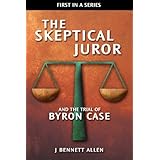
The first few reviews for The Skeptical Juror and The Trial of Byron Case were from early readers and Byron Case supporters. The single adverse early review was from a friend of the victim's family. The last five reviews have been from people we know nothing about. We are therefore pleased that the later reviews are all favorable.

We attempt to learn from the criticisms, whether they be explicit or implied. We want each book to be better than the previous. While that may be difficult to do over a series of 10 books, it should  be an achievable goal for the second in the series.

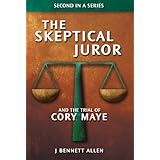
As it turns out, we have just submitted the second in the series to Amazon in Kindle format. It should show up within a week, though we may have to interate with the formatting. The print version should show up on Amazon in two or three weeks.  I've included the cover as an image in this post. Once that cover appears along the right hand sidebar, you will know that it's available for purchase.

Most Recent Reviewer Aeon Flux found the first part of Case to be slow. We agree. The biggest challenge we have had with the series is presenting the trial itself in an entertaining fashion while maintaining the integrity of the testimony. We got part way there in Case, and we think we are a few steps closer in Maye.

Aeon Flux also thought some of the humor was questionable and some of the asides were distracting. We agree. We have toned both down in Maye.

Aeon Flux thought Case picked up steam in the jury deliberation. We agree. That's why we start Maye in the jury room. That idea came from The Skeptical Spouse / Skeptical Editor, and it seemed strange at first. I now think it was a spectacular idea.

After completing the third part of Case, The Aftermath, Aeon Flux had a hard time getting over the anger at how it all turned out. We agree. We caution, however, that the last part of Maye, The Alternate Scenario, is no more likely to be soothing.

Aeon Flux was frustrated that the ending lacked a resolution. We agree. Welcome to real life. Hopefully there will be a happy ending for both Byron Case and Cory Maye. Maye is certainly well represented, and the Mississippi Supreme Court has agreed to hear his case. With respect to Case, we have a longer row to hoe. I don't write of his legal situation because it's best at this point if I do not.

Aeon Flux mentioned The Skeptical Juror's prediliction for hot dogs and diet Mt. Dew in Case. Flux will be happy to know that Funyuns and Mr. Pibb each make a guest appearance in Maye.

Now without further ado, I offer the lastest Amazon review for The Skeptical Juror and The Trial of Byron Case.
4.0 out of 5 stars Rabid Reader, July 11, 2010
By AEON FLUX (here and there) - See all my reviews
This review is from: The Skeptical Juror and The Trial of Byron Case (Paperback)
I don't read true-crime books, as a general rule. Before I read this one the closest I ever came was Truman Capote's accomplished "In Cold Blood." And let me be clear, "The Skeptical Juror and the Trial of Byron Case" was nowhere close to that highfalutin level of literature. Then again, it didn't try to be. What it was was an accessible but exacting introduction to state criminal court and to jury duty. It was also an unflinching look at one particular murder trial. It was not what I expected.

Here's where I'd insert a spoiler alert, except other reviewers before me have already ruined the surprise of the verdict: Byron Case was found guilty of 1st degree murder in a 2002 judgment. The verdict wasn't what made this book interesting, though. Allen broke from the rules of genre to come up with something that wasn't a whodunit, a profile, or even a dramatized narrative of the crime. Instead, he concerned himself with a "Dragnet"-like interest in "just the facts." He deconstructed the evidence, walked the reader through his research, and came away with some truly unsettling conclusions. It's amazing that nobody yet has spilled the beans about those conclusions in a review (and I'm not about to), but wow.

I liked this book. I liked it so much I read it in two days. Then again, "liked" is the wrong word. In spite of Allen's obvious effort to break up the tedium of some longer testimonies, using asides of sometimes questionable humor and distracting (but fascinating) local history, the first of the book's three "acts" was slow going. Once I made it through Act One, however, it all paid off. I was compelled, pulled along by a gnawing curiosity about where the evidence led. By Act Three, I felt like a private eye. Then bits and pieces came together and I felt sick to my stomach.

The only thing the ending left to be desired was a resolution, but that's a problem with the reality of Allen's source material, not with the author himself. After I put the book down, I had a hard time getting over my anger (yes, anger!) at how it all turned out. Not even Capote managed that strong a reaction, so there's obviously something to be said for Allen's hot-dog-eating, Mt.-Dew-swigging plain-spokenness. I will definitely look out for the release of the two other "Skeptical Juror" titles mentioned as "forthcoming."

Thursday, July 15, 2010

On The Rate of Wrongful Conviction: Chapter 0.5

In my spare time, I'm preparing a compilation of essays on various estimates of our country's wrongful conviction rate.  As I draft them, I'll publish them here. When I'm done with all of them, I'll compile them into a single document and make it available on Scribd for free, and on Amazon for a minimal cost.

The chapters will be numbered according to the predicted wrongful conviction rate, in percent. I began with the lowest estimate of 0.027%, and I am working my way up to the highest. Keep in mind that we have a lot of people incarcerated, around 2.5 million. That means a wrongful conviction rate of only 1%, if applicable to all those incarcerated, means we have wrongfully imprisoned 25,000 people. A wrongful conviction rate of 10%, if applied to all those incarcerated, would mean we currently have a quarter million people incarcerated for crimes they did not commit.

I didn't pull the 10% number out of thin error air. We'll soon be talking about estimates that exceed 10%. For now, it's time to look at the Huff number.


Chapter 0.5
The Huff Number

Twenty years before Oregon Prosecutor Joshua Marquis wowed Justice Scalia with his 0.027 percent wrongful conviction rate estimate, Ronald Huff bothered to ask 53 Ohio prosecutors what they thought the wrongful conviction rate might be. He also asked 55 Ohio county judges, 59 Ohio sheriffs and chiefs of police, and 21 Ohio public defenders. In addition, he asked 41 state attorney generals from across the U.S.

Huff didn’t just guess at a number, as Joshua Marquis would do twenty years later. Huff asked other people to guess for him. He asked each of his survey participants to select one of four answers:
     Never
     Less than 1%
     1 to 5%
     6 to 10%

Seventy-two percent of the respondents selected less than 1 percent but greater than zero. Twenty percent guessed somewhere between 1 and 5 percent. Only two percent of the respondents felt the number was greater than 5%.

Astonishingly, six percent of the respondents indicated their belief that innocent people are never convicted. Judge Learned Hand would be proud.

Huff distilled the results into a single number of 0.5 percent.
With these figures before us … we decided to see what the magnitude of the problem would appear to be if we cut the 1% figure in half, on the grounds that most of the respondents selected the category “less than 1%,” thereby indicating that they believed wrongful conviction does occur (they rejected “never”), but also indicating that it occurs in less than 1% of all felony convictions. Given that the midpoint between zero and 1% is 0.5%, we felt justified in using that figure.

We are left with what appears to be an impressive figure for accuracy and justice: 99.5% of all guilty verdicts in felony cases are handed down on people who did indeed commit the crimes of which they have been accused. But in terms of real numbers, this figure is more disheartening. According to the U.S. Department of Justice’s Bureau of Justice Statistics … the estimated total number of persons arrested and charged with index crimes in 1993 was 2,848,400. [Index crimes are murder, non-negligent manslaughter, forcible rape, aggravated assault, robbery, burglary, larceny theft, motor vehicle theft and arson.] Conviction rates vary from state to state and by type of offense, but based on the best available data, an analysis of the likelihood of felony conviction in the nation’s 75 largest counties, we can reasonably assume about 70% of all felony arrests result in conviction. … Now, if we go to our survey data and to the study of the American jury, and assume that 70% of those arrested for index crimes are convicted, this would yield the following estimate of wrongful conviction for the eight crimes in the FBI index only:

1990 arrests for index crimes                              2,848,400
    x conviction rate (70%)                                          x 0.7
1990 convictions for index crimes                        1,993,880
    x wrongful conviction rate (0.5%)                          x .005
Estimated number of wrongful convictions                  9,969

Thus, if these apparently conservative estimates are reasonable, we are facing an interesting dilemma: A high volume of prosecutions, even if 99.5% accurate when guilty verdicts are rendered, can still generate about 10,000 erroneous convictions for index crimes in a single year. And this figure does not including [sic] the many erroneous convictions that occur in cases involving crimes not in the index; when these are added to the 10,000 “index false positives,” the result is even more sobering.
Huff was a pioneer. He was the first to make an effort to quantify the rate of wrongful conviction. His number though is probably low, for several reasons.

First, Huff’s sample was dominated by police, prosecutors, and judges, all of whom are loath to admit that those in their profession may be putting innocent people in jail. Only nine percent of the respondents were public defenders. Huff himself recognized this problem.

Second, Huff was ambiguous about whether the respondents were to assess the wrongful conviction rate within their own district or for the U.S. as a whole. Later surveys, to be discussed soon, will show that police, prosecutors, and judges consistently perceive their district to have lower wrongful conviction rates than the rest of the country. It’s the Lake Wobegon phenomenon, where every child is above average.

Third, Huff conducted his survey when use of DNA was still in its infancy, and I do mean infancy. In 1986, the same year Huff initially published his results, DNA testing was used for the first time in the case of Pennsylvania v. Pestinikas, a civil case involving allegations of switching body parts at a funeral home.

Later surveys similar to that conducted by Huff will show that the spate of DNA exonerations cause respondents to significantly increase their estimate of the wrongful conviction rate.

Notes:
1. When I refer to Ronald Huff, I refer also to his colleagues Arye Rattner and Edward Sagarin. They published their work first in the October 1986 of Crime and Delinquency as “Guilty Until Proved Innocent: Wrongful Conviction and Public Policy.” Ten years later, they republished their work in book form as Convicted But Innocent: Wrongful Conviction and Public Policy, 1996. The following note appears in the Acknowledgments section of that book: “We have contributed equally to the research and writing in this book, and our names are therefore displayed alphabetically.”

2. At the time their book was published, Ronald Huff was director of the Criminal Justice Research Center at Ohio State University. Rattner was a Professor of Sociology at the University of Haifa, Israel. Edward Sagarin died prior to the original publication the work. He had been a Professor of Sociology at City College and City University of New York.

3. Huff actually asked more law enforcement officials than listed above. The numbers given in the first paragraph include only those who bothered to respond.

4. It would have been better had the last survey choice been “Greater than 5%.” As written, the options excluded estimates greater than 5 percent but less than 6. Perhaps some of those who didn’t’ respond believed the wrongful conviction rate was 5.5% and refused to compromise their ethics by selecting from the options provided. The options also exclude all estimates greater than 10%. Perhaps the rest of those who didn’t respond believed the wrongful conviction rate was 12.5%.

5. The quoted text is from Huff's 1996 book rather than his 1986 article.

Hank Skinner: Hell Hole News #25

It's pretty easy for me to sit at home and respond casually, as time permits, to Lynn Switzer's public pronouncements on why Hank Skinner should not be allowed to have all potentially-probative DNA tested before Texas executes him. So far I've posted only two of four responses that I claimed I would post, though nearly five weeks have already passed. I'm discomforted by that, as I would be discomforted by ignoring other demands on my time. For each of us, our time is finite, and it should therefore be precious. 

While it's easy for me to be casual, flippant, and lackadasical, it must be an entirely different matter being patient while sitting on death row. Precious few people have come within minutes of being executed for a crime they did not commit, surviving due to the intervention of a Supreme Court jurist not known for such intervention, and then being unable to respond in timely fashion when the State argues you have no valid basis for defending yourself.

Hank Skinner has now responded, as we all knew he would. He has published his repsonse in his 25th edition of Hell Hole News. I have placed a copy on Scribd, a document management service. You can view and download Hank's response here.

Two aspects of Hank's response stand out for me, though neither is a surprise. First, the response is thorough. Hank understands his case as well as anyone, and he has never been shy about sharing that information. Second, Hank seems even angrier in this edition than he has been in the previous 24. While most of his response focuses on the issues, his anger jumps out on more than a few occasions.
Comer sold me out.
No one is “gaming the system” Lynn Switzer. But your lying ass is attempting to game the public at large and the citizens of Gray County with your subterfuge and misdirection.
What D.A., what true servant of the citizenry and taxpayer, would take such an illogical, asinine stance when all three of your predecessors in office, including Mann himself before he died, as well as the medical examiner who worked the case, three lead detectives and the first officer on the scene have all publicly stated that this evidence needs to be tested? You, woman, are a sick walking joke.
This case has “dragged on for years” only because of the State’s never ending delays, subterfuge, lies, stalling and resistance to allowing the testing. They could’ve opted to put an end to this at any time by simply testing the evidence! Do not allow Lynn Switzer and her ilk to mislead you as she has others.
Lynn Switzer has something to hide regarding this evidence and these subterfugial arguments are merely designed to protect their illegal secrets.
Lynn Switzer has something to hide. Time will bear that out, mark my words on it.
I agree with Hank on the points made above, though I may have stated my argument in a slightly different manner. On the other hand, I type from an easy chair in my living room. Hank writes from somewhat less comfortable environs.

I agree that Harold "Fiscal Foibles" Comer did a less than stellar job defending Hank Skinner. (That was the second part of my ever-impending four-part response to Lynn Switzer's response to the Supreme Court's response to Hank Skinner's petition for a writ of certiorari. See Harold Comer: The Gift That Keeps on Giving)

I agree that Lynn Switzer was somewhat less than completely honest in her public response to the Supreme Court's ruling. (That will be the third part of my ...)

I agree that the State of Texas must share the responsibility for the delay in executing Hank Skinner. It's not entirely Hank's fault that he still breathes. (That will be part four.)

I agree that the State of Texas has been less than completely forthcoming in all matters related to Hank Skinner. (In fact, I will be arguing that Texas not only knows Hank Skinner did not commit the crime, they know who did. That will be part five of my four-part response. The thought has been rolling around inside me for a while, and I guess it's getting close to bursting forth, like that gruesome meal time scene from Alien. [Warning: Not suitable for the faint of heart!])

So for now, read Hank Skinner's Hell Hole News #25. Soon, someday, perhaps in the distant future, read the remainder of my response.

Tuesday, July 13, 2010

Words That Inspire ...

... me at least

I previously offered the words of Bono (U2 not Sonny) as inspirational. Now I offer the words of Jeff Bezos, founder of Amazon (the company not the rain forest.) I have a particularly found place in my heart for Bezos, since his company makes possible much of what we are trying to do with The Skeptical Juror. We are on pace to write and publish five books in this, our first, year. (The Trial of Byron Case is out. The Trial of Cory Maye will be out within a month. The Trial of Susn B. Anthony is nearly done. The monograph On The Rate of Wrongful Convictions is underway. Book 5 ... we'll get back to you on that one.) Without Amazon, our ability to distribute our  printed work would be non-existent. If we fail, it won't be Jeff's fault.

I offer his words not because our small company benefits from his vision and his passion, but because they are good words. Sometimes, when circumstances are a bit frightening, inspirational words are good to hear.

"We are What We Choose"
Baccaluareat remarks by Jeff Bezos, as delivered to the Princeton Class of 2010
May 30, 2010
As a kid, I spent my summers with my grandparents on their ranch in Texas. I helped fix windmills, vaccinate cattle, and do other chores. We also watched soap operas every afternoon, especially "Days of our Lives." My grandparents belonged to a Caravan Club, a group of Airstream trailer owners who travel together around the U.S. and Canada. And every few summers, we'd join the caravan. We'd hitch up the Airstream trailer to my grandfather's car, and off we'd go, in a line with 300 other Airstream adventurers. I loved and worshipped my grandparents and I really looked forward to these trips. On one particular trip, I was about 10 years old. I was rolling around in the big bench seat in the back of the car. My grandfather was driving. And my grandmother had the passenger seat. She smoked throughout these trips, and I hated the smell.

At that age, I'd take any excuse to make estimates and do minor arithmetic. I'd calculate our gas mileage -- figure out useless statistics on things like grocery spending. I'd been hearing an ad campaign about smoking. I can't remember the details, but basically the ad said, every puff of a cigarette takes some number of minutes off of your life: I think it might have been two minutes per puff. At any rate, I decided to do the math for my grandmother. I estimated the number of cigarettes per days, estimated the number of puffs per cigarette and so on. When I was satisfied that I'd come up with a reasonable number, I poked my head into the front of the car, tapped my grandmother on the shoulder, and proudly proclaimed, "At two minutes per puff, you've taken nine years off your life!"

I have a vivid memory of what happened, and it was not what I expected. I expected to be applauded for my cleverness and arithmetic skills. "Jeff, you're so smart. You had to have made some tricky estimates, figure out the number of minutes in a year and do some division." That's not what happened. Instead, my grandmother burst into tears. I sat in the backseat and did not know what to do. While my grandmother sat crying, my grandfather, who had been driving in silence, pulled over onto the shoulder of the highway. He got out of the car and came around and opened my door and waited for me to follow. Was I in trouble? My grandfather was a highly intelligent, quiet man. He had never said a harsh word to me, and maybe this was to be the first time? Or maybe he would ask that I get back in the car and apologize to my grandmother. I had no experience in this realm with my grandparents and no way to gauge what the consequences might be. We stopped beside the trailer. My grandfather looked at me, and after a bit of silence, he gently and calmly said, "Jeff, one day you'll understand that it's harder to be kind than clever."

What I want to talk to you about today is the difference between gifts and choices. Cleverness is a gift, kindness is a choice. Gifts are easy -- they're given after all. Choices can be hard. You can seduce yourself with your gifts if you're not careful, and if you do, it'll probably be to the detriment of your choices.

This is a group with many gifts. I'm sure one of your gifts is the gift of a smart and capable brain. I'm confident that's the case because admission is competitive and if there weren't some signs that you're clever, the dean of admission wouldn't have let you in.

Your smarts will come in handy because you will travel in a land of marvels. We humans -- plodding as we are -- will astonish ourselves. We'll invent ways to generate clean energy and a lot of it. Atom by atom, we'll assemble tiny machines that will enter cell walls and make repairs. This month comes the extraordinary but also inevitable news that we've synthesized life. In the coming years, we'll not only synthesize it, but we'll engineer it to specifications. I believe you'll even see us understand the human brain. Jules Verne, Mark Twain, Galileo, Newton -- all the curious from the ages would have wanted to be alive most of all right now. As a civilization, we will have so many gifts, just as you as individuals have so many individual gifts as you sit before me.

How will you use these gifts? And will you take pride in your gifts or pride in your choices?
I got the idea to start Amazon 16 years ago. I came across the fact that Web usage was growing at 2,300 percent per year. I'd never seen or heard of anything that grew that fast, and the idea of building an online bookstore with millions of titles -- something that simply couldn't exist in the physical world -- was very exciting to me. I had just turned 30 years old, and I'd been married for a year. I told my wife MacKenzie that I wanted to quit my job and go do this crazy thing that probably wouldn't work since most startups don't, and I wasn't sure what would happen after that. MacKenzie (also a Princeton grad and sitting here in the second row) told me I should go for it. As a young boy, I'd been a garage inventor. I'd invented an automatic gate closer out of cement-filled tires, a solar cooker that didn't work very well out of an umbrella and tinfoil, baking-pan alarms to entrap my siblings. I'd always wanted to be an inventor, and she wanted me to follow my passion.

I was working at a financial firm in New York City with a bunch of very smart people, and I had a brilliant boss that I much admired. I went to my boss and told him I wanted to start a company selling books on the Internet. He took me on a long walk in Central Park, listened carefully to me, and finally said, "That sounds like a really good idea, but it would be an even better idea for someone who didn't already have a good job." That logic made some sense to me, and he convinced me to think about it for 48 hours before making a final decision. Seen in that light, it really was a difficult choice, but ultimately, I decided I had to give it a shot. I didn't think I'd regret trying and failing. And I suspected I would always be haunted by a decision to not try at all. After much consideration, I took the less safe path to follow my passion, and I'm proud of that choice.
Tomorrow, in a very real sense, your life -- the life you author from scratch on your own -- begins.

How will you use your gifts? What choices will you make?
Will inertia be your guide, or will you follow your passions?

Will you follow dogma, or will you be original?

Will you choose a life of ease, or a life of service and adventure?

Will you wilt under criticism, or will you follow your convictions?

Will you bluff it out when you're wrong, or will you apologize?

Will you guard your heart against rejection, or will you act when you fall in love?

Will you play it safe, or will you be a little bit swashbuckling?

When it's tough, will you give up, or will you be relentless?

Will you be a cynic, or will you be a builder?

Will you be clever at the expense of others, or will you be kind?

I will hazard a prediction. When you are 80 years old, and in a quiet moment of reflection narrating for only yourself the most personal version of your life story, the telling that will be most compact and meaningful will be the series of choices you have made. In the end, we are our choices. Build yourself a great story. Thank you and good luck!