Friday, May 2, 2014

The Framing of Robert Otis Coulson

This is the fifth post in the series Framing the Guilty, Framing the Innocent. For ease of navigation among the posts, use the Table of Contents.

Regarding the framing of Cesar Fierro, the State and People of Texas acknowledged that they had used the threat of torture to extract a confession. The Texas Court of Criminal Appeals ruled it to be a harmless error. Cesar Fierro went insane while isolated for decades in a minuscule cell.

Regarding the framing of Richard Ochoa and Richard Danziger, the State and People of Texas acknowledged that they extracted a false confession from an innocent man, then coerced that innocent man to falsely implicate an innocent friend. While under the care and custody of the State and People of Texas, that innocent friend had a piece of his skull driven into his brain by the steel-toed boot of another inmate.

In the case of Robert Otis Coulson, to be discussed herein, the State and People of Texas may have coerced a false confession from one innocent man, then had that innocent man falsely implicate his innocent friend. In other words, the case of Robert Otis Coulson may be strikingly parallel the case of Richard Danziger. There are differences, of course. Significantly, no one has proven that the confession and implication in the Coulson case were false. More significantly, Robert Coulson was administered lethal chemicals to his bloodstream rather than a steel-toed boot to his brain.

There is one other difference, and that difference is directly relevant to the framing of Larry Swearingen. Evidence was planted in both cases to help insure a conviction. I'll discuss the planting of evidence in the Coulson case in this post, and the planting of evidence in the Swearingen case in the next.

On 13 November 1992, the Houston Fire Department responded to a residential fire. Inside the house, the firefighters discovered a total of five bodies in three different rooms. Each body had been bound at the hands and feet. Each had been asphyxiated by a plastic bag secured over the head. Each had been doused with gasoline and set on fire.

Each victim was a relative of Robert Otis Coulson. Homeowners Otis and Mary Coulson were Robert's adoptive parents. Sarah Coulson and Robin Wentworth were Robert's adult sisters. Both were pregnant. Rick Wentworth was Robin's husband and Robert's brother-in-law. Not insignificantly, Rick was a 6-foot tall, 230 pound jailer for the Harris County Sheriff’s department.

The police theorized that Robert, the sole remaining family member, had single-handedly and sequentially murdered everyone in the house to secure a $600,000 inheritance. The State built its case on the multiple, muddled confessions of Robert's roommate Jared Althaus, on Robert's alleged preoccupation with the inheritance, and on a letter discovered on top of his father's desk.

Robert claimed that he had been scheduled to have dinner with his family at a Luby's restaurant. Jared dropped him off at the restaurant, but his family members did not arrive as planned. Robert called the house between 5:45 and 6:00 PM to see why they were late, but no one answered. Robert assumed there was confusion over the chosen restaurant. Jared returned as scheduled around 6:30 PM, and the two of them drove as planned to the Althaus' family farm for the weekend. Only after arriving at the farm did Robert learn that his family had been murdered.

The evidence supports Robert's claim of a scheduled dinner. The Coulson's neighbor reported that the four cars of the five victims had been in the Coulson driveway since 3:30 PM, meaning that all five victims had been present in the residence from that time. A friend of Robin's had called at 4:45 PM. Robin answered in a natural and normal sounding voice and explained they were on their way out for dinner. The fire was called in at 6:17 p.m.

In his initial police statement, Jared corroborated Robert's version of events. In his second police statement, Jared recanted his first statement and claimed that he dropped Robert off at his parent's house, picked him up a few hours later, and was unaware (at least initially) that Robert had murdered his family.

Between his second and third statements, the police tracked Jared to a motel where he had gone with his girlfriend. There the police conducted an unrecorded interview with Jared in the police car. The police made no written report of that interview. Immediately thereafter, Jared paged the homicide detectives to inform them he was returning to the station. Jared reached the station even before the police officers.

In the wee hours of the morning, after an all-night interrogation, Jared finally confessed that he had helped Robert plan the murders and had helped him carry them out. Jared claimed, however, that he was not at the house while Robert was murdering his family.

By 8:25 AM, Jared had completed a polygraph examination regarding the truthfulness of his confession. He failed that examination.

In exchange for Jared's guilty plea and testimony, the DA offered to recommend a sentence of 20 years rather than death. Jared testified so well for the State that he was sentenced to only 10 years. In fact, he testified so well that he served only 5 years for his alleged role in the brutal murders of 5 people.

Jared testified that Robert had, before the murders, called his parents and told them that he wanted to speak with them about a business deal. He arranged to have Robin and Rick Wentworth arrive around 5 PM, leaving himself enough time to kill his parents and his sister Sarah before Robin and Rick arrived.

Jared dropped Robert off near the house around 4:15 PM. He picked Robert up around 6 PM. Robert detailed the murders for him.

Soon after arriving at the house, Robert lured his mother into a garage bedroom on the pretense that he wanted to share a surprise with her about the business deal. He tried to immobilize her with a stun gun, but the stun gun didn't work. As she struggled, he assured her that he just needed money, that he was not going to hurt anyone, and that he was just going to tie her up. He smothered her with a pillow before binding her hands and feet.

Robert had no difficulty disposing of his father, whom he described to Jared as a "wimp".

Robert then went to Sarah's room. Once again he used the stun gun in an effort to immobilize her, but once again the stun gun didn't work. As Robert was binding Sarah's hands and feet, he told her that he needed money and that nothing would happen to her. She thanked him for sparing her baby. He then put a plastic bag over her head and zip-corded it closed.

While Robert was still in Sarah's room, Robin and Rick arrived early. Rick jimmied the locked screen door and entered. Robert attempted to speak with each of them alone, one after the other, but failed to separate them. Robert therefore threatened them with a gun. He told them that Jared was in the other room and would kill the parents if either Rick or Robin failed to cooperate.

Robert feared the gun would make too much noise if he used it. He therefore retrieved a crowbar from the garage. He hit each of them on the back of the head with that crowbar, striking Rick several times. He bound them, gagged them, and tied bags over their heads.

Robert had planned to remove all the bags and zip cords to make it appear as if each of the victims had died of smoke inhalation. However, while pouring gas over the bodies, the water heater ignited the fumes in the garage bedroom where he had doused his parents. Robert therefore lit the remaining three bodies on fire using matches.

After Jared picked up Robert around 6 PM, Jared drove hither and yon as Robert disposed of evidence by throwing it out the passenger window. In this fashion, Robert disposed of a crowbar, a gas can, a stun gun, a pistol, a backpack, the clothing he had worn, and a pair of sunglasses.

Four days after the murders, Jared helped the police locate the evidence Robert had thrown from the car. As part of the search, the police employed helicopters, dive teams, dogs, and mounted search teams. They recovered a crowbar, a gas can, a sweatshirt, a cap, a backpack, a ski-mask, and the slide mechanism from a gun.

Forensic examinations could link none of items to either Robert or the crime. There was, for example, no blood, hair, or fingerprints on the crowbar to tie it to Robert or to any of the victims. Jared claimed that he had purchased most of those items. All efforts to confirm Jared's claims about when and where he had purchased them failed.

Other aspects of Jared's confession also failed to comport. Jared testified that Robert suffocated his mother with a pillow. No pillow as found near the body, and no fibers were found in Mary Coulson's airway. Jared testified that the water heater caused an explosion that disrupted Robert's plans. Arson investigators for both the prosecution and the defense testified that the no such explosion occurred. Jared testified that Robin and Rick surprised Robert by arriving early around 4:15 PM. The neighbor testified that all the cars were in the driveway by 3:30 PM.

Soon after the murders, the police examined Robert's person, clothing, and the alleged getaway car for any sign of a struggle, or burnt skin, or singed hair, or gasoline fumes, or anything else that might link him to the murders. They found nothing.

I do not know whether or not Robert Otis Coulson murdered his five family members, but I believe he did not. I suspect the police extracted a false confession from Jared Althaus by threatening him with a death sentence, just as the police extracted a false confession from Richard Ochoa by threatening him with a death sentence. I suspect the police tailored Jared's confession to fit their theory of the crime, just as the police tailored Ochoa's confession to fit their theory of the crime.

I am particularly suspicious of Jared's claim that Robert told him that Robin and Rick appeared earlier than expected, and that Rick jimmied the screen door to gain entrance. I suspect that even the police doubted that Robert could have so easily murdered all five separately and sequentially if all five had been in the house when Robert arrived. I suspect that the police discovered the screen door had been jimmied and needed an explanation for that as well. Jared's final story was the best they could manage, even though the timing conflicted with the observations of the neighbor.

I suspect further that the gun was nothing more than an invention to make more credible Robert's ability to single-handedly murder the five victims separately and sequentially. It made no difference to the police that they could not link Robert or Jared to any purchase or ownership of a handgun. They found the slide mechanism of a pistol during their extensive search for evidence, and they incorporated that tidbit into Jared's confession.

I suspect the murders may have instead been a case of mistaken identity. Neighbor Charlotte Diemer feared that the attack on the Coulson home may have been intended for her and her family. Four days prior to the murder, she received a death threat by telephone. She reported the threat to the police. She pointed out to the firemen that the Coulson house was quite similar to hers. The two houses were located near one another, on the same street, on the same side side of the street. Each had a "For Sale" sign in the yard. Each had a realtor lockbox on the front door. The police and arson reports indicate no follow-up on the threat against Ms. Diemer's family. The State withheld the threat from the defense for more than a year, until the trial was well under way and an arson investigator mentioned Ms. Diemer's concern.

Mass family murders are quite rare, as are death threats to an entire family. The probability is near zero that death threats against an entire family would be soon followed by murders of a neighboring family, unless those two events were related.

I do not believe that Robert Coulson killed his family, but I cannot prove he did not. I can, however, prove that the police planted an envelope on the desk of Robert's father, and that the State and People of Texas used that envelope to help convince a jury that Robert Coulson was a murderer.

The envelope was an old Aetna letter-sized envelope with notations about a prior loan to Robert Coulson. The State claimed that the envelope was proof that Robert was expected at the house to discuss a business opportunity. Jared had incorporated this alleged business opportunity into his final confession.

(Please keep that last point in mind, that Jared claimed Robert used an alleged business opportunity to lure his family to the house. If the envelope was planted, and I will soon show that it was, then there was no evidence whatsoever that Robert lured anyone anywhere with any business opportunity. It seems as if the State manufactured the testimonial evidence just as they manufactured the physical evidence.)

The State argued that the father, Otis Coulson, had pulled the envelope from his other papers and placed it on the top of his desk in preparation for the impending discussion about a business opportunity. During its closing argument, the State asked the jurors to remember that the envelope was found "on the table in the den apart from anything else because [Otis] is expecting his son to come over and talk to him about a business deal."

It is clear that the jurors believed the envelope to be significant. During deliberations, they twice asked to see the "envelope that was on the desk." The first request was during the guilt / innocence phase of the trial. They voted guilty. The second was during the penalty phase of the trial. They voted death.

During the appeal process, the State once again emphasized the importance of the envelope, noting that it "was discovered on top of Otis Coulson's desk on the night of the murders. As such, it corroborates Jared Althaus' testimony that the Appellant [Robert Coulson] called his father to arrange a meeting for the night of the murders to discuss his business deal."

The Court of Criminal Appeals agreed that the envelope was significant. They wrote that the importance of the envelope was not what was written on it, but its location "on Otis Coulson's desk on the night of the murders. This fact tended to show that Otis Coulson was expecting to discuss Appellant’s business plans around the time of the murders."

Without further ado, I will now prove that the envelope was planted. More accurately and less impressively, I will now summarize and simplify the remarkable proof developed by Robert Coulson's defense team during the appellate process.

Buckle up. Here we go.

The photo below shows the envelope resting in plain view on top of Otis Coulson's desk.

ex1.jpg

There's the envelope, just in front of the lamp, just to the left of the calculator. The yellow exhibit sticker at the lower right of the image was apparently added by Robert's defense team for their presentation of the evidence. It does not correspond with the exhibit numbering at Robert's trial.

Two of three such similar photos were shown to the jury to convince them that Robert Coulson used the ploy of a business opportunity to lure his entire surviving family to the Coulson home on the day of the murder. During the trial, Officer Halling testified that she had taken the photographs on the night of the murders. She testified further that the photographs accurately portrayed the conditions of the room as she found it.

Officer Halling would later concede, under oath during an evidentiary hearing, that neither claim was true. She did not take the photographs of the envelope on the table. The envelope was not on the table when she photographed the room on the night of the murders. She claimed during that evidentiary hearing that she did not perjure herself during that capital murder trial of Robert Otis Coulson. She claimed instead that she simply made an honest mistake.

No harm, no foul.

The photo is suspicious on its face, and should have been noted as such by Robert's trial attorneys. Portions of the envelope are still a pristine white while most of the envelope is covered with soot. The soot pattern suggests that the envelope was elsewhere during the fire, mostly exposed, partially covered.

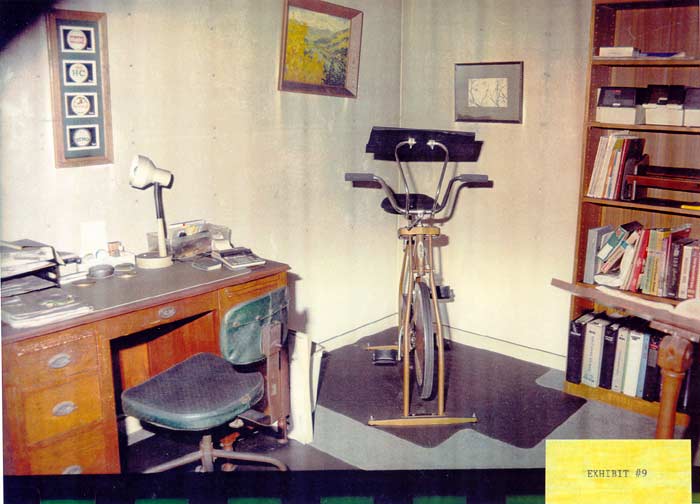
After Robert's conviction and sentence of death, his appellate attorneys submitted an open records request to the Houston police department. Such requests had only recently been allowed by state law. As part of the response to that open records request, Robert's defense team received the photo below.
ex9.jpg

Holy withheld evidence, Batman! The envelope is not on the desk. Perhaps it was removed before this photograph. Perhaps it was added after the previous photograph.

To help resolve the conundrum, I rotated, scaled, and cropped the two images to provide a head-to-head comparison. I provide the result below.

ex1 and 9.jpeg

As you can see, the answer is that the envelope was added after the first photograph was taken. The composite image makes clear also that the envelope was not on the desk during the fire. If the envelope had been on the desk, there would be a soot-free rectangle on the desk pad marking the location of the envelope. There is no such soot-free region on the pad.

A video of the crime scene taken on the night of the murders confirms that the envelope was not on the desk at the time of the murders. How then did the envelope end up on the desk?

During an evidentiary hearing granted in response to this new evidence, Officer Verbitsky testified under oath that he had been called to the crime scene the morning after the murders to take additional photographs. He was the person who took the photograph of the envelope on the desk. As it turns out, he was also the person who took the video of the crime scene on the night of the murders. In that video, the envelope is not on the desk. The envelope appeared sometime after he took the video on the night of the murder, sometime after Officer Haller took her photographs on the night of the murder.

Sergeants Ross and Atchetee were in charge of the crime scene on the night of the murders and during the day after the murders. Sergeant Ross testified under oath at the evidentiary hearing that her partner, Sergeant Atchetee, found the envelope. She testified that she was not in the office when Atchetee found it, that she was in another room. According to the police reports, however, Sergeant Ross was the person who called Officer Verbitsky back to the house to take additional photos of the desk.

(I have not been able to determine whether this Sergeant Ross of the Houston PD homicide squad was also the Sergeant Theresa Ross of the Houston PD homicide squad who testified that Preston Hughes' confession was freely given.)

Sergeant Atchetee testified under oath at the evidentiary hearing that he was the person who found the envelope and placed it on the desk. He testified further that the envelope was not on the desk when he first observed the desk.

Somehow, neither Sergeant Atchetee nor Ross, nor anyone in the Houston Police Department, nor anyone working for the State and People of Texas, ever informed Robert's defense team of this clearly inculpatory evidence.

Sergeant Atchetee then claimed, for the first time ever, that he had picked up the stack of papers from on the left side of the desk, thumbed through them, found the envelope with Robert Coulson's name on it, removed that single envelope from the stack of papers, returned the stack of papers to the desk, then placed the envelope on the desk to be photographed and collected into evidence. Atchetee testified further that the envelope was not on the top of the stack; that he did not find any other papers in the stack that had any value to the case; that he did not tell Officer Verbitsky where he found the envelope; that he just showed the envelope to Verbitsky as it was sitting by itself on the desk; and that he told Verbitsky to photograph the envelope and take it into evidence.

When asked how the envelope could have been so heavily sooted if it had been buried in the stack of papers, Atchetee testified that he had no idea.

None whatsoever.

Sergeant Atchetee first claimed that he removed the envelope from the stack of papers during his testimony at the evidentiary hearing. He certainly did not make that claim to the defense before trial. He certainly did not make it during trial. The State and People of Texas did not make it for him in any of the many pleadings prior to the evidentiary hearing.

The first time Coulson's attorneys ever heard of Atchetee's remarkable discovery was during the evidentiary hearing. Caught off guard, the appellate attorneys were unprepared to thoroughly impeach Atchetee and his testimony.

The court ruled that Atchetee did have cause to consider the envelope as potentially significant. The court ruled that Atchetee therefore did have cause to have the envelope photographed and taken into evidence. The court ruled that the evidence had not been manufactured. The court affirmed the conviction. The court ruled that that Robert Otis Coulson must still die with a needle in his arm.

After losing the appeal, Coulson's attorneys built an even more compelling case that Sergeant Atchetee perjured himself. (I believe the sooted nature of the envelope should have been sufficient.)

The attorneys pointed first to the stack of papers on the left side of the desk, the stack amidst which Atchetee swore he had found the envelope. The photographs show that the stack of papers is identically situated before and after the appearance of the envelope atop of the desk. It is impossible, they argued, that Atchetee could have lifted the stack of papers from the desk, thumbed through the papers, found one document he believed to be relevant, removed the document, and returned the stack of papers to the desk without leaving nary a hint that it had been moved and manipulated.

The attorneys pointed out also that the envelope would not have been relevant if it had been found in the stack of papers. In that case, it would have been nothing more than one of many old documents. Recall that the the State and the appellate courts explained that it was the position of the envelope that mattered, not its content.

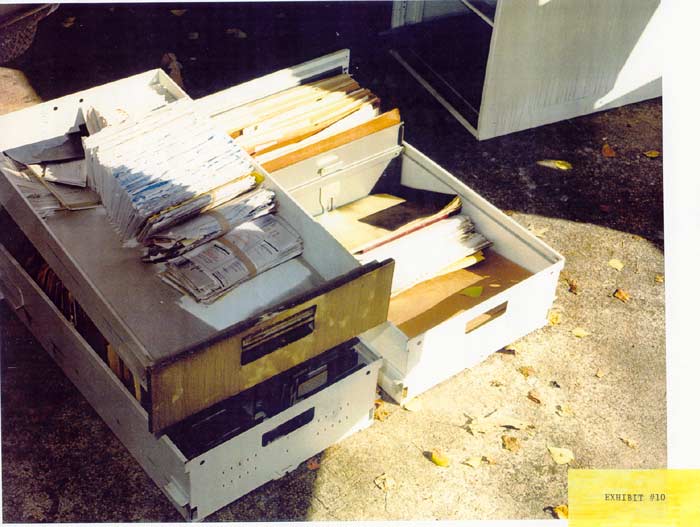
Finally, while pouring again through all the videos and photographs provided both before and after trial, they discovered the likely source of the envelope, and it certainly wasn't the undisturbed stack of papers. The envelope was almost certainly taken from a filing cabinet drawer. Consider the photograph below.
ex10.jpg

Look inside the upper left drawer. There is a white rectangle there. The rest of the drawer is sooted. Something was covering the soot-free rectangle during the fire. That something was almost certainly the envelope that later appeared on the desk, that later proved Robert Coulson had lured his family to the house so that he could murder them. The size and soot pattern of the envelope corresponded nicely with whatever document was removed from the cabinet drawer, after the fire, while Sergeants Ross and Atchetee were in charge of the crime scene.

With this additional evidence in hand, Coulson's attorneys appealed to the U.S. Fifth Circuit Court of Appeals. The Court found that the envelope was placed on top of the desk on the day after the murders and that the photograph of the envelope on the desk was false evidence. From their ruling: 
We agree that the state evidentiary hearing … sufficiently establishes that the evidence regarding the location of the envelope was “false.” We also agree that this knowledge may be imputed from the police to the prosecution.
Then the Court threw in their twist. They declared that the manufactured evidence was nothing more than a harmless error.

Robert Otis Coulson was executed on 25 June 2002, forever framed by the State and People of Texas. "I'm innocent," he said just before they injected the lethal cocktail into his vein. "I had absolutely nothing to do with my family's murder. I want to thank the people who supported me. I hope they will continue the fight. That's all."

Thursday, May 1, 2014

The Framing of Christopher Ochoa and Richard Danziger

This is the fourth post in the series Framing the Guilty, Framing the Innocent. For ease of navigation among the posts, use the Table of Contents.

In the early morning hours of 24 October 1988, Nancy DePriest was working alone in a Pizza Hut restaurant in Austin, Texas. The 20-year-old mother of a 15-month-old baby girl was rolling dough when Achim Josef Marino used a restaurant key to let himself in the side door. Marino bound DePriest with a pair of handcuffs and her own bra, raped her, and shot her in the head.

After a religious awakening in 1996, Marino began trying to confess to the crime. He contacted the Austin police, a local newspaper, the ACLU, and Governor George Bush, but none of them would take him seriously. He provided information to the Austin PD that led directly to the recovery of the restaurant keys, the handcuffs, and the .22 calibre Ruger pistol he used in the attack, as well as two money bags he took from the restaurant.

Rather than charge Marino for the murder, the police (and pretty much everyone else) simply ignored him and his evidence. The police conducted no DNA testing to connect the evidence to the crime. They did no ballistics comparison to match shell casing found at the scene with Marino's pistol.

The State and People of Texas were uninterested in Marino because they had already framed Christopher Ochoa and Richard Danziger for the rape and murder of Nancy DePriest. So tight was the frame that the presiding judge at Danziger's trial recalled that "any jury hearing that testimony would have found those two guys guilty." So tight was the frame that the jury took only seven and a half minutes to deliberate Danziger's fate.

The only evidence against Danziger was the testimony of Danziger's friend, roommate, co-worker, and alleged accomplice Christopher Ochoa. The presiding judge recalled that Ochoa's testimony was "very compelling" because it "contained details police said only a witness to the crime could have known."

Christopher Ochoa pled guilty and a jury found Richard Danziger guilty. Both young men were sentenced to life imprisonment.

While under the care and custody of the State and People of Texas, Richard Danziger was attacked by fellow inmate Armando Gutierrez. Gutierrez threw Danziger to the floor and kicked him in the head repeatedly with a steel-toed boot. One or more of the kicks drove a segment of Danziger's skull into his brain. Danziger was taken to a nearby hospital where, during emergency surgery, a piece of his brain was removed from his shattered skull. Because of his injuries, Danziger suffered partial paralysis, seizures, anxiety, and mental problems. Frequently unable to carry on a simple conversation or recognize family members, Danziger was eventually transferred to the Skyview psychiatric prison.

Pleasant name, Skyview.

In 2000, under pressure from a Wisconsin innocence project, the State and People of Texas finally got around to testing Marino's pistol and the male DNA from Nancy DePriest's body. The shell casing from the crime scene matched Marino's pistol. The male DNA from DePriest's body matched Marino. The testing excluded both Ochoa and Danziger as contributors of the DNA.

Marino was absolutely, unequivocally guilty, despite the State's reluctance to believe so. Ochoa and Danzinger were absolutely, unequivocally innocent, despite the manufactured case of guilt that framed them so well.

There is no doubt that Christopher Ochoa and Richard Danziger were framed by the State and People of Texas. It makes no difference if the police and the prosecutors believed Ochoa and Danziger were guilty. The case against them was manufactured out of whole cloth. Such a manufactured case is, purely and simply, a frame.

Christopher Ochoa and Richard Danziger became suspects in the case for the flimsiest of reasons. The two had also been Pizza Hut employees, though they worked at a different restaurant than Nancy DePriest. After the murder, they visited the restaurant where the crime had occurred, ate some pizza, drank some beer, and raised a toast to the murdered Nancy DePriest. An employee found this behavior suspicious and reported it to the police.

The police hauled the two in for questioning and decided Danziger knew too much about the crime. Investigator Hector Polanco homed in on Ochoa as the weak link. Polanco led a lengthy interrogation of the small, timid Ochoa.

Ochoa requested a lawyer. Polanco refused on the pretense that Ochoa had not been officially charged with a crime.

Ochoa pleaded his innocence. Polanco told him 'You're going to get the needle for this. We got you." Polanco threatened him with prison rape, telling him that he would be "fresh meat" for the other inmates.

Ochoa pleaded his innocence. Polanco threw chairs around the room and threatened to "crush his head" if he didn't confess.

Ochoa pleaded his innocence. Polanco showed him pictures of death row and pointed to the spot in Ochoa's arm where the lethal chemicals would be injected.

Polanco did not limit his threats to Ochoa. Donna Angstadt was the manager of the Pizza Hut where Ochoa and Danziger worked. Danziger was her former boyfriend. Polanco questioned her as well. She described the event as "the most horrific, the most horrible experience I've ever been through in my life." Polanco tried to link her to the crime. He told her that she supplied the gun. He told her that she pulled the trigger as Danziger held DePriest's head. He threatened to have her children removed from her custody.

The DePriest case was, of course, not the only one in which Polanco would be accused of coercing confessions and lying about them. In 1992, the Austin PD fired him for perjuring himself during a different murder trial. Polanco was reinstated by an arbitrator who attributed Polanco's false testimony to a memory lapse.

Polanco, unfortunately, was not the only Austin police officer to engage in such abusive and corrupting behavior. In 1992, and investigative task force found that an excessive workload, inadequate training, and inadequate supervision resulted in false confessions. The task force observed also that the Austin PD detectives tended to leave out information that was "not good for our side."

After a lengthy interrogation, Christopher Ochoa did what 20% of all exonerees did: he confessed to a crime he did not commit. Only then was Ochoa provided an attorney. So tight was the frame that even the attorney thought Ochoa was guilty: "There's a detailed confession, you gotta be guilty."

In exchange for taking the death penalty off the table, Ochoa agreed to plead guilty for his role in the robbery and rape. He agreed also to testify against Danziger as the person who shot Nancy DePriest in the back of her head.

While awaiting his sentencing and Danziger's trial, Ochoa maintained his innocence, but only when speaking with his attorney and his family. His attorney explained that if he were to publicly proclaim his innocence, the State might try to execute him. "They made me confess," he told his uncle, "and how am I going to prove my innocence now? It's my word against theirs."

At Danziger's trial, Ochoa provided details of the crime that he could have obtained only from the police. He and Danziger met at a McDonald's near the Pizza Hut at 7 AM. They entered the side door of the Pizza Hut using a master key that Danziger had managed to obtain. DePriest was cutting pizza dough when they arrived. They had a conversation with her. They bound her. They gagged her. They raped and sodomized her eight different times, twice after she had been shot in the head.

Ochoa departed from his confession when describing who shot DePriest. In his confession, he claimed Danziger was the shooter. At trial, he testified that he shot DePriest because she recognized him.

Danziger always maintained his innocence. He could offer no explanation why Ochoa would accuse him. He claimed that he had been with his girlfriend when the murders occurred. The jury deliberated for seven and a half minutes before convicting him.

Danziger and Ochoa were each sentenced to life imprisonment. They served 12 years behind bars before being released. Had it not been for religious conversion of Achim Josef Marino, and his persistent efforts to prove his guilt, Richard Danziger and Christopher Ochoa would be in prison today, framed by the State and People of Texas.

Monday, April 28, 2014

Framing The Guilty, Framing the Innocent

TABLE OF CONTENTS

The Framing of Larry Swearingen, Part 2 
The Framing of Preston Hughes, Part 1
The Framing of Preston Hughes, Part 2 
The Framing of Larry Swearingen, Part 3 
The Framing of Larry Swearingen, Part 4 
The Extent of Framing the Innocent in Texas 

Later in what will be a long-running series:
The Framing of Gilbert Alejandro (coming)
The Framing of George Rodriguez (coming)
The Framing of Derrick Johnson (coming)
The Framing of David Shawn Pope (coming)
The Framing of Arthur Merle Mumphrey (coming)
The Framing of Cameron Todd Willingham (coming)
The Framing of Frances Elaine Newton (coming)
The Framing of James Lee Woodward (coming)
The Framing of Entre Nax Karange (coming)
The Framing of Steven Phillips (coming)
The Framing of Max Soffar (coming)

The Framing of Cesar Fierro

This is the third post in the series Framing the Guilty, Framing the Innocent. For ease of navigation among the posts, use the Table of Contents.

On 27 February 1979, border patrol agents discovered the body of taxi driver Nicholas Castanon in an El Paso park. He had been shot in the back of the head.

Not long after the shooting, eyewitnesses in Juarez, Mexico identified two men exiting what turned out to be Castanon's cab. Based in part on descriptions provided by the eyewitnesses, the El Paso police soon arrested two men, neither of whom were Cesar Fierro. The El Paso district attorney declined to prosecute, and the case went cold.

Late in July, under circumstances that remain murky to this day, 16-year-old Geraldo Olague fingered Cesar Fierro as the person who shot and killed Nicholas Castanon. Olague explained to the Juarez police that he and Fierro hailed a cab with the intention of robbing the driver. Fierro surprised Olague when he shot and killed Castanon. The Juarez police promptly turned Olague over to the El Paso police.

On 1 August, at 3 in the morning, eight heavily-armed Juarez police officers broke into the home of Cesar Fierro's parents. They took the parents to the Juarez jail. There they threatened Fierro's stepfather with an electric cattle prod placed close to his genitals. They beat Fierro's mother.

A bit later that morning, El Paso police detective Al Medrano received a phone call from Juarez police commander Jorge Palacios. Palacios invited Medrano to breakfast in Juarez. During their meeting, Palacios informed Medrano that the Juarez police had located Cesar Fierro. Fierro, he explained, was already in the custody of the El Paso police, being held for a parole violation in an unrelated case.

Medrano quickly retrieved Fierro and began interrogating him. Fierro acknowledged that he knew Olague and conceded that they had committed robberies together. Fierro, however, steadfastly denied that he was in any way involved with the murder of Nicholas Castanon.

Medrano called Palacios and gave the phone to Fierro. Palacios informed Fierro that his parents would be tortured if he did not confess. Fierro hung up the phone and confessed to the murder of Nicholas Castanon.

At his trial for capital murder, the case against Cesar Fierro consisted of his confession and the testimony of Geraldo Olague. Medrano testified that the confession was voluntary. Olague's testimony was a jumble. He testified that in the hours before the murder, he committed his first-ever burglary. The burglary consisted of breaking into a car and stealing a CB radio, which he later pawned. He identified one of the jurors as the pawnbroker to whom he had sold the radio.

Olague testified that Fierro had forced him to commit approximately 10 burglaries in the six months prior to the CB radio theft, despite his own testimony to the contrary. When asked how many burglaries he had committed, he estimated 40.

To explain away the obvious inconsistencies between his trial testimony and his police report, Olague explained that he had psychological problems and that he was impaired even while testifying.

The defense called Fierro's parents who testified to the brutal treatment they had suffered at the hands of the Juarez police. The defense called also Fierro's landlord who testified that Fierro was at home on the night of the murder. The defense witnesses were of no consequence, however, in the face of Fierro's confession.

On 12 February 1980, the jury found Cesar Fierro guilty of capital murder and sentenced him to death.

After Fierro had been on death row for 14 years, his appellate attorneys interviewed Al Medrano under conditions that turned out to be favorable to Fierro. Medrano was dying of cirrhosis of the liver, and he provided what was effectively a dying declaration. He signed an affidavit admitting that Fierro's confession had been coerced.

Fierro's attorney took the affidavit to the district attorney who had prosecuted Fierro. The DA signed an affidavit stating that he would not have prosecuted Fierro if he had known the confession had been coerced.

In addition to the two affidavits, the Juarez police officer who had led the pre-dawn raid on home of Fierro's parents agreed to testify.

That evidence in hand, Fierro's attorneys convinced a lower court to grant Fierro a new trial. The Texas Court of Criminal Appeals, however, overruled the lower court decision. Each of the nine TCCA judges agreed that the confessions had been coerced. Each of the nine agreed also that Detective Medrano had provided perjured testimony during Fierro's legal proceedings. Only four of the judges, however, voted to grant Fierro a new trial. The other five ruled the coerced confession to be nothing more than a "harmless error". They ruled that the jury would have convicted Fierro on Olague's testimony alone.

During his time on death row, Fierro has been scheduled for execution 14 different times. On 6 of those occasions he came within days of being executed. His mother died. His brother died. His wife divorced him. His daughter stopped visiting him.

On 15 May 1986, Fierro contacted the prison's psychiatric department for the first time. He explained that he was hearing voices and feared he might harm himself.

After March of 1999, Fierro's communications with his attorneys became increasingly irrational. He accused them of conspiring against him. He refused to meet with them. He returned their letters unopened. He refused to shower. He refused to leave his cell for any reason and had to be forcibly extracted. He spread feces on the wall.

Fierro now spends his days in the Beauford H. Jester IV Psychiatric Unit. It is unlikely he will ever be executed.

He will, however, always have been framed by the State and People of Texas.

Sunday, April 27, 2014

The Framing of Larry Swearingen, Part 1

This is the second post in the series Framing the Guilty, Framing the Innocent. For ease of navigation among the posts, use the Table of Contents.

Introduction
On 8 December 1998, Melissa Trotter disappeared from Montgomery College, a community college 30 miles north of Houston. Twenty-four days later, on 2 January 1998, several hunters discovered her body in a heavily wooded area of Sam Houston National Park. She had been strangled with one leg of a pair of pantyhose. The ligature was still knotted around her neck.

On the day Melissa Trotter disappeared, Larry Swearingen was scheduled to lunch with her. Swearingen quickly became the primary suspect. The police arrested him for outstanding traffic warrants on 11 December, just 3 days after Melissa went missing, 22 days before her body was discovered.

At his trial, the State presented a circumstantial, but substantial case for murder. With respect to the attempted rape and kidnapping charges, however, the evidence was gossamer thin. I summarize the State's case below.

The Case Against Larry Swearingen
On December 6, Swearingen met Melissa Trotter and talked with her at length. She gave him her phone number, and they made plans to talk again the next day.

Later that evening, while using his truck to help transport some furniture, Swearingen commented to Bryan Foster and William Brown that he was going to meet a young lady named Melissa for lunch. He bragged that if everything went right, he was going "to have Melissa for lunch." Swearingen called Melissa from Foster's house and talked with Melissa about meeting her for lunch and helping her study for an exam.

On December 7, Melissa paged Swearingen. He called her back. She apparently canceled or postponed their lunch date. His co-workers teased him about being stood up. He explained she was taking a test. He appeared to be angry the rest of the day.

On December 8, three witnesses saw Melissa sitting with Swearingen in the Montgomery College library between 11:30 AM and 1:30 PM. The two of them were sitting by the computers and chatting amicably. Melissa's biology teacher saw her leave with a male shortly after 1:30 PM.

At 2:05, Swearingen returned a page from his friend Sarah Searle. He told her that he would have to call her back because he was having lunch with a friend.

Around 3:00, Swearingen's landlord saw Swearingen's truck arrive. Not long thereafter he saw Swearingen's truck leave. Because the truck had tinted windows, the landlord could not see who was in the truck.

At 3:03, Swearingen placed a cell phone call that utilized a cell tower near FM 1097 in Willis, Texas. The State argued the call was consistent with Swearingen driving from his rented mobile home to the Sam Houston National Forest where Melissa's body was found.

At 4:30, Swearingen placed another cell phone call picked up by a different cell tower near Willis. The State argued the call was consistent with Swearingen returning to his home after dumping Melissa's body in the Sam Houston National Forest.

When Swearingen returned home, he was again observed by his landlord. Swearingen in fact spoke briefly with the landlord.

By 5:30, Swearingen left again, this time to pick up his wife Terry from his mother's house. Terry Swearingen testified that when she and her husband returned home, she noticed their home was in disarray. She noticed also a pack of Marlboro Light cigarettes and a red lighter on top of the television. Terry Swearingen testified that neither she nor her husband smoked. Melissa Trotter, however, smoked Marlboro Lights and used a lighter similar to that found in the Swearingen's home.

That same evening, Larry Swearingen called Phyllis Morrison, an ex-girlfriend. Swearingen told her that he was in trouble and that the police might be after him. On December 11, Swearingen told an acquaintance that he anticipated being arrested by Montgomery County authorities.

Also on December 11, Swearingen noticed a patrol officer observing him. Swearingen sped away, leading the officer on a high-speed chase. The chase ended in front of the home of Swearingen's mother and stepfather. Swearingen was arrested on several outstanding warrants. While being placed in handcuffs, he asked that his hands be placed in front of him rather than behind. He explained that his wrist and ribs were sore because he had been in a bar fight the week before. Following his arrest, law enforcement authorities observed and photographed red marks on his neck, cheek, and back.

On December 17, two neighbors of his mother and stepfather collected numerous pieces of torn paper from their street. The papers turned out to be Melissa Trotter's class schedule and some health insurance paperwork her father had given her.

On January 2, Melissa's body was discovered in the Sam Houston National Forest. The location was heavily wooded, secluded, and remote. The police had previously searched the area three times without finding the body. They explained later that they would have had to walk within twenty feet of the body before seeing it. Larry Swearingen was familiar with the area. He had driven a date around the vicinity just a few months earlier in his red pickup.

Melissa was laying on her back in a pile of bushes. Her right arm was above her head and slightly to the left. Her sweater, shirt, and bra were pulled up under her arms, exposing her breasts and back. Her jeans were still on. The fly was closed. The right rear pocket was torn downwards, exposing red underwear beneath. A note was in one pocket. The note had been given to Melissa by a friend on the day Melissa disappeared.

A piece of hosiery was knotted around her neck, as a ligature. The hosiery was one leg from a pair of pantyhose. Swearingen's landlord testified that he found the remainder of the pantyhose in Swearingen's mobile home as he was cleaning the trailer for another tenant. The discovery occurred after the body had been found. Terry Swearingen, Larry's wife, testified that the pantyhose belonged to her.

Chief Medical Examiner Dr. Joye Carter conducted the autopsy on 3 January. That was one day after Melissa's body was discovered, 25 days after she had disappeared, and 22 days after Larry Swearingen had been arrested. Dr. Carter did not estimate a time of death. She did not note any evidence of sexual assault. She did not note any defensive wounds or evidence of restraint.

During Swearingen's trial for capital murder, Dr. Carter testified that death was caused by asphyxia due to ligature strangulation. There was no evidence of penetration of the vagina, anus, or mouth. The lack of defensive wounds, such as broken fingernails and the difficulty of tying an elastic nylon around a struggling victim, suggested that the Melissa may have been unconscious when the ligature was applied.

Based on the state of decomposition, including the presence of fungi that take several weeks to develop, Dr. Carter estimated Melissa Trotter's death occurred 25 days prior to the discovery of her corpse. That matched exactly the date of Melissa's disappearance. Dr. Carter had not estimated a time of death in her autopsy report.

Melissa's stomach contents included a French fry-like form of potato, some chicken, and a small amount of greenish, vegetable material. The State claimed the stomach contents were consistent with the tater tots Melissa had eaten while at Montgomery College. The State claimed further that chicken was consistent with Chicken McNuggets Melissa might have purchased at the nearby McDonald's. Dr. Carter testified that a person's stomach will usually not empty in less than two hours, and that any food within the stomach at death will remain there.

Criminalist Sandra Musialowski, from the Texas Department of Public Safety, testified that several fibers recovered from Melissa's jacket were consistent with fibers from Swearingen's jacket. Criminalist Musialowski testified also that several fibers found on Trotter were similar to seat material from Swearingen's vehicle. A few other fibers found on Trotter were similar to fibers from the headliner of Swearingen's truck and from the carpet in his home. Criminalist Musialowski testified also that three hairs found in Swearingen's truck were microscopically similar to Melissa's hairs. Those hairs still contained the anagen root, indicating they had been forcibly removed.

Officer Ivan Wilson, also from the Texas Department of Public Safety, testified regarding a paint fleck found on Trotter's clothing. He testified that the quantity was "an insufficient amount to do all the testing that I normally do." The fleck, however, was similar in appearance to paint on Swearingen's red pickup.

A Luminol test conducted on the seats of Swearingen's truck found no blood. The investigators concluded that the truck had been wiped down with with Armor All. Two empty containers of Armor All wipes were found in the garbage at Swearingen's home.

While Swearingen was in jail awaiting trial, a cellmate asked him whether he had committed the murder. Swearingen replied, "Fuck, yeah, I did it." Swearingen added that he was just trying to avoid the death penalty.

Swearingen's Fabrications
Larry Swearingen provided substantial assistance to the State of Texas in their effort to convict him. On three occasions, he clumsily attempted to fabricate exculpatory evidence. These clumsy efforts were used against him at trial.

Swearingen's first clumsy effort was claiming that his house had been burglarized. Part of the circumstantial case presented against Swearingen at his trial was that his house was in disarray when he returned there with his wife. His wife noticed the disheveled state of their home as well as the strange cigarettes and the strange lighter. Apparently in an effort to explain the tumultuous state of his home, Swearingen contacted the police and reported a burglary. He falsely claimed to have been out of town from 11:00 AM on 7 December through 7:30 PM on 8 December. He also falsely claimed that someone had stolen his VCR and his Jet Ski. The police, however, found no sign of any prying mechanism on the doors or windows to his home. His Jet Ski was located at a repair shop where Swearingen had dropped it off for maintenance.

Swearingen's second clumsy effort was asking a friend to provide an alibi for him. On 9 January, When Swearingen's friend, Elyese Ripley, visited him in jail, Swearingen asked her to say that she had been with him on the day Melissa disappeared. He asked her to say that they had gone to the Texaco-McDonald's restaurant near Montgomery College.

Swearingen's third effort was by far the most clumsy. While in jail awaiting trial, he attempted to compose an exculpatory letter from a mystery woman. Swearingen foolishly decided to write the letter in Spanish, a language with which he was clearly less than fluent. He relied heavily on an English-to-Spanish dictionary. The resulting letter was so garbled and so ungrammatical that precise translation was impossible. The narrative was of somebody name Ronnie who took Melissa Trotter to the forest and strangled her.

According to the State, this purportedly anonymous, exculpatory letter included details of the crime that could have been known only to the person who murdered Melissa Trotter. Those details included the Dr. Carter's testimony that Melissa was injured on the left side of her face, that Melissa's neck was cut, that one of Melissa's shoes had fallen off, that Melissa was laid on her back among the bushes, and that Melissa was wearing red underwear.

The Defense Case
Larry Swearingen offered a brief affirmative defense, but need hardly have bothered. He had impeached himself so thoroughly by his efforts to manufacture exculpatory evidence that the jury was unlikely to believe anything he said. Nonetheless, Swearingen testified that he did in fact encounter Melissa Trotter that day at the college, but only briefly. She was talking to another man. Swearingen did not go to McDonald's or anywhere else with her that day. Instead he went from the college to see his grandmother.

Swearingen's grandmother corroborated his testimony. She testified that he picked her up and took her to the post office around 2:00 PM, and that he was with her until around 2:50 PM. Assuming the grandmother testified truthfully and accurately, then Larry Swearingen was probably not responsible for the disappearance and murder of Melissa Trotter. During their cross-examination of the grandmother, however, the State called into question her memory of both the date and time. They questioned her also about why she had not earlier informed the authorities of her grandson's alibi.

The most intriguing bit of exculpatory evidence was, in my opinion, the discovery of fresh blood under one of Melissa Trotter's fingernails. DNA testing of that blood excluded Larry Swearingen as the contributor.

Pre-emptive trial testimony about the blood came from Chief Medical Examiner Dr. Carter and from two employees of the Texas Department of Public Safety crime lab. Taken as a whole, their testimony was that the initial testing of fingernail scrapings revealed no human DNA. A later inspection, however, revealed some "very tiny, bright red flakes." The flakes had a total size "no bigger than ... a point of a pencil." The flakes tested positive for human blood.

Given that the flakes were blood, and given that they were still bright red, the flakes were too well preserved to have been exposed to the elements for more than a couple of days. No one disputed the conclusion that the flakes were freshly deposited, within days of their discovery.

DNA testing of the flakes produced a profile consistent with a male, but inconsistent with Larry Swearingen. The DNA profile was run through the standard database system to search for a match, and no match was found. The DNA profile was then compared against that of six individuals identified by Swearingen's defense team. Again, no match was found.

The State argued that the blood came not from Melissa's assailant, but from contamination unrelated to the crime. State witnesses testified that the blood could have come from a deputy present during the autopsy, a deputy who claimed he had cut himself shaving earlier that morning. Alternatively, the state witnesses suggested that the flakes could have been circulating through the morgue's air conditioning system, that they wafted through a vent, and that they landed unnoticed on the exposed fingernail scrapings.

The defense refuted, effectively in my opinion, the lesser pieces of circumstantial evidence that the State amassed against Swearingen. I detail those refutations in my lengthy series The Most Innocent Man on Death Row, and I will not repeat them here.

The most damning pieces of evidence against Swearingen were:
1. the discovery of the pantyhose at his home, 
2. the discovery of Melissa Trotter's paperwork near his parents' home, and 
3. Dr. Joye Carter's testimony that Melissa Trotter died on the day Trotter was last seen alive with Swearingen.
When I continue with The Framing of Larry Swearingen, I will explain how each of those three pieces of evidence was manufactured. I will explain why Larry Swearingen is absolutely innocent. I will explain how he was framed for the murder of Melissa Trotter.

Before doing that, I will explain how other innocent people have been framed by the State and People of Texas.

Stay tuned.