Friday, August 3, 2012

The Case of Preston Hughes III: The Searchers Part 4

In Part 2 of this mini-series within an extended series, I  scientifically proved  conclusively demonstrated   argued effectively  suggested Shandra's eyeglasses did not innocently fall or slide into the position in which they were photographed by the HPD. The obvious alternative is that they were planted.

In Part 3 I argued that the preferential evidentiary treatment provided to those glasses adds to suspicions that the glasses were planted.

In this Part 4, herein, I discuss whether or not the eyeglasses had been photographed at the crime scene before being photograph between the cushions of Preston's couch. I'll leave it to the reader to figure out the implications of such a photograph, assuming it exists or once did.

The Hughes' Claim
Preston Hughes III pulls no punches when it comes to the eyeglasses. He argues that they were planted and that there is a photograph from the crime scene to prove it. From his blog, obviously maintained by a third party:
The eyeglasses were planted, by the police, in the cushions of PHIII's white couch and pictures were taken to make it appear as though they were found there. The police apparently did this to make it appear as though the victims had been in PHIII’s apartment prior to their deaths. However there's a problem with this because there was a picture taken of the glasses at the crime scene where the victims were found, before they were planted in PHIII's apartment. The arresting officer made PHIII aware of the fact he planted the eyeglasses in his apartment when he made statements to PHIII, during the interrogation, concerning the fact he searched his apartment. The first attorney, Randolph A. McDonald, appointed to handle PHIII's Habeas Corpus appeal acknowledged the fact he knew the police planted the glasses in PHIII's apartment. And in a phone conversation he had with PHIII he acknowledged the existence of a picture that depicts the glasses on the ground at the crime scene where the bodies of the victims were found. The attorney ended up withdrawing himself from the case because he wasn't being paid enough to represent PHIII. However since learning of the existence of the picture that depicts the eyeglasses at the crime scene PHIII has been diligently trying to obtain this evidence. His family managed to scrape up enough funds to purchase a copy of the police report(s) and a copy of the pictures taken by the crime scene officer. Unfortunately the Houston Police Department purposely withheld a number of the pictures taken by the crime scene officer.
I'll interrupt Hughes' long paragraph at this point. Hughes claims that appellate attorney Randolph McDonald told him (Hughes) that he (McDonald) somehow acknowledged the existence of a photograph showing the eyeglasses at the crime scene. I find the past-tense verb "acknowledged" to be weaker than "possessed" or "confirmed" or "saw."  I can't tell from Hughes' description above whether or not the attorney might be willing to unequivocally state that he knew of such a picture, that he had seen it, that he had held it in his hands, that he had a copy.

Now back to Hughes' paragraph.
Although the attorney has been off of PHIII’s appeal for some years PHIII wrote him in June of 2006 seeking his help with obtaining a copy of the picture(s) that could help prove his innocence and that he was framed. PHIII was very clear in his letter concerning what he was seeking to obtain. The attorney responded to PHIII's letter by stating where he believed PHIII would be able to obtain the evidence he's seeking. Unfortunately, the individual PHIII was told to contact was the ineffective attorney that mishandled PHIII's state Habeas Corpus appeal after Mr. McDonald withdrew from the case. The response from Mr. McDonald to PHIII's letter, although very short, is the only proof PHIII has at this time to prove the police planted the eyeglasses in his apartment.
Hughes claims that McDonald's reply proves the existence of the photo. It's a bold claim, and I credit Hughes for attempting to substantiate it using the text of McDonald's reply, if not an actual image. Here's the response from McDonald, as presented on Hughes' blog.
Dear Mr. Hughes: 
I received your correspondence of June 22, 2006. I do not have the
requested information that you asked for. I believe you might be able to
obtain them from attorney Dick Wheelan. 
Please do not hesitate to contact me should you need further
assistance. Good luck! 
Yours truly,
Randy McDonald
I fear that reply comes up well short of the proof Hughes so badly needs, even more so now that he has only 104 days to live.

Attempt, if you dare, to put yourself in Preston's shoes. Imagine you are innocent but sentenced to death. Imagine you have been on death row for twenty years, even longer. You are locked up for 23 plus hours per day in a concrete box the size of your bathroom. You are totally dependent on others to keep the State from strapping you to a gurney, from swabbing your arm with alcohol to prevent infection, from then putting a needle in your arm, and from them pumping you full of lethal chemicals. You believe, correctly or incorrectly, that there is a photograph out there that can prove the police framed you. Your family is already made poor by your absence, by the incidental (but not insignificant) costs of your trial, and by the substantial costs of your appeals. You family continues to be drained by the costs of you incarceration, by the outrageously priced phone calls, by the postage you need to plead for help, and by your pathetic commissary purchases. Imagine that you hit them up for hundreds more so that the HPD will provide you the photos you request, as they are obliged to do.

Then imagine the HPD stiffs you.

They take your money, then withhold critical, life-saving photos.

They stiff you.

Yet again.

I will not be able, in this now humble post, to prove the existence of a photo showing Shandra's eyeglasses at the crime scene. What I will be able to do, however, is describe independent evidence that the HPD does indeed withhold photos.

On March 14, 2010, Barbara Lunsford submitted an open records request to the city of Houston for any and all reports regarding the case of Preston Hughes III, for copies of all evidence and property reports for all items collected as part of the case, and for all crime lab reports and all crime scene photos. She received a smattering of what she requested. I will focus here on the 35mm photos of the crime scene and the bodies.

After I began writing of this case, Barbara Lunsford generously shared with me (for free) all the material she had obtained (for hundreds of dollars). She also gave me her permission to use any and all the material as I see fit. I've said it before and I'll repeat it here: Barbara Lunsford is the person responsible for bringing this case to public attention. I am, by comparison, a Johnny Come Lately. I write of Preston's case so extensively only because I learned of the case from Barbara's Mystery Crime Scene web site, and only because she has been so gracious in sharing everything she collected.

Barbara Lunsford assures me that I have a copy of each 35mm photo provided to her in response to her public records request. Let's now compare the number of photos provided to Barbara by the number taken by the Houston Police Department.

Hang on. Here we go.

The Hale Photos
From CSU Officer F.L. Hale's report:
At this time I loaded my 35mm Nikon Camera with 100 ASA film. Using the Sun Pac flash attachment a total of 2 roll [sic] of 35mm was exposed, at the scene and morgue. The two rolls of 35mm film was [sic] kept in officer's are, control, and custody until tagged into the 4th floor I.D. Photo Lab lock box.
From Hale's list of items he recovered:
(2) Rolls of 35mm film.
In summary, Hale reported that he had taken two and only two rolls of 35 mm film. Since he claims to have taken pictures inside Hughes' apartment, I presume he included the apartment as part of the crime scene. I believe he was incorrect in that assumption. Time will tell.

For the youngsters out there, let's see what the Guide to Film Photography web site has to say about 35mm film.
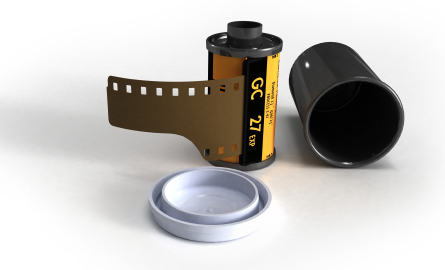
35mm film is the most popular film photography type. 35mm film, or 135 film, was introduced by Kodak in 1934. Fitting 35mm cameras, including single-lens reflex (SLR) and range-finder cameras, basic 35mm film photography is named after the size of the film – 35mm wide. Individual rolls of 35mm film are enclosed in a single-spool, light-tight, metal case that allow it to be loaded into cameras in the daylight. ... Most 35mm film is found in 24-exposure or 36-exposure counts. However, with most cameras and proper film settings, you will be able to squeeze out an additional two or three photographs.
Though film usually comes in 24 or 36-exposure counts, the image associated with the article shows a 27-exposure count roll.

I'm aware that film also comes in 12 and 15-exposure rolls, but these will turn out to be irrelevant, as you soon will see.

So ...

Officer Hale most likely took 48 or 72 pictures. Less likely scenarios, assuming up to 3 extra pictures per roll, range from 49 to 60, and 71 to 78.

Officer Hale could have easily removed any confusion about the number of pictures he took by simply stating the number of exposures he took for each roll of film he used. Alternatively, and even better, Officer Hale could have (and I suspect did) maintained a photo log describing the nature of each picture taken, and the sequence in which they were taken.

The Lunsford Photos
I've inventoried the photos Barbara sent me. As I mentioned before, she assures me that I have a copy of every 35mm photo she has for the Hughes case. Here's my accounting of how many photos Barbara received from Officer Hale's first two rolls of 35mm film.
Marcell's body at the scene:  9 photos
Beer can at the scene:  1
Trail and brush, excluding Marcell and the beer can:  15
Fuddruckers:  2
Wooden Fence and its opening into the field:  4
Exterior of Preston's apartment:  1
Exterior of apartment in Lakewood Village complex: 1
Interior of Preston's apartment:  14
Shandra's body at the morgue:  3
That's a grand total of 50 photos.

The Possibilities
All of the possibilities (and the one impossibility) I list below assume I properly accounted the number of 35mm photos received by Barbara Lunsford in response to her open records request.
It is impossible that Hale used two rolls of 24-exposure film unless he managed at least two extra pictures between the two rolls. 
It is possible that Hale used two rolls of 24-exposure film and managed exactly two extra pictures between the two rolls. In this case, and in this case only, all photos were provided. 
It is possible that Hale used some other combination of 24, 27, and 36-exposure rolls, and that he managed as many as six extra pictures. The permutations are many and I have worked through them all for you. In these cases, Hale took anywhere from 51 to 78 photos, excluding 70 and 71. In this case, the number of photos withheld range from 1 to 28, excluding 20 and 21. 
The most likely possibility is that Hale used two 36-exposure rolls in normal fashion, taking 72 pictures total. In this most likely scenario, the number of photos withheld is 22.
That's a lot of missing photos. I think a few of them may indeed show Shandra's glasses laying on the ground somewhere in that dark, overgrown, field. I think I know the subject matter of most the other missing photos as well.

Stay tuned.

ADDENDUM (4 August 2012):
Reader Anonymous has quickly and properly faulted me for an unforced error.  His comment in its entirety:
I don't understand how this evidence leads you to conclude that phots are being withheld. You've told us that

(a) There were 50 photos released(b) 24-exposure film was one of the most commonly used types(c) That "most" cameras would be able to get an extra picture or 3 out of each roll. 
Under these circumstances, it seems to me, if Hale did use 24-exposure film, and if the camera that he used was like "most" cameras (and I have no reason to believe it wasn't), then 50 pictures (or even 52) would be about what one would expect. 

Suppose Hale did (as you suggest) use two rolls of 36-exposure film. Suppose further that he took exactly 50 pictures: some 36 from the first roll and the rest from the second. Is it not likely that he would have the second roll of film developed with the first, even though it wasn't entirely used up? I hardly think he would just leave the half-used roll of film lying in the camera until he had another occasion to use it up. 

I'll acknowledge the possibility that the glasses were planted. I'll event acknowledge the possibility that there exists (or existed) photographic evidence of this. But the information you've given here does nothing to support that claim.
Now my groveling response:
Anon, 
I can't (and won't) disagree with your first point, since I made it myself in the post. 
Your second point does highlight a glaring weakness. I didn't make any case that Hale used all the shots on the second roll, and I probably cannot make that case now. 
I know that he reported that he "exposed two rolls" and I consider that suggestive of using all of them. But you properly fault me for simply assuming that, rather than making a more substantive argument.
I'll add an addendum, confess my sin, and move on. 
Thank you for challenging me.
And I spent a really long time on that post. Seriously.

 <-- Previous                           Table of Contents                              Next --> 

Wednesday, August 1, 2012

The Case of Preston Hughes III: The Searchers Part 3

In The Searchers Part 2, I argued that the eyeglasses wedged between the cushions of Preston's couch appear to have been intentionally inserted rather than inadvertently dropped.


In this post, I argue that the glasses were treated with greater deference than all other evidence in this case. I suggest that such deferential treatment bolsters arguments that the glasses were planted by the HPD.

Consider first how the eyeglasses were treated relative to the other evidence collected from Preston's apartment.

Regarding the knife, the sheath, the jeans, the two blue shirts, the one maroon shirt, and the plastic bag containing a green leafy substance, CSU Officer F.L. Hale reported he kept them in his "care, control and custody until tagged into the police property room."

Regarding the eyeglasses, Officer Hale reported that he kept them in his "care, control and custody until hand carried to the latent lab to be printed."

Of all those items, only the glasses were sent (indeed hand carried) to a lab for analysis. It's not clear at all why the other items were even collected. The green leafy substance did not make it to the property room, at least according to the property invoice prepared by Officer Hale. None of the other items were (seemingly) ever tested for fingerprints. None of the other items were tested for blood until days before the trial or, in the case of the knife, in the courtroom during the trial.

The HPD, its crime lab, and the DA seemed strangely incurious about any physical evidence other than the eyeglasses. Their lack of curiosity extended well beyond the items taken from Preston's apartment. It extended even to the rape kit and fingernails. Those items were left in the morgue, untested, until days before trial.

The lack of curiosity extended as well to items collected from the crime scene. The beer can in particular provides an interesting contrast.


Let's see what Officer Hale had to say about that beer can.
Between the area of the trail, from where the complainant's [sic] were was an empty Busch beer can, which appeared to be fresh. The beer can was clean and had a small amount of condensation on the outside. ... This beer can was recovered in the high grass, on the north side of the trail, west from where the male complainant was found. The beer can was later printed by Officer Hale, however no prints were located. The beer can was recovered and placed inside a property room envelope and kept in officer's care, control and custody until tagged in the police property room.
Hale finds a beer can on the trail, between the two bodies. The beer can looks fresh. It's resting high in the brush. It has a few drops of condensation on it. Hale doesn't deliver it to the crime lab for printing. He prints it himself. Even though the can is fresh, and even though smooth metal is one of the easiest surfaces from which to lift prints, Hale somehow failed to find any prints whatsoever.

Unless the beer drinker wiped the can clear of prints, there must have been some prints to be found. Hale conveniently managed to find none, and conveniently elected to not turn the can over to the crime lab for more sophisticated testing. Instead he simply turned it over to the property room along with everything else the State found uninteresting.

Though Hale had good reason to suspect the beer can might have been left by the murderer, and though Hale had no reason to believe the eyeglasses belonged to Shandra rather than Preston, Hale treated the eyeglasses with more professionalism than he did the beer can.

Though usable prints could be recovered only from the lenses of the eye glasses, and though fingerprints on eyeglass lenses are easily visible to the naked eye (trust me), and though the lenses of the eyeglasses found in Preston's apartment appear to be print free, Hale nonetheless went the extra mile and sent the glasses to the lab for printing.

Just in case.

ADDENDUM (4 August 2012):
Reader Anon challenges my suggestion that Hale should have been able to lift prints from the can. Anon commented:

Exposure to the elements, i.e., water, rain, dew, condensation, etc., ruins fingerprints.
I replied:
Anon, 
Do you believe that "a small amount of condensation" on a beer can that seemed recently deposited would obliterate all the prints everywhere on the can?
He answered:
He reported that it "appeared to be fresh" -- that does not necessarily mean it was. 
Condensation of any amount can obliterate prints.
I believe Anon begin cautiously enough by suggesting that water can ruin fingerprints. I think he went a step too far when he claimed any amount of condensation can obliterate prints.

His last overly broad comment prompted me to put his claim to the test. I once again relied on my trusty reading glasses, the heroic spectacles introduced in The Searchers Part 2. I cleaned the lenses, then put a nice thumbprint on the inside of one lens. I then held that lens under my faucet to test Anon's claim.

I first tried a few drops. The print survived.

I then let water run slowly and briefly over the lens. The print survived.

I then filled the concave lens with water and let it stand for a while.  The print survived.

Having failed to obliterate my fingerprint with tap water, I turned to the source of all knowledge: The Internet. Sure enough, I quickly found someone who had more carefully tested fingerprints on aluminum submerged in sea water for 3 days. From the Underwater Criminal Investigators web site:
... the author printed and dropped in the last pieces of aluminum on hand and left them relatively undisturbed for three days. When drawn from the water, prints were found on all pieces, using both methods. Some prints had less detail or were fainter than others. Regardless, prints were detected and enhanced, shown in Figure 1.
Fig. 1, Prints detected/enhanced, 3 days immersion, black powder and cyanoacrylate 
Base on my own simplified testing and the more sophisticated testing conducted by UCI, I remain suspicious that Hale was unable to find any fingerprints on the beer can he described as "fresh."

 <-- Previous                           Table of Contents                              Next --> 

Sunday, July 29, 2012

The Case of Preston Hughes III: The Searchers Part 2

Having considered the absence of any visible blood (and the likely absence of any blood whatsoever) on the clothing taken from Preston Hughes' apartment, it is now time to consider the eyeglasses discovered (or planted) between the cushions of his couch. The first step is to have a look at them. Here's the remote shot.

You can see them if you look hard, if you squint. There they are between the center seat cushion and the one beside it, the one rightmost in the image.

Here's the second shot, presumably the one the HPD would consider to be a closeup.

There you go. You can barely see the glasses unless you click on the image to enlarge it. So I've cropped the glasses, enlarged them, and rotated them for easier viewing. Here they are now, the best look at them so far.

For simplicity, I'll refer to these glasses as Shandra's glasses, though I do not know with certainty that they are.

Shandra's glasses do not appear to me as if they simply fell there. They are not laying either in between or on top of the cushions. They are wedged between the cushions. The upper rims have somehow been forced into the side of the upper cushion. (For convenience, I'll refer to the two cushions as the upper and lower cushions.)

The arrangement seems odd to me, so let me tell you what I'm going to do. I'm going to conduct a test. I'm going to repeatedly drop my cheap, well-used reading glasses between the cushions of my couch, take some photos, and report my results. Hang on. I'll be right back.

[removing smudges from lenses]

[dropping glasses repeatedly]

[taking crappy photos of glasses where they fell]

[importing images to my computer]

[using GIMP to select images and crop them to appropriate size]

Okay. I'm back. Here we go.

Most of the times I dropped my cheap, well-used, temporarily smudge-free reading glasses near the seams between the cushions, my glasses didn't actually fall into the seam. My glasses most frequently straddled the seam. My glasses did, however, fall between the seams with sufficient frequency that I have no difficulty believing eyeglasses can fall between couch cushions if dropped or placed nearby. Here's a picture of one instance in which my reading glasses fell between the cushions.

When my glasses actually landed between the cushions, they usually (almost always) ended up with the lenses nearly vertical. This is different than Shandra's glasses. Her glasses ended up with the lenses nearly horizontal.

Sometimes (not very often) my glasses end up with the lenses horizontal, just as Shandra's had.

(Try to ignore the differential lighting among the images I present. The differential is merely a reflection of my photography skills.)

While my glasses would sometimes land with lenses horizontal, they always ended up on top of the cushions. They never managed to wedge themselves in between, as Shandra's were. I did not expect that they would wedge themselves in. They're eyeglasses, not anvils.

I  did wonder, however, if they might wedge their way in between the cushions if people sat on one or both of the cushions. So I tried repeatedly to cause my glasses to wedge themselves into a position similar to Shandra's glasses. I positioned the glasses in many different positions, and I pressed on one cushion, then the other, then both. No luck. No matter what I tried, I could not give my glasses a couch cushion wedgie.

I came close a couple times. Consider the following image.

Here I managed (by pressing on the lower cushion) to get the upper rims pressing into the edge of the upper cushion. However, when I relaxed pressure on the lower cushion, my glasses rotated such that the lenses ended up in the vertical position.

Finally, I forced my glasses between the cushions to see if I could get them to remain there, between the cushions rather than on top of them, lenses horizontal rather than vertical.

TA myopia DA! Though it's somewhat difficult to see, the glasses are wedged between the sides of the two cushions. It's not quite like the arrangement of Shandra's glasses. But it's as close as I could get, given that my couch cushions are not quite as worn and soft as Preston's seem to have been.

For what it's worth, I consider my testing to be suggestive but not compelling. I accept that it is possible (but to me unlikely) that Shandra's glasses could have innocently ended up oriented between the cushions as they appear in the photo. Possible, but unlikely. I suspect instead that a human was directly involved in the unnatural placement of Shandra's glasses.

In Part 3 of The Searchers, coming soon to a blog near you, I'll discuss why this beer can ...


... provides additional evidence that Shandra's glasses were planted by the HPD.

 <-- Previous                           Table of Contents                              Next --> 

Friday, July 27, 2012

The Impending Execution of Marvin Lee Wilson

Marvin Wilson sits on death row awaiting execution by the people of Texas on 7 August 2012. Because his IQ is reported to be 61, I expect additional challenges to the execution date.

I summarize his case by extracting from the adverse appellate decision Marvin Lee Wilson v. State (1999). I have replaced each instance of the word appellant with Wilson's name.
In a trial beginning in January 1998, Wilson was convicted of capital murder for the kidnapping and murder of Jerry Williams. ... 
The evidence showed the following: On November 4, 1992, Officer Robert Roberts and other police officers entered Wilson's apartment pursuant to a search warrant. Jerry Williams was the confidential informant whose information enabled Roberts to obtain the warrant. Williams entered and left the apartment minutes before the police went in. Wilson, Vincent Webb, and a juvenile female were present in the apartment. Over 24 grams of cocaine were found, and Wilson and Webb were arrested for possession of a controlled substance. Wilson was subsequently released on bond, but Webb remained in jail. Sometime after the incident, Wilson told Terry Lewis that someone had "snitched" on Wilson, that the "snitch" was never going to have the chance to "to have someone else busted," and that Wilson "was going to get him." 
On November 9, 1992, several observers saw an incident take place in the parking lot in front of Mike's Grocery. Vanessa Zeno and Denise Ware were together in the parking lot. Caroline Robinson and her daughter Coretta Robinson were inside the store. Julius Lavergne was outside the store, but came in at some point to relay information to Caroline. The doors to Mike's Grocery were made of clear glass, and Coretta stood by the door and watched. Zeno, Ware, Coretta, and Lavergne watched the events unfold while Caroline called the police. These witnesses testified consistently although some witnesses noticed details not noticed by others. 
In the parking lot, Wilson stood over Williams and beat him. Wilson asked Williams, "What do you want to be a snitch for? Do you know what we do to a snitch? Do you want to die right here?" In response, Williams begged for his life. Andrew Lewis, Terry's husband, was pumping gasoline in his car at the time. Williams ran away from Wilson and across the street to a field. 
Wilson pursued Williams and caught him. Andrew drove the car to the field. While Williams struggled against them, Wilson and Andrew forced Williams into the car. At some point during this incident, either in front of Mike's Grocery, across the street, or at both places, Andrew participated in hitting Williams and Wilson asked Andrew: "Where's the gun?" Wilson told Andrew to get the gun and said that he (Wilson) wanted to kill Williams.They drove toward a Mobil refinery. Zeno and Ware drove back to their apartments, which were close by, and when they arrived, they heard what sounded like gunshots from the direction of the Mobil plant. 
Sometime after the incident, Wilson told his wife, in the presence of Terry Lewis and her husband, "Baby, you remember the nigger I told you I was going to get? I did it. I don't know if he dead or what, but I left him there to die." When Terry looked back at her husband, Wilson stated, "Don't be mad at Andrew because Andrew did not do it. I did it." 
On November 10, 1992, a bus driver noticed Williams' dead body on the side of a road.The autopsy report concluded that Williams died from close range gunshot wounds to the head and neck. 
Having known Wilson for 16 years, Zeno identified Wilson. Lavergne and Coretta recognized Williams but did not know Wilson or Andrew. Lavergne subsequently identified Andrew in a photo line-up. At that time, Lavergne told law enforcement authorities that the man he identified in the photo was the "helper," rather than the primary actor. The other man, who Lavergne described as having a "gerry curl," made the threats and conducted most of the beating of Williams. Under defense cross-examination at trial, Lavergne testified that the man in the photo (i.e. Andrew Lewis) was the man with the gerry curl and hence, the primary actor. But, upon redirect examination, Lavergne testified that his earlier testimony was in error, and that the man in the photo was not the one with the gerry curl. 
This contradiction led to questioning that explored an incident involving Lavergne, defense counsel, and Wilson. At one time, defense counsel and Wilson interviewed Lavergne together, while Lavergne was in jail for an offense unrelated to the present case. No representatives of the district attorney's office were present. Wilson asked Lavergne for his father's name, and Wilson asked if Lavergne had a new baby. These questions made Lavergne feel scared and intimidated, and he wondered how Wilson could have known about Lavergne's new baby. ... 
Our review of the record shows ample evidence to support the conviction. Williams was the informant who caused Wilson to be arrested for cocaine. Wilson could have inferred from Williams' presence at his apartment immediately before the police arrived that Williams had indeed "snitched" on Wilson. That sequence of events established a motive for the murder. Wilson's statements to Terry Lewis and his later statements to Williams show that Wilson intended to act upon that motive and kill Williams. Wilson assaulted and kidnapped Williams in front of several eyewitnesses, and later, Wilson bragged that he had left the "snitch" to die. The latter statement could have been reasonably interpreted as an admission that Wilson had in fact fulfilled his earlier threats to kill the victim. The short time frame in which these events occurred—a matter of several days—also supports the inference that these events were connected. And Wilson's references to Lavergne's father and new baby reasonably could have been interpreted as a veiled attempt to influence Lavergne's testimony. Such an attempt to tamper with a witness is evidence of "consciousness of guilt." ...
I oppose the execution of any person who may be innocent of the crime for which he are about to die. With respect to all other executions, I stand mute. I neither support them nor oppose them. In the case of Marvin Lee Wilson, I stand mute.

ADDENDUM (8 August 2012)
Marvin Wilson was executed by the people of Texas on 7 August 2012.

The Stayed Execution of Michael Tisius

Michael Tisius sits on death row awaiting execution by the people of Missouri. He was scheduled for execution on 3 August 2012. His execution has been stayed by the Supreme Court of Missouri due to a lack of drugs with which to conduct the execution.

I summarize the case by extracting from the adverse appellate decision in State v. Tisius (2002). I have replaced each instance of Appellate with Michael Tisius' name.
In early June of 2000, Michael Tisius and Roy Vance were cellmates at the Randolph County Jail in Huntsville, Missouri. Tisius's sentence lasted thirty days, and Vance told Tisius he would be in jail for some fifty years. As such, Tisius and Vance discussed various schemes where Tisius would return to jail to help Vance escape. In one of those plans, Tisius was to return to the jail with a firearm, force the guards into a cell, and give the gun to Vance, who would then take charge and release all of the inmates. 
The Randolph County Jail was a twostory brick building that had been converted from a house. The front door of the jail was kept locked, and the officers could remotely open the door when visitors rang a doorbell. Inside the front door was a small foyer, and to the right behind a counter was the dispatch area where the officers were stationed. A hall led from the dispatch area to the jail cells in the rear of the building. 
Tisius was released on June 13, 2000. Shortly after his release, Tisius contacted Vance's girlfriend, Tracie Bulington, who said that she wanted to go through with the escape plan. Four days later, Bulington drove from Macon to Columbia with a woman named Heather Douglas to pick up Tisius and drive him back to Macon; Tisius and Bulington stayed at Douglas' home for four or five days. During the ride to Columbia, Douglas heard the two discuss various ways of breaking Vance out of jail, including the idea of locking the jailers in a cell. They told Douglas they were joking. Douglas testified that over the days to follow, she heard Tisius and Bulington say that they were "on a mission," but they would not elaborate. Tisius and Bulington also described taking cigarettes to Vance at the jail and of having gotten information from a "stupid deputy." At other times they would stop talking when Douglas entered the room. Douglas also testified that Tisius and Bulington kept a stereo, clothing and camping gear in Bulington's car and that she also saw a pistol in Bulington's car. 
Beginning June 17, 2000, and continuing over several days, Tisius and Bulington visited the jail several times. At or around 1:30 a.m. or 2 a.m. one of those mornings, they were admitted in the front door and delivered a pack of cigarettes to an on-duty officer, requesting that it be given to Vance. A day or two later, Tisius and Bulington returned to the jail with a pair of socks for Vance and asked questions about his upcoming court date. 
Bulington testified that each delivery signified to Vance certain facts, such as that Tisius had made it to town or that the jail break would not occur the night of the delivery. During some of those visits, Tisius kept a .22 caliber pistol that Bulington had taken from her parents' home in the front of his pants. Tisius had tried to acquire a bigger gun than the one Bulington took. On the night of one of their visits, one officer testified that Tisius and Bulington were acting "real funny," nervous and erratic, such that he wrote a police report about the visit. 
Tisius tested the gun by firing it outside of Bulington's car window while the two were driving on country roads on June 21, 2000. Later that evening, Tisius and Bulington drove around listening to a song with the refrain "mo murda" (more murder) as they prepared to get Vance out of jail. Tisius rewound the cassette and played the "mo murda" song over and over. Tisius told Bulington "it was getting about time" and that "he was going to go in and just start shooting and that he had to do what he had to do." Tisius also said he would go "in with a blaze of glory." 
At 12:15 a.m. on June 22, Tisius and Bulington returned to the Randolph County Jail, rang the doorbell and were admitted. Tisius again carried the pistol in his pants. Tisius and Bulington told the officers they were delivering cigarettes to Vance. The two officers present were Leon Egley and Jason Acton. Tisius made small talk with one of the officers for about ten minutes, discussing what Tisius was planning to do with his life and how Tisius was doing. Bulington testified that at that point, she was about to tell Tisius she was ready to leave but froze as she noticed Tisius had the gun drawn beside his leg. Tisius then raised his arm with the pistol drawn and, from a distance of two to four feet, shot Acton in the forehead above his left eye, killing him instantly. Egley began to approach Tisius, and about ten seconds after he killed Acton, Tisius shot Egley one or more times from a distance of four or five feet, until Egley fell to the ground. Both officers were unarmed. 
Tisius then took some keys from the dispatch area and went to Vance's cell. Tisius could not open the cell, so he returned to the dispatch area to search for more keys. While Tisius was in the dispatch area, Egley grabbed Bulington's legs from where he was lying on the floor, and Tisius shot him several more times at a distance of two or three feet. Egley suffered five gunshot wounds, three to the forehead, a graze wound to the right cheek and a wound to the upper right shoulder. Not long afterwards, police found Egley gasping for air and a heard gurgling sound; he was surrounded by a pool of blood. Egley died shortly afterwards. 
Tisius and Bulington fled in her automobile. Tisius threw the keys from the dispatch area out of the car window on the way out of town. Bulington threw the pistol from the car window while crossing a bridge on Highway 36. After the two had passed through St. Joseph and crossed the Kansas state line, Bulington's car broke down. Later that day, the two were apprehended by the police, and the keys and gun were recovered. After having waived his Miranda rights, Tisius gave oral and written confessions to the murders. 
Tisius's theory at trial was that he was guilty at most of second-degree murder because although he admits that he shot and killed the two officers, he argues that he did so without deliberation. Further facts are set forth below as necessary.
I oppose the execution of anyone who might be innocent of the crime for which they are about to die. In all other cases, I stand mute. I neither support nor endorse the execution. In the case of Michael Tisius, I stand mute.