Warning: At the end of this post are two graphic and gruesome death-scene photos. They are not suitable viewing for all readers.
Dana Lizette Sanchez was 21 years old. The first picture below shows her when she was a bit younger. The second picture is cropped from her "Missing" poster.


Dana was living with a girlfriend and that girlfriend's boyfriend. They lived within the apartment complex located along the 600 block of Cavalcade in Houston.

Dana Lizette Sanchez was 21 years old. The first picture below shows her when she was a bit younger. The second picture is cropped from her "Missing" poster.


Dana was living with a girlfriend and that girlfriend's boyfriend. They lived within the apartment complex located along the 600 block of Cavalcade in Houston.

Dana was two months pregnant. On the evening of 6 July 1995, she planned to tell her boyfriend who lived some 15 miles away. Around 7 PM, she walked to a pay phone outside the nearby Mr. Qwik's to arrange a ride. That convenience store was located at the corner of Cavalcade and Airline. It was only two-tenths of a mile from where Dana lived. It was only six-tenths of a mile from where Anthony Shore lived.
Shore: Last and final case. Dana Sanchez.
Shore: Last and final case. Dana Sanchez.
Swaim: Right.
Shore: I got that name from the newspaper. She told me her name was Ruby. I don't know where Ruby came from. And she told me when her birthday was. I was driving --
Swaim: Do you know when her birthday was?
Shore: I don't remember now.
Swaim: Or what she told you?
Shore: But it also never came out in the paper, um, it's verifiable but I'm telling you --
Swaim: Okay. I believe you.
Shore: I was driving, at that time I was driving a Ford Econoline van, old piece of shit, beat up, green --
Swaim: '78?
Shore: How in the world you get '78 from?
Swaim: Nah, whatever.
Shore: That I don't know. All I know is that it was an older model van about an '88. It was green, not Army green but like a dark metallic green. It was beat up.
Swaim: You traded it in?
Shore: Yeah, I traded it in. I think I traded it in for the, uh, Dodge custom conversion van that I ended up buying.
Swaim. Do you know where you traded it in?
Shore: Yes, the Auto Sales on Shepherd somewhere between 11th and 15th. Somewhere on --
Swaim: Okay.
Shore: Anyway. One of the things that you can put in your report, I had done the interior with Berber carpet which is uncommon.
Swaim: Alright.
Shore: I was driving around and I saw this girl, I'm gonna say she was wearing white coveralls and a striped shirt underneath and she was mad. She had this look that she was angry and upset and she was at a pay-phone.
Swaim: Where was this at?
Shore: Corner of Cavalcade and Airline.
Swaim: Okay.
Shore: And she, I guess, had called somebody from the pay phone. She started storming off and I was making the "Say, hey. ..." She said "Man, I'm going to see my boyfriend" somewhere. Forget where she told me.
Swaim: No problem.
Shore: And we went driving and we had [a] conversation and I had this sick fantasy going through my mind like there could be something, relationship there, or some type of thing between us. I was flirting with her heavily. At the time I had really long hair. I though I looked good or maybe I just looked like a freak. I don't know. But, she was real friendly, you know. Talking about, I think she said she was a runaway. Don't know what happened.
Swaim: She's a Hispanic girl, also?
Shore: Yeah. She is Hispanic. But she wasn't Hispanic in the sense, she spoke good English. And we drove, if I remember correctly, 45 North. I have no idea where she wanted to go. I don't remember where she wanted to go. 34th sticks in my mind. I don't recall. And she told me her name was Ruby. Why she told me that, I don't know, but, I remember she told me her birthday and we drove somewhere off of 45. She never even questioned why I was taking so long getting where I was going. She was just happy to have conversation and everything. So, I thought, "What the hell. I'll go for it." I pulled into this parking lot. I started flirting with her and pettin' on her. She was jokingly "No, no, no, I gotta boyfriend" this and that. So, I grabbed her, pulled her into the back of the van, and she cried. She bit me hard. Drew blood, I forget. My chest, hold on a sec.
Swaim: Mmm, hmm.
Shore: So, I restrained her, tied her hand with, I wanna say duct tape. I can't remember but I think duct tape. I remember that I taped her.
Swaim: Alright.
Shore: And she was fighting so hard. And I was there and getting sick about this whole thing. Oh. I'm with the psychopathology [and its] craziness is ... and I just knew that this was fucked up and I didn't want it to happen and once again I knew that I couldn't stop. I knew there was nothing I could do to get out of this. And I used a ligature.
Swaim: In what way?
Shore: I wanna say it was a yellow twisted nylon rope, but I don't remember. I think that's right. Like the boat rope. Ski rope. Nylon.
Swaim: What color?
Shore: Yellow, I wanna say.
Swaim: Okay.
Shore: And, uh, there wasn't gonna be any sex with her. I had these sick, sick notions.
Swaim: Did you use any kind of tool to cut on there, Tony?
Shore: Same, same thing. I don't recall, I just remember the yellow rope. I'm not even positive about that. Just the whole thing. I was getting sicker in my brain. I just couldn't, at this point I was almost in like a state of shock or dream state. I just, I wanted the shit to stop. I didn't want to keep not knowing what was going on. I just knew that I couldn't get caught but I wanted it to stop. And, I uh, couldn't get aroused, I remember that I was so sick in my brain and I knew in my mind I knew that something had change in my head. This wasn't at all what I bargained for. So I drove and drove and drove and drove.
Swaim: With her in it?
Shore: With her in the van in the back. I don't remember for sure.
Swaim: Mmm, hmm.
Shore: And I found this area way out in, got some streets in 'em --
Swaim: You remember what area?
Shore: I don't. Off the north freeway somewhere. It was way out, way out.
Swaim: Alright.
Shore: And during that time I was thinking, "God, this is so fucked." And I remember seeing it in the paper for some type of thing she made or something ... and I was just, I thought I was in a different county. I just knew I was way the hell out, so ...
Swaim: Mmm, hmm.
Shore: ... I pulled her out into a field and [took off] like a bat out of hell. I was scared to death.
Swaim: How far out in the field? Did you drive out in the field or not?
Shore: No, I just pulled up to the side. This was like an area that was so overgrown with trees and --
Swaim: Trees were removed? The streets were cut or something.
Shore: Yeah, they look like they were putting in a subdivision or something.
Once again, Shore deviates from what would otherwise have seemed a pattern. He did not dump the body behind a nearby building. He dumped the body of Dana Sanchez in a field well north of where he abducted her.
"So I drove and drove and drove and drove," and ended up 15 miles away near the exit of I-45 and Ritchey.

Shore: It was remote enough. I just, as fast as I could, probably a hundred feet, maybe off the road.

Note that the area was being developed at the time. The roads had been cut, but the buildings were apparently not yet constructed. The field would have appeared even larger and more isolated than it appears in the image above.
Shore: I jumped in the van, sped away scared to death and anytime I think I had taken every identifiable thing I could think of: clothing, jewelry, all of that. I wanted to sit it up and I didn't know what to do with it. I didn't throw it in a Dumpster this time. I drove around somewhere away, way away from where she was at but still way north and I don't even know where I was at. I was in a shock state. My brain wasn't the same. It's just everything is something or nothing. I was scared and I knew I was fucked. And I remember seeing another area similar where the streets cut in and the big utility easements cut out and it was overgrown and stuff.
"So I drove and drove and drove and drove," and ended up 15 miles away near the exit of I-45 and Ritchey.

Shore: It was remote enough. I just, as fast as I could, probably a hundred feet, maybe off the road.

Note that the area was being developed at the time. The roads had been cut, but the buildings were apparently not yet constructed. The field would have appeared even larger and more isolated than it appears in the image above.
Shore: I jumped in the van, sped away scared to death and anytime I think I had taken every identifiable thing I could think of: clothing, jewelry, all of that. I wanted to sit it up and I didn't know what to do with it. I didn't throw it in a Dumpster this time. I drove around somewhere away, way away from where she was at but still way north and I don't even know where I was at. I was in a shock state. My brain wasn't the same. It's just everything is something or nothing. I was scared and I knew I was fucked. And I remember seeing another area similar where the streets cut in and the big utility easements cut out and it was overgrown and stuff.
Swaim: Was it on the same side of the freeway or on the other side of the freeway?
Shore: It was on the other side of the freeway but I don't remember for sure. This time I drove an off-road and I threw all the shit out and I drove back.
Swaim: What kind of ... clothes?
Shore: Clothes and duct tape and --
Swaim: Whatever she had?
Shore: Whatever she had.
Swaim: So, she was like completely naked?
Shore: As I recall. I can't remember because my brain wasn't straight that day.
Swaim: Okay.
Shore: And the jewelry I didn't throw it in the same area. I threw that out on the freeway behind my back.
Swaim: And that was that one? Do you know how her body got found?
Shore: Yes, I do. An anonymous phone call.
Swaim: And who made that phone call?
Shore: I did.
Swaim: And what did you say? Who did you call?
Shore: I was in the area of T.S.U. [Texas Southern University], Third Ward. I was a telephone main installer and repairman. So I used an effects box and tapped into one of those college campus lines and I couldn't be traced.
Swaim: Right.
Shore: I don't remember what I said.
Swaim: Who did you call?
Shore: I talked to Crime Stoppers, it wasn't Crime Stoppers. Crime Stoppers wouldn't give me the time of day. I want to say it was "Tips." The 222-TIPS, "Please use this line," something. Whatever, it is you call --
Swaim: They wouldn't take your call?
Shore: At first Crime Stoppers didn't, they didn't, they thought I was full of shit and didn't listen. That's two calls I made. The second one was to TIPS and I changed my voice and I remember telling them where to find her and I remember telling them her name and I remember telling them her birthday.
Swaim: You remember who you were talking to? A male or a female?
Shore: Honest to God, I don't recall. I want to say female but I don't recall.
Swaim: You told them what? I'm sorry I interrupted you.
Shore: I told them where they could find her and at what time I had a better recollection of approximately where it was and I told them her name was Ruby and I told them what her birthday was so they could identify here. There was a part of me that just wanted to be caught and stopped.
From Corey Mitchell's Strangler:
Once again, I quote from Strangler, this time presenting Corey Mitchell's summary of the coroner's findings.
Melissa Trotter's body, by comparison, weighed 105 pounds, nude. During her previous doctor's visit, she weighed 109 pounds, presumably clothed or partially so. Melissa Trotter's body lost approximately 4% of her body weight as it lay there in Sam Houston National Forest. The State of Texas insists the body was laying there for 25 days and plans to execute Larry Swearingen based on that claim.
In order to believe that Larry Swearingen is guilty, you must believe that Melissa Trotter's body decomposed only 2% as quickly as did Dana Sanchez' body.
Put another way, in order to believe that Larry Swearingen is guilty, you must believe that Dana Sanchez body decayed 59 times faster than did Melissa Trotter's body.
I recognize that Dana Sanchez was killed in the summer and Melissa Trotter was killed in the winter. I realize as well that bodies tend to decompose faster when the temperature is higher. Here's the trial testimony of ME Joye Carter during Swearingen's trial on that very issue.
After the medical experts begin to explain, post conviction, that Trotter's body could not possibly have been decomposing for anywhere near 25 days, Joye Carter wrote an affidavit recanting her estimated date of death, and faulting others for not providing her with enough information at the time. Her affidavit helped win Swearingen another hearing on his case to consider the post-conviction medical evidence. During that hearing, Joye Carter recanted her recantation of the date of death she presented at trial after failing to identify one in her autopsy report. It is on such terribly shaky evidence that Texas intends to execute Larry Swearingen.
At trial, Joye Carter needed to give some explanation why the body was not more seriously decomposed. She therefore pointed out that the decomposition process was probably delayed by the cold winter weather. Even then, when she needed an explanation to bail the State of Texas out of a decompositional jam, she could only bring herself to say that cold weather would slow down the decomposition "somewhat".
In my book, "somewhat" in no way corresponds to a factor of 59.
Using the historical data from the Weather Underground website, I reviewed the weather data for the two areas over the relevant time periods. First I found that the temperature on the day Dana Sanchez' body was discovered was not as remembered by Detective Valerio and related by Corey Mitchell.

On the other hand, the December in which Trotter's body supposedly lay in the Sam Houston National Forest had some unseasonably warm days. On 21 December 1998, the maximum temperature was 77 degF.
During the eight days that Sanchez' body laid outside, the maximum temperature averaged 95 degrees. During the eight warmest days that Trotter's body allegedly laid outside, the maximum temperature averaged 71 degrees.
None of that comes close to explaining a factor of 59 difference in the decomposition rates between the two bodies.
This point is so important that I've decided to show a comparison of the two corpses. The images are already available on the internet elsewhere. They have, however, never before been displayed side-by-side for comparison.
On one hand, I'm reluctant to present them. They are gruesome. There is no way that they cannot be painful to friends and family. On the other hand, a man's life is at stake.
Though the rate of decomposition comparison is just one of many powerful arguments of why Larry Swearingen cannot be guilty, I think the side-by-side comparison of the two bodies provides a clear, easy-to-understand explanation of why I describe Larry Swearingen as The Most Innocent Man on Death Row.
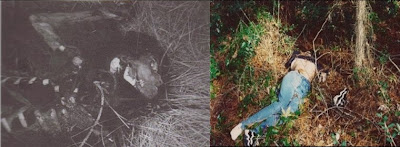
That is Dana Sanchez' body on the left, after 8 days in a field. That is Melissa Trotter's body on the right. In order for the State of Texas to be correct, in order for Larry Swearingen to be guilty of murdering Melissa Trotter, her body had to be laying there in the Sam Houston National Forest for 25 days.
Clearly she was not. Texas is once again on the verge of executing an innocent man.
Shore: I don't remember what I said.
Swaim: Who did you call?
Shore: I talked to Crime Stoppers, it wasn't Crime Stoppers. Crime Stoppers wouldn't give me the time of day. I want to say it was "Tips." The 222-TIPS, "Please use this line," something. Whatever, it is you call --
Swaim: They wouldn't take your call?
Shore: At first Crime Stoppers didn't, they didn't, they thought I was full of shit and didn't listen. That's two calls I made. The second one was to TIPS and I changed my voice and I remember telling them where to find her and I remember telling them her name and I remember telling them her birthday.
Swaim: You remember who you were talking to? A male or a female?
Shore: Honest to God, I don't recall. I want to say female but I don't recall.
Swaim: You told them what? I'm sorry I interrupted you.
Shore: I told them where they could find her and at what time I had a better recollection of approximately where it was and I told them her name was Ruby and I told them what her birthday was so they could identify here. There was a part of me that just wanted to be caught and stopped.
From Corey Mitchell's Strangler:
The officers got back into their cars and headed over to Northview Park Drive, off Richey Road. At the end of the wide concrete road, Detective Valerio exited his cruiser and made his way over to the nearby field overgrown with tall green grass, acutely aware of the oppressive heat that had marked this unreasonably hot summer, even for the notoriously scorching Houston.
Taber and Wedgeworth pulled their vehicle up next to Valerio's. Taber headed toward the west side of the street while Valerio checked the east side.
The familiar, acrid smell caught Detective Taber's attention.
"Valerio, get over here!" Taber hollered. Valerio sidled up to the edge of the field. He noticed that the green grass was blotted with a large twenty-foot-long pathway of dead brown grass. At the upper portion of the dead grass path was an image that would forever be etched in the mind of the thirteen-year veteran detective. It was the severely composed body of a human being. It appeared as if a scarecrow had been blown off its perch by a tornado, its clothes and hat ripped off in the process, revealing nothing but the skeletal remains.
As Valerio stepped closer to the body, combating the stench and controlling his gag reflex, he noticed a full head of black hair, almost like a wig, atop a human skull. The skull was not completely shorn of all its all its flesh. It appeared as if the skull were wearing a Leatherface mask from The Texas Chainsaw Massacre. It was a grayish tan color. Bits of the skull peeked out at certain points. The victim's eyeballs were missing and the ears were halfway chewed off.The condition of Dana's corpse proves that Larry Ray Swearingen did not kill Melissa Trotter. One need only compare the advanced state of her decomposition after only eight days in a field against the near absence of decomposition of Melissa Trotter's body.
Once again, I quote from Strangler, this time presenting Corey Mitchell's summary of the coroner's findings.
Dana Sanchez was literally a bag of bones. Her total body weight was now only twenty-five pounds. Dr. Bellas noted that the majority of her skin had been eaten away by maggots. There was no skin on her pelvic, neck, head, chest, and abdominal area. Additionally, there was no skin on her face and her eyes were missing. What little skin remained was in a nearly mummified state, due to advanced decomposition.She weighed only twenty-five pounds. Assuming she weighed at least a hundred pounds before her murder, she lost at least 75% of her body weight in only eight days.
Melissa Trotter's body, by comparison, weighed 105 pounds, nude. During her previous doctor's visit, she weighed 109 pounds, presumably clothed or partially so. Melissa Trotter's body lost approximately 4% of her body weight as it lay there in Sam Houston National Forest. The State of Texas insists the body was laying there for 25 days and plans to execute Larry Swearingen based on that claim.
In order to believe that Larry Swearingen is guilty, you must believe that Melissa Trotter's body decomposed only 2% as quickly as did Dana Sanchez' body.
4% / 25% x 8 days / 25 days = 0.017 = 2%
Put another way, in order to believe that Larry Swearingen is guilty, you must believe that Dana Sanchez body decayed 59 times faster than did Melissa Trotter's body.
1 / 0.017 = 59
I recognize that Dana Sanchez was killed in the summer and Melissa Trotter was killed in the winter. I realize as well that bodies tend to decompose faster when the temperature is higher. Here's the trial testimony of ME Joye Carter during Swearingen's trial on that very issue.
Temperature will somewhat, well, a cool temperature somewhat slows down decomposition. Warm temperature will accelerate, speed it up, usually.Recall that Joye Carter was no friend of the defense. Au contraire! She was going out of her way to help the prosecution convict Swearingen. Though she gave no estimate of how long Trotter had been dead when she wrote her autopsy report, she gave an overly precise and darn convenient estimate of 25 days during her trial testimony. That estimate, never previously published, put Trotter's death on the very day the State claimed Swearingen killed her. Had it been even a few days later, Larry Swearingen would likely have been found not guilty. He was jailed on 11 December, 22 days before Trotter's body was discovered in Sam Houston National Forest. If Trotter had been there fewer than 23 days, Swearingen could not have been the person who dumped her body.
After the medical experts begin to explain, post conviction, that Trotter's body could not possibly have been decomposing for anywhere near 25 days, Joye Carter wrote an affidavit recanting her estimated date of death, and faulting others for not providing her with enough information at the time. Her affidavit helped win Swearingen another hearing on his case to consider the post-conviction medical evidence. During that hearing, Joye Carter recanted her recantation of the date of death she presented at trial after failing to identify one in her autopsy report. It is on such terribly shaky evidence that Texas intends to execute Larry Swearingen.
At trial, Joye Carter needed to give some explanation why the body was not more seriously decomposed. She therefore pointed out that the decomposition process was probably delayed by the cold winter weather. Even then, when she needed an explanation to bail the State of Texas out of a decompositional jam, she could only bring herself to say that cold weather would slow down the decomposition "somewhat".
In my book, "somewhat" in no way corresponds to a factor of 59.
Using the historical data from the Weather Underground website, I reviewed the weather data for the two areas over the relevant time periods. First I found that the temperature on the day Dana Sanchez' body was discovered was not as remembered by Detective Valerio and related by Corey Mitchell.
Detective Valerio exited his cruiser and made his way over to the nearby field overgrown with tall green grass, acutely aware of the oppressive heat that had marked this unreasonably hot summer, even for the notoriously scorching Houston.Instead, the maximum temperature that day was 92 degF compared to an average maximum for that day of 91 degF.

On the other hand, the December in which Trotter's body supposedly lay in the Sam Houston National Forest had some unseasonably warm days. On 21 December 1998, the maximum temperature was 77 degF.
During the eight days that Sanchez' body laid outside, the maximum temperature averaged 95 degrees. During the eight warmest days that Trotter's body allegedly laid outside, the maximum temperature averaged 71 degrees.
None of that comes close to explaining a factor of 59 difference in the decomposition rates between the two bodies.
This point is so important that I've decided to show a comparison of the two corpses. The images are already available on the internet elsewhere. They have, however, never before been displayed side-by-side for comparison.
On one hand, I'm reluctant to present them. They are gruesome. There is no way that they cannot be painful to friends and family. On the other hand, a man's life is at stake.
Though the rate of decomposition comparison is just one of many powerful arguments of why Larry Swearingen cannot be guilty, I think the side-by-side comparison of the two bodies provides a clear, easy-to-understand explanation of why I describe Larry Swearingen as The Most Innocent Man on Death Row.

That is Dana Sanchez' body on the left, after 8 days in a field. That is Melissa Trotter's body on the right. In order for the State of Texas to be correct, in order for Larry Swearingen to be guilty of murdering Melissa Trotter, her body had to be laying there in the Sam Houston National Forest for 25 days.
Clearly she was not. Texas is once again on the verge of executing an innocent man.