Monday, October 8, 2012

Hughes News: Fraud on the Court (Part 1 of 2)

James Bolding told the jury he found blood on Preston's clothing. James Bolding thereby committed a fraud on the court and on the people of Texas.

I intended to hold this story until it was time to present Bolding's trial testimony. The information now turns out to be critical for reasons that will become known quite soon. I therefore now present my case that James Bolding, supervisor of the Houston Crime Lab serology section, defrauded the court and the people of Texas.

Despite Bolding's testimony, there was no blood on Preston's clothing. Bolding knew that to be so. Not only was he the supervisor of the serology division, he may have conducted the very test that disproved the presence of blood.

In this post, I'll discuss the test results. In the next, I'll discuss Bolding's testimony. I present the test results below.


The form was apparently used by the crime lab to summarize the results of blood and/or semen testing. The form is dated 4-28-89. That is 218 days after the murder, and just 4 days before Bolding provided his deadly testimony.

The case number on the form, L89-4594, corresponds exactly to the case number referenced by Bolding in his supplemental narrative to the HPD reports of the Hughes case. In that supplemental narrative, he makes clear that he received the items on 27 April, one day before they were tested.

According to Bolding's supplemental narrative, he received more items for testing than indicated in the form above. Obviously missing from the form above (or any other form provided in response to an open records request) is the knife and its sheath. I'll limit the discussion herein to just those items shown in the form. The items to be tested consisted of:
One purse strap (discovered near Marcell)
One beer can (the "fresh" Busch beer discovered near the bodies)
One pair of bloody white shoes (Shandra's shoes)
One pair of bloody white shorts (Shandra's shorts)
One pair of blue jeans (Preston's jeans)
Two blue works shirts (Preston's shirts)
One red shirt (Preston's shirt)
One chain (Shandra's gold chain)
Money (Shandra's one $5 and five $1 bills)
Ring (owner unknown; name Avon engraved)
Paper (note from Shandra's pocket; "Dog" & phone number)
Only two of those items were tested for blood: Preston's blue jeans and one of Preston's blue work shirts. The jeans and the shirt were subjected to a series of three tests:
a screening test,
a confirmatory test, and
an anti-human test.
I'll discuss each in turn.

Screening tests are used when blood is not apparent or when blood is not easily discriminated from other stains. Screening tests are easy and inexpensive to conduct. They are used to indicate where more complex and more expensive confirmatory testing should be conducted.

Screening tests are quite sensitive to blood. Unfortunately, they are also quite sensitive to a number of other substances. Screening tests are therefore presumptive. If the results are negative, it is almost certain no blood existed on the item tested, at least in the area tested. If the results are positive, something that reacts to the screening agent was on the item. That substance detected may or may not be blood.

According to the form, the screening tests consisted of subjecting the clothing (or a swab from the clothing) to ortho-tolidine (aka o-tolidine) and/or phenolphthalin (not phenopthalein). These reagents are colorless dyes that become colored in the presence of hemoglobin, peroxidases (a family of enzymes found in fruits and vegetables), and/or metal salts and oxides (such as rust).

Ortho-tolidine is particularly susceptible to false positives. Some foods that have tested positive are asparagus, avocado, green beans, broccoli, Brussel sprouts, cabbage, carrots, cauliflower, celery, corn, cucumbers, eggplant, garlic, lettuce, okra, white onions, green onions, bell peppers, Irish potatoes, sweet potatoes, radishes, spinach, yellow squash, tomatoes, and turnips. Some inorganic substances that have tested positive are rust, iodine, copper salts, nickel salts, and some bleaches.

Phenolphthalin (a great spelling bee word) is somewhat less sensitive to blood than is ortho-tolidine, but it is also less likely to result in false positives. Some foods that have tested positive are apples, apricots, beans, blackberries, Jerusalem artichokes, potatoes, radishes, carrots, beets, horseradish, broccoli, cauliflower, turnips, cabbages, cucumbers, corn, dandelion root, and onion. Some inorganic substances that have tested positive are iodine and the salts of heavy metals such as cooper, lead, and iron.

Despite what it says on the form, Bolding may have used neither ortho-tolidine nor phenolphthalin. According to his trial testimony, assuming we can believe anything he said, he used a "fluorescent reagent that reacts only in dark." That would probably be luminol or possibly fluorescein. From Forensic Biology: Serology and DNA:
In any case where blood is suspected, the analyst must first determine what areas of an item of evidence may possibly contain blood. While the color change presumptive tests are good indicators for the presence of blood, they are not practical for testing whole items on which no stains are visible. ... For this reason, the luminol and fluorescein tests are used to indicate nonvisible blood stains. [Note: no stains were visible on Preston's clothing.]
Luminol is a chemical presumptive test that, instead of producing a color change reaction, causes stained areas to emit light which must be observed under ‘black’ light. Fluorescein also causes a light reaction but the fluorescence must be observed using an alternate light source. Either luminol or fluorescein can be sprayed onto large surfaces such as walls or floors and the positive areas marked for further testing. Both tests are very sensitive and will indicate bloodstains that may not be visible. Positive areas should be marked and photographed immediately because the light reaction is not permanent and will fade. 
One disadvantage to these tests is that both can have false-positive reactions. Luminol and fluorescein will react with the same false positives as PH [phenolphthalin] and also with bleach and other cleaning fluids, which may interfere with blood detection on surfaces that have been cleaned.
The paragraph breaks in the excerpt are mine, for your reading convenience.

Luminol (and presumably fluorescein) also prompts positive reactions in rust, iodine, fonnalin (used for preserving tissues) potassium permanganate (found in some dyes), potassium dichromate, nickel salts, copper compounds, and cobalt. Some of these items can be found in tap water, dirt, and blue jeans.

Luminol (and presumably fluorescein) is particularly reactive to copper (such as the rivets on blue jeans), bleach, enamel paint, turnips, parsnips, horseradish, and furniture polish. It is presumably reactive to all the food items that respond to phenolphthalin. It reacts less dramatically to cigarette ash and smoke. Preston  Hughes smoked.

It is therefore not particularly surprising or insightful that the screening tests returned positive. It is absolutely wrong to say, however, that they returned positive for blood. More frequently, such a test will be reported as indicative of blood. That's not much better. The test is also indicative of potatoes. The test is also indicative of copper. The test is also indicative of tobacco. The test is also indicative of bleach.

Screening tests are, however, never reported to the jury in such innocent fashion as "indicative of onions." Though the lab is supposedly a scientific body having no interest in the outcome of the case, the lab personnel almost always testify in a fashion most damaging to the defendant. They almost always testify for the prosecution, they most always testify that the screening test is indicative of blood, and they leave it to the defense to try to convince the jury otherwise.

The unbiased, scientific purpose of the screening test was to help Bolding, or whomever actually did the testing, to identify areas worthy of more complex, more definitive, confirmatory testing. Since the screening test returned positive, the lab quite properly followed with a confirmatory test. Specifically, they followed with a Takayama hemochromogen test. From the National Forensic Science Technology Center:
Many different tests have been used to confirm that a stain contains blood. The oldest is chemical confirmation of the presence of hemoglobin or its derivatives by the formation of specific crystals. For example, the Takayama or hemochromogen test, in which ferrous iron from hemoglobin reacts with pyridine to produce red feathery crystals ... 
In other words, the lab added a bit of pyridine to the areas that returned positive on the screening test, and watched for the growth of red feathery crystals.

No such crystals appeared.

The confirmatory tests were negative.

To see that the confirmatory tests were negative, look again at the form. In the two boxes where the lab would record the results of the confirmatory tests for the jeans and shirt, you will see two dashes. Now look at the upper left of the form. There is a legend there. The legend instructs that a positive result will be noted by use of the letters "pos" or a plus sign ( + ). The legend further instructs that a negative result will be noted by the letters "neg" or a minus sign ( - ).

Those are not dashes in the confirmatory test results box. Those are minus signs. The tests were negative. When Preston's jeans and shirt were subjected to a confirmatory test, one that would discriminate blood from all those other substances, the results came back negative.

Somehow, the jury would never hear this. Somehow, Bolding would (with the assistance of the prosecutor) dance around this point. Somehow, the defense would never ask a sufficiently pointed question to get Bolding to tell the jury that the confirmatory tests were negative for blood.

And now, if you are sufficiently skeptical of the State's motives, you can understand why the testing was not done until just before the trial. The testing was withheld until after discovery.

Discovery is the process when the defense requests all the inculpatory and exculpatory evidence the State has in its possession. The State is required to turn over all such information, but they clearly can't turn over what they do not have. If they had tested the jeans and shirt earlier, they would have been required to provide the results to the defense. The defense attorney would have had the test results form shown above available to him before he cross examined James Bolding. The defense attorney may have needed to do some research or consult an expert to understand the form, but he would have had time to do so, assuming he cared.

The State was still not off the hook though. It was still required to provide the defense all inculpatory and exculpatory it gathered after discovery. It this case, it did so by calling the defense attorney on the phone, telling him that they had tested the clothes and the testing indicated the presence of blood. They did not tell him that the confirmatory tests were negative. They did not provide him with the form you see above.

The State abetted and possibly probably encouraged Bolding's fraud on the court.

But it gets worse.

After finding no blood during the confirmatory testing, the lab conducted an antihuman test to determine whether the blood that they did not find was human or animal. It makes no sense of course to do such testing, unless you wish to use the expected non-result for nefarious purpose.

One of the fundamentals of an antihuman blood test (also known as the precipitin test) is that blood be present for testing. Assuming you have found some blood to be tested, you place some human antiserum in the bottom of a capillary tube and then you place some blood above the human antiserum. Assuming there is blood to be tested, and assuming the blood is human, then a cloudy ring will form between the two layers. If no cloudy ring forms, then whatever was tested was not human blood.

In the form, Bolding (or whomever) reported the antihuman test results as negative. In other words, no cloudy ring formed between the antihuman serum and whatever it was they placed above the antihuman serum. In other words, the test found no human blood.

The HPD crime lab may therefore attempt to defend its antihuman testing of Preston's jeans and shirt by arguing that they used the test simply as a second confirmatory test. If a cloudy ring had formed, then they would have detected human blood, even though the Takayama confirmatory test did not detect blood of any sort.

If that was their intent, then Bolding should have informed the jury that the lab conducted two confirmatory tests for blood and that neither detected any blood. He did not. He used the antihuman test to tell the court and the jury that he followed up the screening test with another test, and his follow-up test did not reveal whether the blood they found was animal blood or human blood.

The framing of Preston Hughes began when the HPD fabricated the tale of Shandra's dying declaration, continued during the HPD investigation of the case, and continued during Preston's trial. As it turns out, the framing now seems to have continued after the trial.

It is that possible post-conviction framing I will be writing about soon. First, however, I will write of James Bolding's testimony.

Stay tuned.

Saturday, October 6, 2012

Hughes News: False Confession = Death

Associated Press Article dated September 29, 2012

NEW ORLEANS – A 38-year-old man wrongly convicted of raping and killing his 14-year-old step-cousin in 1997 was released Friday from Louisiana's death row after his confession was determined to be false and DNA tests found him to be innocent.

Damon A. Thibodeaux was released at about 12:30 p.m. after spending 15 years on death row at the Louisiana State Penitentiary at Angola, said Pam Laborde, a spokeswoman for the Louisiana Department of Corrections. ...

The Innocence Project said the review of Thibodeaux's case also revealed that Champagne had not been raped and that she had not been murdered in the manner described by Thibodeaux in his confession.

Defense attorney Steve Kaplan said Thibodeaux's false confession was "a tragic illustration" of why police officers should be required to videotape interrogations. He said juries need to be shown entire interrogations to determine "whether it's truthful and reliable not only in light of the interrogation methods used in obtaining the confession, but also in light of other evidence that contradicts or disproves the confession." ...

"There can be no stronger argument against capital punishment than the condemnation of a truly innocent man," said LeBoeuf. "Louisiana citizens should demand a moratorium on executions until they can be assured that there are no more miscarriages of justice like the one that occurred in this case."

Since 2000, six people have been exonerated from Louisiana's death row, the Innocence Project said. Scheck said Thibodeaux was the 18th death row inmate in the United States to be exonerated by DNA.

Friday, October 5, 2012

The Trial of Preston Hughes: Sgt. Dennis Gafford - Direct

Overview
Homicide detective Dennis Gafford was one of the two detectives to take control of the crime scene, confront Preston in his apartment, interview him at the police station, and extract the first confession. Of the two homicide detectives, Gafford and Bloyd, Gafford was by far more directly involved.

His testimony is so long that I will present it in two posts. This post will present his testimony during direct examination by DA Noll. The next post will present his testimony during cross examination. The transcript of his entire testimony is available in two parts at Skeptical Juror Docs, here and here. The first link provides the entire direct examination and a portion of the cross examination. The second link provides the remainder of Gafford's testimony, taken after a defense witness was questioned briefly outside the presence of the jury.

I present Sgt. Gafford's direct testimony in narrative format below.

Narrative of Direct Testimony
I'm Sergeant Dennis J. Gafford. I'm with the Houston Police Department, assigned to the homicide division. I've been working homicide a little over four years. Before homicide I worked in narcotics for a year and a half and in radio patrol for about five years. 
I was working the night shift on September 26, 1988. The night shift nominally runs from 11 p.m. to 7 a.m. If we begin an investigation, we work as long as we need to wrap up the things that we're involved in, then we pass it onto another detective on the day shift. They continue with anything that needs to be done during the day. 
My regular partner is Sergeant Bloyd, and we were working together that night. At about 11:55, we received a call concerning a homicide on the far west side of Houston. We were given the location of 2475 South Kirkwood. 2400 block is where we ended up, and it's a Fuddrucker's restaurant at that location. The scene that we were directed to was directly behind that restaurant on a grassy -- on a field, path through a grassy lot toward an apartment complex. 
We arrived out there at about 12:30. We were escorted into the field by patrol officers who had received the original call and they led us down the path behind the Fuddrucker's and we first came upon a bloody area in the path. They led us past that point to, say, another 20 feet or so. At that point, we found the body of a 3-year-old boy. He was deceased. 
There was a crime scene unit officer at the scene, Officer Hale. The crime scene units are detailed specifically to collect evidence, take photographs, fingerprints, anything having to do with the evidence we locate at the scene. They're the ones that will recover that evidence and process it and send it to its final destination, labs or whatever. 
In addition to the crime scene unit officer, there was a Sergeant Hamilton present. We spoke with him. Based on that conversation and what we observed at the scene, we went to the Lakehurst apartments. That's directly behind the trail. That's actually where the trail leads to is the rear of that complex. It's 2310 Crescent Parkway, I believe, and we talked to security personnel for that complex, a Mr. Marshburn and a Mr. Guajardo. 
We spoke with them, asked them if they could allow us to to show pictures -- we had taken a Polaroid photo of the little boy. We didn't know who he was at that point and were trying to identify him and so locate the family that was possibly somewhere in the complex. So we took a Polaroid photograph of the boy to the assistant manager of the complex, and she could not identify him, said that she's not sure who he was. 
We didn't have a photograph of the young girl. She had been taken -- prior to our arrival, she had been taken to the hospital by an ambulance. 
We then asked if they could provide us with a list of residents to the complex. It would have been later than 2:30 at that time. We did our preliminary investigation before we left the scene, talking to a few people in the area, seeing if they had seen anything and tired to make sure that everything was going well, as far as the processing of the scene. It was after that that I went over and talked to the security guards and assistance manager at the Lakehurst Apartments.
When we went to the Lakehurst Apartments, we had the name of a suspect in mind. It was the name we received from Sgt. Hamilton: Preston. We didn't have a last name. The only reason we had to think that Preston or the offender might be in the apartment complex was that the trail led from the Fuddrucker's to the apartment complex. We figured that would be a reasonable place to check to begin with. 
Looking through the records of the apartment complex, we located one individual in the entire list with the name of Preston, and that was Preston Hughes. The information included his apartment number: 138-A. 
We went to the complex office and we met with Joe Casler, who was the manager of the complex, and asked him if he could pull his files on Mr. Hughes. We looked over the files and obtained identifying information -- the driver's license number, date of birth, social security number, the type of vehicle that he had had, this type of thing -- and recorded that information. After we completed doing that, myself and Sgt. Bloyd and Sgt. Hamilton approached the apartment. 
I believe the apartment complex security officers went with us. I believe there was a uniformed patrol officer that stayed downstairs, but he didn't go up with us. The apartment was upstairs and there was a balcony door that we allowed or asked the patrol officer to keep and eye on as we went upstairs and it was myself and Sergeant Bloyd and Sergeant Hamilton that went upstairs to the apartment. 
I knocked on the door. There was no response for several minutes and we decided to ask Mr. Guajardo, one of the security officers at the complex, to go back to the complex office and see if you could find a telephone number for Mr. Hughes. And he went back there, returned three or four minutes later and said that there was no phone number listed. During that entire time, I continued to knock, and this, I guess, is a period of eight to ten minutes now. Finally, Mr. Hughes did open the door. 
I don't think he said anything first. I believed that first thing that happened is I asked him what his name was, and he said that he was Preston Hughes. I told him that I was a police officer, that I was in the homicide division, and we had Sergeant Hamilton with us. He was in uniform, the regulation uniform for the police department. We asked him if we could come in and talk to him for a moment. He said that was fine. So we walked in, and as we entered the apartment, there's just kind of an entryway that connects the whole apartment together. There's a hallway going off to one side, the living room behind and the kitchen to the left. We stood in that area and talked for a few minutes. 
As we walked in, I looked to the left and there's a kitchen and a dining room beyond that and where we were standing, the living room was directly behind me. As a matter of fact, I was standing beside a couch. I could see down a hallway which led to the bedroom and bathroom. 
We did not have a search warrant at that point. We had no intention of searching his apartment at that point. We did not search his apartment at that point. 
After we entered and identified ourselves as peace officers, I asked him a number of things, identifying information to verify the information that I had already recorded from his lease agreement; and as we continued talking, I asked him questions about where he had been tonight, if he had any problems with anyone. And to each of these questions he responded that he hadn't had any problem with anybody, that he had been out and he had gotten home, was watching TV and he was in bed at the time that we came. 
I felt at that point that there was a possibility that he was a suspect, but we had nothing to substantiate that at that point. All we had was the name of Preston. And so, we didn't know if he had any knowledge of this complainant, you know, if there was any relationship there. We didn't feel that we had enough information to arrest him. 
I asked him then if he would accompany us voluntarily down to the police station. As I said, we had no reason to arrest him at that point. I just asked him if he would accompany us on his own, and he stated that he would. 
He was very calm, didn't act excited about anything, spoke matter-of-factly, didn't give us any reason to suspect anything the he said. It was a little bit odd that he never asked us why we were coming to his door asking him questions. 
When I went to his apartment, there was nothing else I could see. I don't recall if the television was on or if a radio was on or if there was anything going on in the apartment. There were lights in the area that we were in, right in the entryway of the front door, and I assume somewhere in the living room because it was well lit in there, but I'm not sure about the rest of the apartment. 
Once he agreed to go downtown, he asked if he could put some clothes on. He was wearing a pair of gym shorts at that time. And we said yes, that he could. He went to the bedroom and changed. Sgt. Hamilton, I believe, went to the doorway when he was changing. At one point, I may have gone down there as well. I think I may have been at the doorway of the bedroom at some point also. 
There is nothing unusual about an officer accompanying someone who is a possible suspect to the bedroom to change clothes. For our own safety, we would not let them just roam around on their own. 
After he was dressed, we allowed him to secure the door of the apartment, walked out. He was the last one coming out. He locked the door as he came out, he kept the key, and we all left the complex. He was escorted to a patrol car where he was seated and taken down by a patrol unit. We got in our car in a different part of the complex and went down, also. 
He was not handcuffed. He was placed in the back seat. If at that point he had said "No, I'm not coming downtown," we would have left him there. We had no reason to take him if he wouldn't come voluntarily. 
We did not go back to the apartment. We went to our unmarked car, which was parked over by the manager's office, and got in it and drove down to the station from there. At no point while we were in his apartment did we conduct any search of his personal effects or property. I did look around and just scanned the apartment, but didn't move anything or do anything unusual. I observed something that I felt was suspicious, but didn't know anything -- know what it was at that point. 
I observed a pair of eyeglasses that were stuffed between the cushions of the couch. They were partially protruding from the couch. I could see those. The couch was located directly beside me in the living room. That's where I was standing talking to Mr. Hughes. 
When we arrived at the police station at 61 Riesner, we placed the defendant in an interview room, and then did some background checking and some computer checking to make sure that I could -- well, to note everything that I could before I went to the point of interviewing him. 
The interview room is just a small office on one side of the homicide division office that is -- there's no windows and it's just about a five foot by eight foot room, something like that, with a door, a table set inside with a typewriter on it and a couple of chairs. 
The main office of the homicide division was just an open room. There's modular furniture and walls set up in the middle of this room. On each wall of the room, there are offices set off to the side. Most of those are used by individual sergeants. They're equipped with computers and desks for the different sergeants, but there's two specific rooms off to one side that are used primarily for interview rooms or holding rooms when we bring somebody into the division. 
So the main office is a big open room such as the courtroom is and in the center of that room are these -- I guess people have seen more of it in offices where people are divided up in the little cubicle areas about five feet tall. So any sergeant or any person, member of the public or news reporter happening to be visiting in the homicide division would be right outside the interview room. 
The defendant was never handcuffed. He just was escorted in there and asked to have a seat. He sat down, the door was closed, and he was left there. I asked him if he needed anything. He didn't say anything or didn't ask for anything at that point. And so, I begun just talking to him. 
Mr. Hughes came voluntarily from his apartment to the downtown station in a patrol car. The patrol car had a cage separating the backseat from the front seat. There are handles in the back seat but they don't work. Any person in the back seat of the patrol car could not get out unless someone on the outside opened the door. 
We were at his apartment at approximately 2:30 in the morning and then were there, I would say 20 minutes, accounting for the time he got dressed and all. At 4:10 I went in to interview him. My report does say that he was being held. If, however, he wanted to get up and walk out of that interview room at that point, we did not have enough to arrest him. He could have left if he wanted to. 
At this point I began to question him. I asked him again for all of his information -- name, birth date, social security number, this information -- and then began to ask him about whether or not he knew an individual by the name of Shandra Charles, Marcell Taylor and he stated that he -- I'm sorry. At that point I believe we had her name as Shawn and I asked him if he knew a girl by the name of Shawn and he said that he did. 
I didn't know if the Shawn that he was talking about was the one that was involved in this incident. So I continued to ask him questions about her. I asked him to describe her for me and he said that she was yellow skinned, light skinned, that she was approximately the age limit -- I don't recall the exact age he said, but it was an age of this complainant -- and asked him to describe the way she wore her hair and he said she wore it in braids. 
I felt it was definitely the correct Shawn that we were speaking about. He said that the fact that she wore her hair in braids is the way that this Shawn wore her hair, the age range being the same. He also mentioned that she was a friend of a girl by the name of Evelyn who lived at the complex and I had spoken to the security personnel out there at the complex. 
The fact that the defendant knew a girl named Evelyn became of significance. I decided at that point that we were talking about the right Preston that was related to us from Sergeant Hamilton and decided that we did have enough information at that point to arrest Mr. Hughes for this investigation. 
I told him he was under arrest. I immediately read him his Miranda warnings and explained those to him. At this point, he was no longer free to leave. He was under arrest at that point. 
When I read him what we call the Miranda warnings, I am referring to the warnings on the blue card furnished by the District Attorney's office. I have one of those blue cards with me. It is the same card I used to advise Preston Hughes of his rights on the morning of September 27, 1988. 
The first one reads: "You have the right to remain silent and not make any statement at all and that any statement you make may be used against you and probably will be used against you at your trial." The second one reads: "Any statement you make may be used as evidence against you in court." Third one: "You have the right to have a lawyer present to advise you prior to and during any questioning." Fourth one: "If you're unable to employ a lawyer, you have the right to have a lawyer appointed to advise you prior to and during any questioning." And the fifth one: "You have the right to terminate this interview at any time." 
Each time I read one of the warnings to him, I asked him if he understood that. He said "Yes, sir," each time. I formed an opinion that he was of average intellect. He did not appear to have any inabilities. He did not stop me at any point and ask what any word meant. He did not ask to speak to a lawyer. He did not tell me that he did not want to talk to me any more. He did nothing to indicate that he did want to continue with the interview. 
At that point, after he had -- I asked him at the end of that if he wanted to waive those rights, and he said that he would, that he wanted to talk to me about it, that he hadn't done anything. I left the interview room for a few minutes to confer with Sgt. Bloyd to see if he had gained any new information since the time I had been in there with Mr. Hughes, and Mr. Hughes asked if he could have a cigarette. I obtained one for him, and he smoked a cigarette in the room while I was talking to Sgt. Bloyd. 
After I talked with Sgt. Bloyd I went back into the room and continued the interview. I spoke to him at length about anything he would tell me. I asked him questions about Shawn, about how he came to know her, what his relationship was with her. He related this information to me. He was very calm. 
I believe the situation was a girl by the name of Evelyn was -- Evelyn Brown, who lives at the complex, is a friend of this Shawn. His cousin, who is Shawn Graham, is also friends with these two girls, and it was through that relationship that he came to know the complainant, Shandra Charles. He did not indicate that he had any knowledge concerning what had happened to Shandra and Marcell. 
He eventually agreed to make a written statement concerning what he knew about the case. As we went along, I would ask questions -- well, first off, went through the entire scenario with him, getting his information and all, spoke to him at great length about he entire episode. He would talk to me, and we would just -- it was more or less a conversation and once that part ended, I asked him if he would make a written statement and he said that he would and from that point, I went back to the beginning where he -- and brought up points that he had started off the conversation. I would talk to him, ask him questions and to tell me what had happened. So that he would begin again, and we would take it line by line. I would type it as he said it, and we would agree on what was to be put down. I would type it out and just the entire statement went that way. We eventually completed an entire statement. 
The three page document that you show me is the statement that the defendant made that I typed. The first page reflects the date and time I started typing the document, which was September 27, 1988 at 0555 hours. That's 5:55 a.m. 
Each page contains a time entry on the top right-hand side of the paper. That's the time I started the page. I began the first one at 5:55. The second page I started typing at 0613, which would be 6:13 a.m., and the third page I began typing at 6:33 a.m. 
There's entries at the bottom where the witness signatures are, and they signed that document at 7:15 a.m., indicating that's when they -- the statement was ended just shortly prior to that. 
At the top of the page in all caps is the "STATEMENT OF PERSON IN CUSTODY". Underneath that is some pre-typed form language, the legal warnings that I read to him earlier. He was given the paper and was allowed to read those warnings. I also read them aloud to him. He said he did understand them and he wanted to waive those rights and would talk to me about it. 
I gave him a chance to read through the entire statement and to make any changes or alterations which he wanted to make in the typed statement. On the first page of the statement, there is a section in the middle of the second paragraph that he said was incorrect. He told me what he wanted to put down there to make it the way he wanted it worded. And so, I scratched through part of a line and a small portion of another line and wrote above that in pen the words that he wanted there, and then he initialed that to show that that change was at his authority. And then on the third page of the statement on the top line, I left out a word and he brought that to my attention. We added that, and he, again, initialed that. 
I called two sergeants from homicide division into the office and asked them to act as witnesses to the circumstances of the statement and so they could question him about the statement. 
There had been no one else present in the room, other than the myself and the defendant, during the time I typed the statement. Sgt. Bloyd had been in the room when we initially went in to speak with the defendant right as we got to the homicide office and began the initial interview. After the point that Mr. Hughes was arrested, Sgt. Bloyd no longer remained in the room; and I was in there by myself speaking with him and typing the statement. He, Sgt. Bloyd, was in the outer office as were a number of sergeants. 
I wouldn't have had my jacket on, but I was wearing a suit. Sgt. Bloyd was also in civilian clothing. I had my gun on. I'm sure that I wore it into the interview room. At no point did I ever threaten Mr. Hughes to get him to talk with me or to sign the statement. 
At no point did I ever say anything to him to promise anything, any leniency in order to get him to talk with you or to get him to sign this statement. 
At the time we spoke to him at the scene, we didn't go into great detail about the offense. When we had him in the homicide office, I advised him that we were investigating a murder case, and then again, at the time that he was placed under arrest, I advised him he was under arrest for capital murder. 
When I told him that, he gave very little reaction at all. His demeanor changed only at one point. He, during most of the interview, had no reaction at all, very calm and didn't express any emotion. there was only one time that he did. During the questioning, at one point, he started weeping and saying that he didn't wan't to go to jail and that was the only time that he ever showed any emotion. He composed himself after that. It was a very short-lived kind of thing. He broke down for just a second there and was just saying that he didn't want to go to jail and he was silent there for just a few seconds, probably maybe 30 seconds after that and then again we began talking and he was fine after that. 
Again, I did not promise him anything to get him to start talking to me. I did nothing to indicate that if he talked to me or gave me a confession, things would go easier on him. No one, while I was present with the defendant, made any threats to him, hit him, promised him anything or had any contact with him. 
After he agreed to sign the statement and looked over the statement, I asked Sergeants Smith and Ross to come in and witness the statements. I was there for the first few minutes after their introduction. Then I believe I stepped out the door. I don't think I ever just went completely away, but I was in the general area there. 
Actually, after each page that I typed, I would give it to him and allow him to read over that particular page. When that page was completed and he agreed with the way that it was, then he would sign that page; and then we would do the same thing with each subsequent page. Once they came into the room, they went over the statement, asked him if it was his signature and then asked him to do a few other things on the paper. 
After the statement was completed, I, again, left him in the interview room for just a few minutes and went out, talked to Sgt. Bloyd and the other detectives that had been assigned to assist in the investigation, just to see if anything new had developed. And after this statement was completed, I believe I presented to him a form which was a document entitled a voluntary consent to obtain samples: blood samples, urine samples, different things of that nature. 
I also at some point asked him to sign a consent to search his apartment. I had done that before we actually started the typewritten statement. He signed that consent. He said that he had nothing to hide, that he would sign it. 
Those voluntary consent forms were both witnessed by Officers Bloyd and Ross. The voluntary consent for search and seizure was executed at 5:30 a.m. The consent for the taking of samples of blood, ring, and hair was taken just around 7:43 a.m. 
Those forms are kept in reams for our availability over at the homicide office. However, occasionally we will run out of those forms, and when we know we're getting low on the forms, we'll make xerox copies of the ones we have, just to keep us going until we get new forms in. 
I filled in the blanks on the xeroxed form. Preston Hughes signed the document. After he signed the voluntary consent form, I myself did not have an opportunity to go search his apartment. At the time he signed that form, no search of his apartment had yet been accomplished. Likewise, no blood samples or any other samples had been taken from him. 
At that point, I spoke with Detectives or Sergeants Ferguson and Yanchak who were going to continue the investigation on the day shift. We had a number of reports to complete on the initial scene investigation and the follow-up that we had done to that point and basically they were the detectives that were going to continue from there. We updated them on everything that was happening to that point and allowed them to go to the defendant's apartment. 
We put in considerably more than 12 hours, putting in reports and all, but we were around the division there for some time after that. We were aware that later the same morning, the defendant made another statement concerning the events of September 26, 1988. We did not participate in the taking of that statement. We did talk with Sgts. Yanchak and Ferguson concerning our dealings with the defendant. We kind of debriefed those guys on what we had done up to that point in our investigation. 
During the morning, we discovered the names of the two victims involved in the case. They were Shandra Charles, the 15-year-old, and then Marcell Taylor was the 3-year-old. I had spoken on the phone to the security personnel and then the -- I believe it was Sgt. Ross and maybe one other sergeant that went out to the apartment complex to meet with the parents of the victims. I did not personally meet with the parents. 
Beyond taking the statement, debriefing Sgts. Ferguson and Yanchak, and completing the reports, I don't believe we did anything further.
Exhibits
DA Noll showed Gafford and the jury State's Exhibit 13, a photograph which he described as the top of the landing of the Preston Hughes' apartment. I suspect that photograph is the one I include below.


DA Noll showed Gafford and the jury State's Exhibit 14, a photograph which he described as more clearly showing the path between Fuddrucker's and the apartment complex. The photograph was taken during the daytime and shows the path along which Shandra and Marcell were found.  I suspect that photograph is the once I've included below. It is the only aerial photo showing any fraction of the narrow trail on which Shandra was found. The trail of interest runs from the lower left corner of the Fuddrucker's parking lot to just beneath the fence you can barely see at the lower left corner of the picture.


DA Noll also showed Sgt. Gafford and the jury State's Exhibit 5, just as he had shown that exhibit previously to Officer Cook and Sgt. Hamilton. I repeat the photograph below. Sgt. Gafford identified Preston's apartment as being near the red truck. He described the distance as 100 to 150 yards from where the bodies were found.


DA Noll also showed Sgt. Gafford the eyeglasses that were recovered from between the cushions of Preston's couch. Gafford agreed that the glasses shown to him were the same ones he saw in the apartment that night.

DA Noll showed Gafford the three-page document that constituted Preston's first statement. Gafford agreed it was the confession that he typed and Hughes signed.

DA Noll showed Gafford State's Exhibit 1 and State's Exhibit 2. Exhibit 1 was the consent for search and seizure form. Exhibit 2 as the consent for taking of bodily samples form. Gafford agreed they were the forms that he filled out and that Hughes signed.

Possible Skeptical Juror Notes
I do not know if the jurors were allowed to take notes. I certainly do not know what any of them noted, either mentally or on a notepad. I offer below some of what I may have noted if I had been sitting as a juror.
homicide detective sgt gafford; partner bloyd; working that night
learned of murders @ 2355; arrive on scen at 0030; 35 min
met by cook and his partner
bloody area on trail then body of 3 yr old 20 feet further
csu Hale there; and sgt hamilton
went to lakehurst apts at end of trail;
had polaroid of boy; talked to security & assistant mgr; could not id
security: marshburn & guajardo
review resident list; found preston hughes
asked mgr to pull hughes file
approached apt with bloyd and hamilton and 1 or 2 security
he and bloyd and hamilton went upstairs
who took picture of apt door landing? it's night; csu hale not w/ them
hughes opened door after 8-10 min
no search warrant; did not search
asked him to go downtown; okay
put on clothes; hamilton followed; gafford maybe followed
says living room was lit; hamilton says dark inside, real dark
hughes last to leave; locked door, kept key
taken downtown in patrol car
gafford observed glasses btwn cushions in couch; how if dark?
was it dark or light?
hughes always free to not go or to leave
at his apt at 2:30; earlier said 30 min after he arrived at 12:30 ??
20 min at apt
interview at 4:10
hughes knew shandra charles & girl named evelyn
read miranda; understood; waived
calm; denied knowing Shandra / Marcell
written statement; talked, gafford typed, hughes agreed
3 pages; 1st 0555; 2nd 0633; 3rd 0715 (start of each page)
hughes made some corrections; initialed them
2 sgts witnessed after hughes signed
gafford & bloyd in civies; gafford had gun
did not threaten him or offer anything
hughes had little reaction; cried once; didn't want to go to jail
consent for samples form; consent for search form
search -- 0530
samples -- 0743
why all the talk about xerox forms?
sgts ferguson & yanchak take over
discovered names of children from parents; did not meet them

What the Jury Never Learned
In their police reports, both Sgts. Hamilton and Gafford reported that they went to the Lakehurst Apartment complex because Shandra told Hamilton that Preston lived at Lakeside. During trial, both Hamilton and Gafford claimed they went to Lakehurst because it was at the end of the trail on which Shandra and Marcell were found.

The jury would never learn that the other apartment complex adjoining the field was named Lakewood Village apartments.

The jury would never learn that there was a housing complex nearby called Lakeside. The Lakeside Green Condos were located just north of the field.

The jury would never learn that Sgt. Parham was at the crime scene when Gafford and Bloyd was alive, that Parham may have been the supervising patrol sergeant, and that Hamilton may have inserted himself into the case.

Gafford said he hung around the crime scene for 30 minutes. During that time he talked to the few people in the area who may have seen something. The jury never learned the names of those few people who may have seen something, nor of what they had to say. For that matter, the names of those people (and what they had to say) remains a mystery to this day.

Analysis

Item 1: Gafford provides conflicting times regarding the time he spoke with the assistant manager. At first he said it was 30 minutes after he arrived. That would be 1 AM. Later Gafford testified it was soon before he reached Preston's door, which he claimed to be at 2:30 AM.

Recall that Hamilton testified they arrived at Preston's door at 12 midnight, maybe 12:30 PM.

Item 2: Gafford said the living room was well lit as he waited for Preston to change clothes. Hamilton said it was so dark that he could not have seen anything if he looked. Gafford said he noticed the eyeglasses between the cushions of Preston's couch.

Gafford said he stood beside the couch. That seems unlikely. He said that he stood where he could see down the hallway to Preston's bedroom, with the living room directly behind him. Consider Preston's apartment floor plan, presented again below in the sketch Officer Hale created and in the sketch I created.


If Gafford stood where he could see down the hallway to the master bedroom, with the living room directly behind him, as he testified, he could not have been standing beside the couch. It would have been behind him. Whether or not it was dark (as Hamilton swore under oath) or light (as Gafford swore under oath), Gafford could not have been standing beside the couch, nor could he have likely seen the glasses wedged between the cushions of the couch.

Gafford claimed not only to have noticed the glasses, he allegedly saw them clearly. In his police report he wrote: "Sgt. observed a pair of eye glasses partially stuffed between the cushions of the couch. The glasses appeared to have silver colored frames with round eye-pieces."

Consider the image below taken in the daylight by Officer Hale. The glasses are nearly impossible to see.


Gafford would have been to the right of image, the couch behind him, the room so dark that Hamilton could not see anything if he had looked.

It seems likely that Gafford perjured himself at least on this point.

Tuesday, October 2, 2012

The Trial of Preston Hughes: Sgt. Don Hamilton

Overview
Don Hamilton was a patrol sergeant with the Houston Police Department. He is the person to whom Shandra Charles allegedly gave a dying declaration.

Don Hamilton's entire testimony is available at Skeptical Juror Docs. I offer a narrative summary, and more, below.

Narrative of Direct Examination
I am a sergeant with the Houston Police Department. I've been with the department for six and a half years. I'm in the patrol division, assigned to West Houston. My area of responsibility includes the region near Kirkwood and Westheimer, including the Fuddrucker's hamburger joint and the Lakehurst Apartments. 
I was working on the night of September 26, 1988 when I heard a call out on a person down. Shortly after that, they called an ambulance and advised the dispatcher that a female had been assaulted. Roughly 30 seconds later, they said they had found a second victim who had no pulse or respiration, and they requested Life Flight. So I checked by with them. 
The area was a large field, high with weeds and grass. There was no artificial lighting but you could see from the moon how to walk through there and get a general idea of what was out there. I had a flashlight with me. As I was approaching Officers Cook and Baker, I walked past a female laying in the field. She was laying face down in the path. I noticed she was breathing, from just viewing her. I noticed that her face was directly on the ground at an angle that put her nose and her mouth directly in contact with the ground. 
If I recall correctly, she was dressed in whitish or creamish colored shorts and whitish or creamish colored shirt. She had what appeared to me to be a stab wound to the neck and a bloodstain on the upper part of her chest that appeared to be bleeding pretty seriously. There was a puddle of ground where she was lying. 
I turned her over. In observing the injuries to this young lady's neck and chest, I believed she was seriously injured. From the blood that was on her and on the ground, I had the sense that she had injured within the hour. The wound on her neck was still bleeding rather profusely. 
I turned her over to see exactly what the wounds were and to see if she had any other injuries. I noticed her shorts were on her hips. They were from the normal position which someone would have their shorts down on the hips. Her underclothes also had been pulled down and this exposed roughly two-thirds of her pubic area. 
At first, she didn't say anything to me. I asked her, after discovering the condition of her clothes, "What happened?" She replied, "He tried to rape me." I asked her, "Who tried to rape you?" She stated "Preston." 
I asked her if she knew Preston. She stated to me, "Yes." I asked her if she knew Preston's last name. She stated something. I could not understand it. It was more of a mumble. 
At first, she was speaking as clearly as I am to you now but with a little difficulty. As time passed, it did become weaker, almost to a whisper towards then. I had to bend down to hear her talk. She was able to identify the young boy found on the path. She told me it was her cousin. She kept stating, towards the end, her cousin, her cousin, "Find my cousin." 
She was never able to give me the last name of the person who assaulted her. 
Once the paramedics arrived, they started an IV in her situation at that point in resuscitation. At that point after their arrival she began to deteriorate rapidly. We had Life Flight there at the scene but I believe they were dispatched from Galvseston that night and they were still roughly five minutes off. The paramedics made a decision to take her to the nearest hospital they could find. 
Sometime later, Detectives Gafford and Bloyd arrived on the scene. I related to them my findings, especially what the little girl had said to me concerning the person who assaulted her.  After securing the scene, I believe it was Detective Gafford obtained a list of the apartment complex's residents that was nearby the offense. He examined the list and I believe he found the name of a Preston Hughes on the apartment list itself, and I later went over to the apartment -- I believe it was Apartment 138-A -- to see if anyone lived there and to talk with anyone, if they were there. That would be the Lakehurst apartments. 
The path that Shandra was lying on led from the parking lot of the Fuddrucker's, through the field to a wooden fence where there was some planks missing and you could enter either apartment complex from this field. There were two trails, but they were just mud from people that trampled it fairly heavy. 
I accompanied Sergeants Gafford and Bloyd to the residence of the defendant, Preston Hughes III. His apartment is near where the red truck is parked in the photograph. That's about 200, 300 feet from the hole in the fence. I could throw a baseball that far. 
Once we got to Mr. Hughes' apartment, I accompanied Detective Gafford and Bloyd up to the apartment. It was a second floor unit. There was metal stairs, maybe 15, 20 stairs up to the second floor balcony where his apartment was. There was another apartment directly across on the second floor. 
I would say it was after 12:00 when we got to Mr. Hughes' apartment, maybe 12:30 in the very early morning. 
The primary officers investigating the offense were the homicide detectives, Bloyd and Gafford. Detective Gafford was the one who actually knocked on the door. He knocked maybe five minutes, and there was no answer at the door, and he contacted one of the security guards for the complex to see if they could go back to the office and see if there's a phone to the apartments so they could call, see if someone would answer. That turned out -- I believe it turned out they had no phone in the apartment and we knocked a couple more times and he knocked a couple more times. As we were about to walk down the stairs, the door opened suddenly. 
Sgt. Gafford asked the person that answered the door what his name was. The person identified himself as Preston Hughes III. That's him. He's the black male sitting between the two white males, has on a blue blazer, purple tie, whitish colored shirt. 
That evening, he had on a pair of red boxer-type shorts. He invited us in. Sgt. Bloyd had a conversation with him. Sgt. Gafford was standing next to Sgt. Bloyd. At some point, one of them asked him to accompany them downtown to answer questions concerning the case. He agreed. 
He was given the opportunity to change his clothes. I accompanied him into his bedroom, primarily for our safety. As our rule, when we respond to any call, when a person starts walking around, we normally will ask them to stay in the room with us. If they proceed to another room, we'll accompany them, primarily for our safety. 
I did not search his apartment. Neither Sgt. Bloyd nor Sgt. Gafford searched his apartment. 
The apartment was an average, one-bedroom apartment, had a moderate size living room, small bathroom, medium size bedroom, with a hallway between the bedroom and kitchen and living room. 
The defendant changed his clothes and we all left the apartment. Myself, Bloyd, and Gafford were the first to leave. The defendant locked it. He had the key and he locked the door himself. One of our units transported the defendant downtown. 
While we were in the apartment, there were other officers on the downstairs, on the ground in the courtyard. There was a security officer. I'm not sure what his name was. And Officer Vincento and, I believe and Officer Dobbins. 
After I left the apartment, I proceeded downtown to the police building at 61 Riesner to prepare my supplement to the report. Officer Vincento transported, as I said earlier, the defendant downtown. The other units returned to service to additional calls. 
I'm not sure what Sergeants Gafford and Bloyd did after they left the scene. After I turned in my report at the police station, I returned to service, also.
Narrative of Cross Examination
The field behind Fuddrucker's has no lights out there whatsoever. To see the wounds on the victim, I needed my flashlight. As I said, the moon was out that night, and there was enough light for you to walk through the path and to see general things out in the field. You couldn't see anything in detail without additional lighting. You could not make out colors of clothing or stuff like that without using a flashlight. 
I was dressed as I am now, in standard Houston Police uniform, sergeant's chevrons, and gold badge. I introduced myself to the victim as a police officer. I turned her over. There was a great deal of blood. The majority was on her head on to the side of her neck. When I rolled her over, her hair was in her face and matted and pretty soaked with blood. I got some on me in the process of removing the hair out of her face. 
I also went to the place where the little boy was laying. I didn't do anything with the little boy. 
When I went up to the apartment and encountered Mr. Hughes, he did not act nervous or excited. He was relatively calm. He was polite. 
Just myself, Sergeant Gafford, and Bloyd went to the door. He invited us in. I didn't really look around. I was basically just listening to the conversation. I had no right to search, look around his apartment. During the entire time that we were there, Mr. Hughes and Sgt. Gafford and Bloyd were in the living room. I stood right behind them in the hallway. The apartment was dark, and if I wanted to look around, I couldn't see anything anyway. 
The living room area where we are talking, though, was in darkness the whole time. There's a hallway outside the door, the breezeway, whatever you would described that as, has a light. The door was open the entire time. We stepped right out of the breezeway to the entrance of the living room. We were all standing there pretty much together. 
The bedroom was dark when we went in there. When he got dressed, he turned on a light. He went in the bedroom and I followed him. the detectives stayed in the front room, in the dark. I don't recall if the TV or the stereo or radio or anything was on. 
No one checked any of the other rooms. Like I said, when the other sergeants interviewed the defendant, they asked him if anyone else was there. He indicated no one else was there. It was quiet, and I had no reason to believe anyone else was there at the time. When he went to change -- this is a relatively small apartment. As he walked down the hallway, you could look in the bathroom, see there was no one there. As I watched him get dressed, I could see around the bedroom, and there was clearly no one there. I didn't go into the kitchen area or the dining area. 
You would have to see the configuration of the apartment to understand it. When you walk right in, you could see straight to the end of the kitchen. Directly off to your left, you can see the living room. There's a hallway and there's a bathroom off the hallway and and the end is a bedroom. 
I was present when Mr. Hughes was placed in the patrol car. It was a standard blue and white Houston Police Department patrol car. Plastic safety glass separating the front seat from the back, headlights, overhead lights, no door handles on the inside of the back doors. You can only get out if somebody on the outside opens the door and lets you out. The only officer in that patrol car was Officer Vincento. 
I didn't see anything interesting in the apartment and I didn't take anything from the apartment. None of the officers did.
Exhibits
DA Noll showed Hamilton State's exhibits 10, 11, and 12. The exhibits were apparently photographs of Shandra's shorts and shoes. Hamilton identified them as such.  I do not have the photographs available to present. When Houston provided Barbara Lunsford "all" of the case documents in response to her open records request, they did not provide those photographs.

DA Noll also showed Hamilton State's exhibit 5, shown previously to Officer Cook. Once again, I presume that exhibit was the same as the photo below:


Possible Skeptical Juror Notes
I do not know if the jurors were allowed to take notes. I certainly do not know what any of them noted, either mentally or on a notepad. I offer below some of what I may have noted if I had been sitting as a juror.
sgt hamilton
heard call of person down
30 seconds later, second person down / life flight
no lighting in field but moon was up; had flashlight
walked past girl laying in field
laying face down; nose and mouth in dirt
light shorts and shirt
turned her over; did not cradle her as DA said in opening statement
injuries to neck and chest; blood on ground
recently stabbed; within an hour
shorts down on hips
"he tried to rape me"  "preston"
calm at first?  spoke clearly?  mumbled later, then whisper
"cousin, cousin, find my cousin"
paramedics start IV; she deteriorated quickly; they resuscitated her
life flight 5 min out; take her to nearest hospital
sgts gafford and bloyd arrive; take charge
gafford gets list of residents; lakehurst apts; finds preston hughes
field runs from fuddrucker's to lakehurst; hole in wooden fence
200 - 300 yds from hole in fence to preston's apt; 2nd floor
hamilton goes upstairs and inside w/ gafford & bloyd
after midnight; maybe 12:30
preston opens door after 5 min; in shorts
calm; agrees to go downtown
hamilton follows him to bedroom when he puts on clothes
taken to station in patrol car
last one out; locks door himself
need flashlight to see wounds
bloody hair on her face; got some on him
did nothing w/ boy
preston calm; invited them in
lights off; only on in hallway and bedroom
did not check other rooms
did not look around; could see much anyway
officer vincento drove preston downtown
What the Jurors Never Learned

The jury never learned that Hamilton said in his police report that Shandra told him that Preston lived at Lakeside.

The jury never learned that the apartment complex just south of Lakehurst Apartments was Lakewood Village Apartments.

The jury never learned that the Lakeside Green Condos were just north of the crime scene.

The jury never learned that Hamilton was from District 19 and that the crime occurred in District 20.

The jury never learned that Sgt Parham from District 20 was at the crime scene, and that Sgt Parham was probably the supervising patrol sergeant.

The jury never learned that Officers Cook and Baker reported seeing multiple officers standing around Shandra.

Monday, October 1, 2012

The Trial of Preston Hughes: Officer Vincent Cook

Overview
Houston Police Officer Vincent L. Cook had been a patrol officer ever since he joined the HPD nine and a half years earlier. His regular shift was 10 PM to 6 AM. He was familiar with the near the crime scene, including the Fuddrucker's, the Lakehurst Apartment complex, and the empty field between them.

His entire testimony is available at Skeptical Juror Docs. I transform his testimony into first-person narrative format below.

Narrative of Direct Examination 
The field was covered by trees and high brush, approximately knee height, maybe two or three feet high. There is an abandoned house in the midst of the field. 
It was dark outside. I had a flashlight. The time was sometime after the beginning of my shift at 10 PM. 
In that field, we found the body of a young woman. She was laying face down on the trail. Her head faced west [towards Fuddrucker's] and her feet pointed east [towards the Lakehurst Apartments.] She was breathing. I could see her chest rising up and down. I noticed blood around her neck and on the ground below her.

As we continued to look, we saw a small boy. He was also laying face down. His head was pointing in a northeast direction. His feet were pointing in a southwest direction. 
We turned him over and checked for signs of life. He was not breathing. I believed he was dead. We attempted to revive him. 
I recall the boy having a stab wound to his shoulder and a stab wound to the back of his head.   
He had what appeared to be an exit wound on his back shoulder. One of his feet was partially removed from its sandal. There was some sort of plastic bag wrapped around his foot. 
I couldn't determine whether or not there had been in a struggle. 
I immediately notified the dispatcher to have an ambulance sent, and possibly a helicopter to lift them out. 
We called for backup. We cornered off the scene. We looked for any suspects that might be in the area. I stayed with the children, but other officers searched carefully for suspects. In fact, a helicopter arrived to look around. 
Sgt. D. Hamilton was one of the persons who responded to assist in the case. Sgt. Hamilton is one of the supervisors at the station. I told Sgt. Hamilton what we had found. I did not direct him to the area where we had located the young woman. I stayed with the little boy.
Narrative of Cross Examination
I had no idea when the children might have been attacked. I didn't see any suspects in the area.
Exhibits
I do not know exactly which photos were presented as exhibits as part of Cook's testimony. I can infer which may have been presented. Assuming I have copies, I present them below

State's Exhibit 5: Seemingly an aerial view of the scene, capturing a portion of the Lakehurst apartment complex, Fuddrucker's in the distance, and the field between them. The aerial view was possibly this one.


State's Exhibit 6: Seemingly an aerial view of the scene, capturing Fuddrucker's, a portion of the Lakehurst apartment complex, and the field between them.  Cook placed an X in the approximate location where each of the children were found. The aerial view was possibly this one.


State's Exhibit 7: Picture of  boy as discovered by Cook, except turned face up and shirt lifted to expose injuries. Possibly this picture. I have blurred the boy's facial features to preserve at least some modicum of privacy.


State's Exhibit 8: Picture of boy showing what appears to be an exit wound at the back of his shoulder. Shirt raised to show injury. Possibly this picture.


State's Exhibit 9: Picture of boy's feet showing plastic bag and one foot partially removed from its sandal. Probably this picture.


Possible Skeptical Juror Notes
I do not know if the jurors were allowed to take notes. I certainly do not know what any of them noted, either mentally or on a notepad. I offer below some of what I may have noted if I had been sitting as a juror.
girl face down on trail
noticed her breathing
did not hear her talking or making noise
did not stop to help her
boy dead
stab wound to shoulder
stab wound to back of neck
exit wound at back of shoulder
boy stabbed both front and back?
something going on with boy's foot; sandal and plastic bag
attempted to revive him
called for help after finding boy but not after finding girl
tried to help dead boy but not live girl
stayed w/ boy, not girl, while others searched area
sgt hamilton showed up
avoided answering directly if hamilton was his supervisor
talked to hamilton; told him what they found
stayed with boy; hamilton must have come to him
hamilton must have walked past girl
What the Jurors Never Learned
All parties at trial attempt to manage what the jurors see, hear, and discuss. The jurors are frequently the least well-informed players in the macabre play we call a trial. Regarding Cook's testimony, here are some bits of information kept from the jurors.

The jurors never learned that Cook's partner was Officer C. J. Becker.

The jurors never learned that Cook and Becker filed a joint police report. We do not know which of the two actually wrote it.

The jury would never hear from Officer Becker, though he had as much information about the discovery of the bodies as did Cook. The jurors would never learn whether Becker's testimony reinforced that of Cook, or contradicted that of Cook.

The jury would never know that Cook, in his police report, declared that the girl was unconscious. He did not make that part of his testimony.

The jury would never know that Cook did not claim in his police report that he could see her chest move as she breathed. In his police report he described her only as breathing deeply.


The jury would not learn that, in his police report, Cook claimed the time was near 11:30 PM when he was flagged down by the first or second person.

The jury would never learn the details of the first gentleman's plea for Cook's help. The jury would never learn the first gentleman claimed:
that he and his wife had been pursued through the field by a dark shadowy figure; 
that his wife had been abducted by 2 black males in the very field; 
that though his wife had turned up safe, he heard a female scream from the area where the children were found.
The jury would never learn that the plastic bag wrapped around the boy's foot was never reported as taken into evidence. The plastic bag was never tested for fingerprints, blood, or DNA.

When Cook was asked specifically if Sgt. Hamilton was his supervisor, Cook gave an oblique answer.
Q. Is Sergeant Hamilton one of your supervisors or how does that work out there? 
A. One of the supervisors there at the station, yes, sir.
The jury would never learn that Sgt. Hamilton inserted himself from another patrol district. The jury would never learn that another sergeant, Sgt. J.H. Parham, was at the scene at the same time Hamilton was at the scene. The jury would never learn that Sgt. Parham was apparently from Cook's patrol district and that Sgt. Parham may have been Cook's supervisor.

The jury would never learn that the aerial photos were not taken anywhere near the time of the crime. The aerial photos were taken long before the crime, as evidenced by the missing car wash north of Fuddrucker's. The aerial photos were later included as part of Preston's case file because they had been used as exhibits in the trial. When Barbara Lunsford submitted an open records request for all the documents in the Hughes case, she was provided those aerial photos.

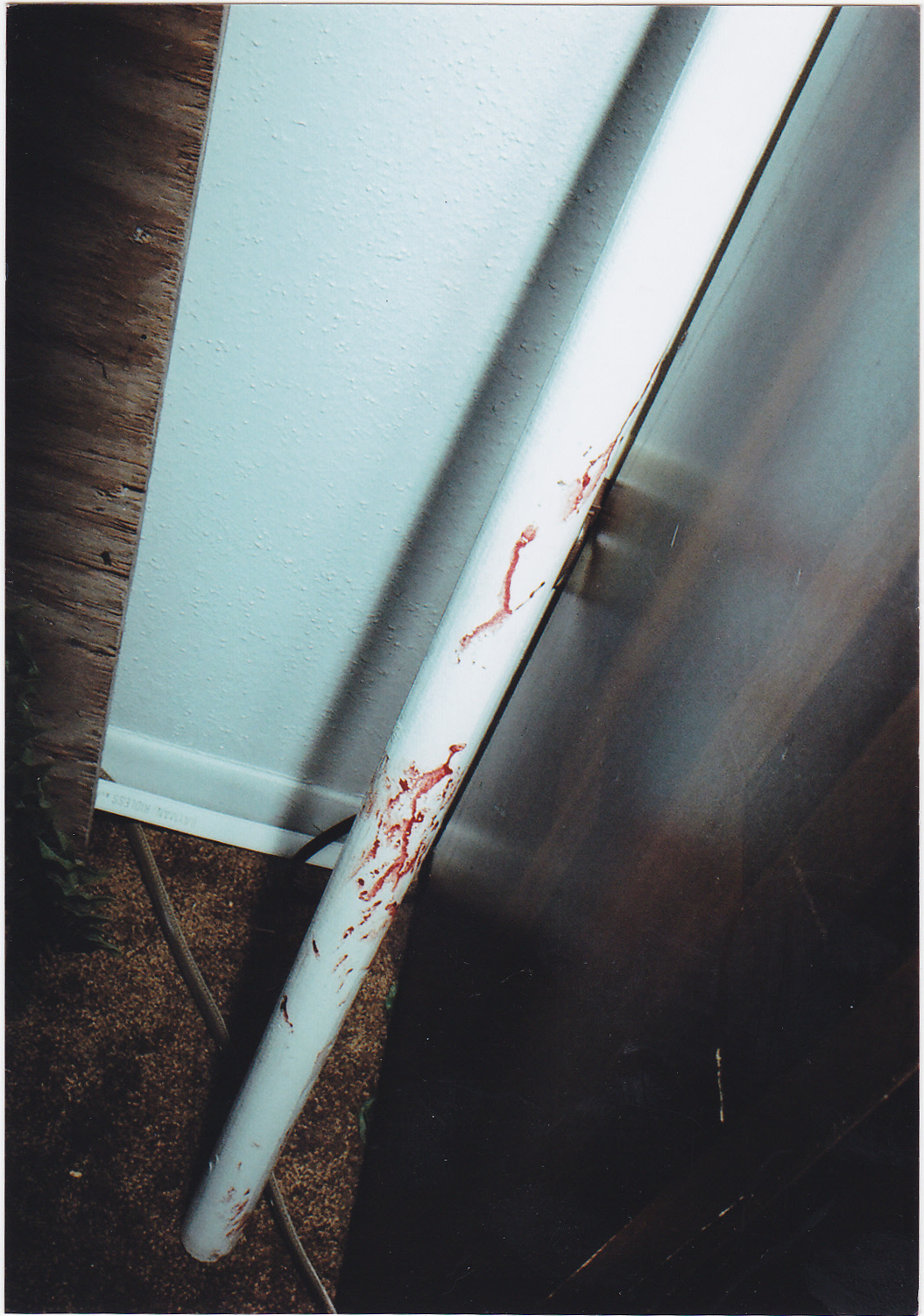
The jury would never learn that there were photos of another crime scene included as part of the Hughes case. The reason for including these photos in the Hughes file is unclear to this day. One suspicion is that the HPD was considering a suspect other than Hughes, someone who had committed another crime of violence.  I present some of the photographs from that other crime scene below.


Based on information gleaned from other pictures of that crime scene, I believe the crime happened near the time of the murders of Shandra and Marcell.

The crime was associated with the upstairs apartment on the left of the first image. The number of that apartment is 2002. If anyone has any information regarding the crime or the specific location of the apartment, please contact me.