Monday, January 31, 2011

The Impending Execution of Roy Willard Blankenship

[Note: This post was written prior to the stay granted to Roy Willard Blankenship. His execution has been re-scheduled for some time between 23 and 30 June, 2011.]

Roy Willard Blankenship is scheduled to be executed by the people of Georgia on 9 Feb 2011 for the rape and murder of 78-year-old Sarah Mims Bowen. I find no credible evidence that Blankenship might be factually innocent of the crime.

For those of you convinced that we execute only guilty people, I suggest you consider the many cases of people wrongfully executed. Examples include (but are no means limited to) Johnny Frank Garrett, Frances Elaine Newton, and Cameron Todd Willingham.

For those of you opposed to the death penalty under any condition, I suggest you familiarize yourself with the details of some of the crimes for which people are condemned to die. For the details of the crime committed by Roy Willard Blankenship, I offer the following description taken from his appeal Blankenship v. Hall.
At around 4:15 p.m. on March 2, 1978, officers from the Savannah Police Department responded to a call at 404 West 44th Street. They were directed to the second-floor apartment of Sarah Mims Bowen. Several members of Bowen's family already had arrived, having been contacted by her downstairs neighbor. Inside the apartment, police found a blood-stained paper towel in the living room. In the bedroom, the body of 78-year-old Bowen lay dead and naked on her bed. She had bruises on her arms and hands, and her face was beaten and bloodied. A plastic bottle of hand lotion had been forced into her vagina.
There were footprints found on the porch outside Bowen's apartment. Police found similar prints inside the apartment. Outside the house, they traced the prints from the bannister supporting the porch southwest along the ground towards the street, in the general direction of the apartment of Roy Willard Blankenship.
Dr. Rodrick Guerry performed an autopsy. He determined Bowen had been severely beaten, suffering repeated blows to her face. Bowen had preexisting chronic pericarditis and arteriosclerosis, and the autopsist attributed Bowen's death to heart failure precipitated by a severe assault. The autopsy also revealed she had been vaginally raped. Semen was found in her vagina, which tests demonstrated came from a blood type-O individual. Both Blankenship and Bowen were type-O. In addition, Dr. Guerry stated the inside of Bowen's mouth and throat were red and bloodied, injuries consistent with oral rape. However, tests did not reveal the presence of semen. Scrapings beneath the nails on Bowen's right hand also tested positive for type-O. Based on the condition of the body, the coroner concluded Bowen had been raped while alive, was beaten, and suffered heart failure as a result.
A fingerprint lifted from glass broken in from the balcony and found inside the apartment matched Blankenship. On March 11, an arrest warrant for Blankenship was prepared, as well as search warrants for his apartment. Inside the apartment, police found shoes belonging to Blankenship whose tracks matched those found in and around Bowen's apartment.
Police arrested Blankenship and he waived his right to remain silent. Blankenship spoke with police and described his presence in Bowen's apartment in the early morning of March 2, 1978. His oral statement was transcribed, and he signed the transcription. In it, he confessed to the following:
I went up on the iron rail on the side of the porch and climbed over the banister. I stood up there for a few minutes thinking, what the hell, I really didn't know what to think. I had to be drunk. Stoned. And I kicked the window in and I waited. When I kicked the window in to see if anybody heard it, I could've got shot or something. I guess I should have. It would have been better. I went in through the window, I think. I scraped my arm on the window. I don't think it cut it. I went into the next room, I saw no one. Just the bedroom. I looked around there and the door was opened into the next room. I went up to the door and started to go through when I saw a mirror straight ahead in the next room where the lady was. I seen her reflection through the mirror sitting in a chair so I stood beside the door for awhile watching her pray or something. Moaning. I don't know. Then I grabbed her. I think her mouth so she did not scream. [sic] I covered her mouth and her nose and then she slid down in the chair. She fell on the floor and I fell on top of her. After I fell over on top of her I didn't have to hold her mouth or anything. She was not screaming or kicking or anything. So this blood was coming out of her head, I think, on the right side. I think. I pushed this little stool back and I picked her up and I carried her and laid her on the bed. All right. I put her on the bed. She had some pajamas on, I think. I took them off. It's crazy. When I put her on the bed and took her clothes off, I was drunk, I guess. I said I may as well go ahead and get some pleasure. That's when I had the relationship with her. As far as I know, I thought I was in the right hole. After that I got up and was afraid that I might have hurt her. I thought I'd better get out of there. I left as soon as I did that shit. I left. I went the same way I came. I was wearing the same shoes that the police confiscated from my house today. I watched her about 10 minutes. After I grabbed her she fell to the floor and I put her on the bed. Right after that I shot off or got my pleasure or whatever you want to call it. I put back on my clothes and left. It probably was not long. I was in the house maybe 45 minutes or an hour all together. I don't know why I did it. I was drunk. I know I had to be drunk. That time in the morning I had to be just coming back from the Orential [sic] Lounge. I came by myself. I had been at the bar with Joe and Alex. They left the bar about 1:30 or 2:00. I know I stayed until closing, 3:00. I walked from the bar to the house. The Orential [sic] Lounge on Abercorn Street. I shoot pool all the time. It takes me about five to seven minutes to get to my house walking. I never did make it home. I stopped at her house and went upstairs before I went home. I know the witnesses in the bar—waitresses, sorry. I know the waitresses in the bar. I don't dance. I just shoot pool and get high and get drunk. I was drinking that night. I was drinking burbon and coke. I don't remember anything about the plastic bottle.
In the footnotes, we find this insight regarding the confession.
Blakenship did not simply give a narrative account of the evening. His statement was a mixture of his narrative and responses to questions and comments from the interrogating officers. Only his statements were recorded, typed and signed as a confession.
During his trial, Blankenship testified that he did enter the apartment and assault the victim, but did not rape or murder her.
Blankenship testified in his own defense. During the time of his arrest, he worked at the Guerry Lumber Company. He said he was an alcoholic and also took Qualudes, a tranquilizer.
Blankenship knew Bowen; in fact, he had been inside her apartment prior to the night of her death, performing odd jobs such as replacing blown light bulbs. He would frequently talk with her on weekends when he would pass by her apartment and she was sitting on her porch.
Discussing the events of March 1 and 2, Blankenship noted he began drinking soon after he returned home from work. After some time, he went to the Oriental Bar. From 7:30 that evening until the bar closed at 3:00 a.m., Blankenship continued to shoot pool, drink, and ingest Qualudes. After the bar closed, Blankenship headed home alone.
Instead of returning home, however, Blankenship scaled the balcony of Bowen's apartment. Once on the balcony, he knocked on Bowen's door. There was no answer. He kicked in a window and crawled into the apartment. As he made his way through the apartment, Blankenship saw Bowen in a mirror sitting in her chair. Bowen was speaking to someone near the area of her kitchen. Blankenship said he reached out to grab Bowen and she jumped, tripped over a foot stool, and fell to the floor.
Bowen was now bleeding from her head and was unconscious. Blankenship picked her up and moved her into the bedroom. Once he placed her on the bed, he pulled her pajama bottoms partially off her body. He did not remove her pajama top, which Blankenship said already was unbuttoned. He tried to have sex with her, but could not achieve an erection. At this time, Bowen appeared to be regaining consciousness, so Blankenship left the apartment the same way he entered.
Hendrix asked Blankenship whether the pictures of the crime scene matched his recollection of how he left it. He insisted they did not; he testified that, when he left her, her pajamas where still partially on, whereas in the photos she was completely naked. The plastic bottle was also not there when he said he left. In addition, he said her face was not in the same condition it was when he left it, and that she had not been beaten up.
Blankenship also testified as to his confession. He had been drinking before being arrested by the police in his apartment. He said he did speak with the police, and he did sign the statement. He said, however, that he had pointed out several errors in the typed statement to the interrogating officers, who told him to go ahead and sign it despite the errors. The errors he pointed out—including, for example, that instead of "slid[ing] down in the chair" she actually jumped up from the chair—essentially coincided with the story he had told the jury. In general, his testimony was that the story he told the detectives was the same as what he told the jury, and the typed confession was riddled with errors. He denied having intercourse with Bowen or ever hitting her.
I oppose the execution of people who might be factually innocent of the crime for which they are to die. I suspect that to prevent the execution of the factually innocent, we might have to ban the death penalty entirely.

With respect specifically to the execution of Roy Willard Blankenship, I stand mute.

Sunday, January 30, 2011

Oklahoma or Aljazeera: Which is More Rational?

An online program called Fault Lines has an extended (23 minute), reasonably balanced, and well done video about the death penalty. One of the interesting things about the program is that it is produced by Aljazeera, the Arabic news station that came into US awareness during the Second Gulf War. The quality of the video is such that had they used the narrator from Frontline, and had they published the video anonymously, there would be no reason to believe it wasn't a Frontline product.

Aljazeera focused on the death penalty in Oklahoma. They interviewed, among others, Frank Keating. Keating was governor of Oklahoma for eight years beginning in January of 1995.  He presided over 54 executions. At one point, Keating offered this insight into our justice system:
"Nobody goes to court because they're misunderstood. Nobody goes to court because they're accused of a crime they didn't commit. They go to court because they did something."
Well there you go. According to Oklahoma's ex-governor, not only do we not imprison any innocent people, we do not even take them to trial. Those people found not guilty must be not guilty only in a technical sense, not in an actual sense. After all: "Nobody goes to court because they're accused of a crime they didn't commit."

Keating also offered this insight.
"In my case, any recommendation, unless it had to do with guilt or innocence, I ignored. I always brought the defense attorney in, the prosecutor in. The question I asked was 'Did this person do it?' In no case was the answer 'No.'"
I believe I'll look into the executions that took place under Frank Keating's watch. Unfortunately, I suspect I will find some egregious cases.

Stay tuned.

Wednesday, January 26, 2011

Proof Kinda Beyond a Reasonable Doubt

In a previous post, I described the concept of "Proof Beyond a Reasonable Doubt" as a convenient judicial myth. At the end of that post, I presented the following summary plot comparing the idealized concept against the reality of jury and judge verdicts.  I include that plot below for easy reference. Click to enlarge and clarify.
Judges and scholars, if forced to quantify the reasonable doubt threshold, tend place the threshold near 90%. While that number flies in the face of the plot above, it comports with quite a few studies attempting to quantify the threshold.

In his 1993 book Inside the Juror, Reid Hastie provides a summary of studies in which groups of people were merely asked to quantify reasonable doubt after being read a standard reasonable doubt instruction. I repeat his summary in a somewhat simplified form below.

In summary, when our country's jury pool is asked to quantify the reasonable doubt standard, they claim they set the threshold at 85%. That's not much lower than the threshold typically selected by judges and scholars. However even if jurors set the standard that high (the plot at the top of this post proves they don't), it seems to me still to be a problem.

If I have a ten-sided die with sides numbered from 1 to 10, I have a 90% confidence that any single roll will result in a number greater than 1. Do I therefore have proof beyond a reasonable doubt that I will not roll a 1? 

In this simple die rolling experiment, I know that if I set 90% as my threshold for reasonable doubt, I will be wrong nearly 10% of the time, over a large sample of tests. Is that acceptable?

If instead of rolling a die, I am sitting as a juror in a criminal trial, should I vote guilty if I am 90% confident in the guilt of the defendant? If I am willing to do so, does that mean there is a 10% chance the defendant is innocent?

If all my fellow jurors are willing to do so, to vote guilty when we are 90% confident, should we expect a wrongful conviction rate near 10%, just as Spencer and Allen have calculated we do?

Saturday, January 22, 2011

The Terminator, Crickets, Kevin Bacon, and Freedom

You are a critical link. The liberty of two young men depends on you reading this entire post.


The Terminator

When I held a more conventional job, one that actually pays, my colleagues would occasionally mention they had met someone noteworthy. It happened so often, I maintained a Claim-To-Fame list of such encounters. People then sought me out to tell me of their encounters.

One colleague played against Arnold Schwarzenegger in a tennis match. Arnold apparently played tennis pretty much as he acted: without much subtlety. My colleague won easily. ("Lub fordy. Don't return dis serve if you want to live.")

One colleague carried Mandy Patinkin's laundry to the cleaners. ("Hello. My name is Inigo Montoya. You killed my father. Prepare to martinize.")

One had urinated next to Bill Monbouquette. ("A finesse pitcher who relied on changing speeds and a superb control, Monbouquette was signed by the Boston Red Sox as an amateur free agent in 1955 ...") Apparently as a young man, this particular colleague had attended a Boston Red Sox game with his father, had availed himself of the restroom facilities, and was taking advantage of the urinal when the guy beside him decided it was an appropriate time for an introduction: "Hi. I'm Bill Monbouquette."

Still another colleague had an aunt who was a professor at some big-name university. The aunt  hosted frequent parties for the intelligentsia. My colleague claimed, that his aunt claimed, that at different times, five different (and apparently besotted) nobel prize winners knocked over her mail box as they backed out of her driveway.

I myself was on a commercial flight with Peter Graves. I sat somewhat further back in the airplane so we never had a chance to speak. However, we both experienced one of the most terrifying flights I've ever been on, the details of which are beyond this post. I'm serious about this claim to fame, and I'm not talking about the movie: "Joey, do you like movies about gladiators?"

In the unofficial parlance of the small world phenomenon, I claim to be only one degree of separation away from Peter Graves. Each of you can now claim to be only two degrees away. "I read this blog by some guy who thought he might die on an airplane with Peter Graves, so it's like we're almost friends."

The small world phenomenon was first discussed soon after Marconi invented the radio. Seemingly impressed by Marconi's work and its implications, Hungarian author Frigyes Karinthy challenged his readers to find someone he could not be connected to by five or fewer people. Frigyes was apparently the first person ever to suggest than anyone on earth is no more than six degrees of separation away from anyone else on earth.

After more than a century of observation, experiment, and theoretical modelling, Frigyes seems to have come pretty darn close to the answer. Amazing.

Crickets

Duncan Watts is a bright and curious man. Currently he is a principal research scientist at Yahoo! Research. Previously, he pondered how crickets managed to synchronize their chirps over long distances. His research into synchronized crickets inspired him (along with Steven Strogatz) to develop the first network model of the small world phenomenon. They discovered that the small world phenomonenon is applicable not just to people who know people, but to brains, power grids, computer security schemes and a seemingly endless list of natural and man-made systems.
"I think I've been contacted by someone from just about every field outside of English literature. I've had letters from mathematicians, physicists, biochemists, neurophysiologists, epidemiologists, economists, sociologists; from people in marketing, information systems, civil engineering, and from a business enterprise that uses the concept of the small world for networking purposes on the Internet."
Think Facebook.

One of Watts' conclusions I find interesting is that randomness is critical to the small world phenomenon.  A perfectly ordered system is a horrifically ineffective means of spreading information. Add just a few random links, however, say one or two percent of the total, and the system becomes very efficient.

To understand this, assume everyone on earth is ordered in a gigantic square. (When we had only 4.9 billion people on earth, that would be a square with 70,000 rows of 70,000 people.)  Assume you can communicate with people in no larger than a fifty person radius, and you want to contact Juan Luigi Chan, Jr. You know Juan Luigi is somewhere in the far corner of the square. The best you can do is yell to someone fifty people away in that direction, asking them to relay a message to Juan Luigi Chan, Jr. who is somewhere in the far corner. That person can then yell to someone else fifty people away and so on. It's going to take a while for your message to get there.

Assume people on average are half a grid away, on a diagonal somewhere. It would take (excuse me while I make use of the Pythagorean theorem) 990 links minimum to get close, then a few more to home in on Juan Luigi Chan, Jr.

Now assume you are also friends with 100 or so people scattered randomly around the huge grid, and you know exactly where each of those friends is, and you can call any one of them on your cell phone. You don't yell to your buddy fifty feet away. You call your friend who near the far corner of the humanity grid. "There's someone in your area named Juan Luigi Chan, Jr. I want to talk to him. I figure you don't know him, but check someone you think might, and see if that person knows him. Pass along my phone number and have Juan give me a call. Thanks, I owe you a solid."

Your phone will be ringing in no time, after no more than five intermediate phone calls.

Kevin Bacon

For some reason, Kevin Bacon has become the American name most associated with the small world phenomenon. For a long time, I've heard people talking about being fewer than six degrees of separation away from Kevin Bacon. In fact, Visa used the bit in a clever commercial.


Kevin Bacon is so closely tied to the small world phenomenon that when you are talking about your connection with him, you don't use the term "degrees of separation." You use the term "Bacon Number." If you are two degrees of separation from Kevin Bacon, your Bacon Number is 2.

In the original sense, connections to Kevin Bacon were allowed only via movie connections. Only actors or actresses could therefore have an official Bacon Number. That rule has since been substantially relaxed, as evidenced by the commercial. However, if you would like to see the small world phenomenon in action, try the brilliant and easy to use utility at The Oracle of Bacon.

According to the Oracle of Bacon, Arnold Schwarzenegger has a Bacon Number of only two. Arnold appeared with Todd Stashwick in the movie The Rundown (2003) and Todd appeared with Kevin in the movie The Air I Breathe (2007). 

And with that insight, I have come full circle, from Arnold Schwarzenegger to Kevin Bacon. It is now time to learn about how this relates to freedom.

Freedom

I estimate that there may be a quarter million people wrongfully incarcerated in this country. That's 10% of the 2.5 million people we currently have incarcerated.

Of that quarter million, there are two I am actively and persistently attempting to help free. Those two are Byron Case and Michael Ledford.

Bryon was wrongfully convicted of murder and armed criminal action. He is serving two life sentences without parole in Missouri. Byron has been through all his appeals, up to and including the U.S. Supreme Court. (They simply refused to hear his case.) Byron has left to him an appeal based on actual innocence and a plea for clemency.

Michael was wrongfully convicted of murder and arson. He is serving 50 years in Virginia, which has no parole for anyone. Michael has used (or has time defaulted on) all his appeals. All of them. He has left  to him only a plea for clemency.

To free a person wrongfully convicted of a serious crime, you must prove that person to be factually innocent beyond any reasonable doubt. It's not the law, it's a fact of life. It's nowhere good enough to argue that the person did not receive a fair trial, or that the prosecution withheld evidence, or that witnesses lied. None of that matters. When it comes to freeing the wrongfully convicted, you must produce proof of innocence.

In each of the two cases, I know what really happened. I know not because someone told me, but because I've lived immersed in the data for months and months and months. In each of the two cases, I can point to the evidence which will prove innocence. It will, however, do neither of them any good, because I am not an expert in the field at question. This too is a fact of life.

I need to find, somewhere out there in the vast sea of humanity, two experts who will be the key to freeing Byron Case and Michael Ledford.

And now you can see where I'm headed. I'm trying to find two people among the great sea of humanity. I don't know their names or where they live, but I can describe them to you, and you can ask around.

Each person is intelligent, highly-qualified, and generous. Each person would be personally offended that an innocent person would be imprisoned for life for a crime they did not commit. Each person would be willing and able to provide his or her expertise pro bono to correct a terrible wrong.

The first person has expertise regarding a little-used time-of-death indicator. More specifically, the first person can speak with expertise regarding how long a person has been dead if that person's corneas are not cloudy, though the person died with their eyes open. The person probably works in the medical field, possibly as a medical examiner, pathologist, eye surgeon, or ophthalmologist. That person might work in the field of corneal transplants.

The second person should be easier to find. That person has expertise regarding the interpretation of the evidence left behind by fires. More specifically, that person can determine from photos of circuit breakers, wall outlets, cords, and plugs whether a related fire was caused by an electrical problem.

Each of you reading this post is no less than one-sixth of the distance between Bryon Case and the person who might help free him.

Each of you is also no less than one-sixth of the distance between Michael Ledford and the person who might help free him.

I suspect none of you reading this post are either of the two people I seek. I suspect also there is but little chance you know either of the people I seek. I believe, however, that you know someone who might know someone who might know one of the two people who can help.

Please ask that person you know. Please ask them to forward a message from me to someone they know who might know the person I seek.
"I need your assistance. You are a critical link. The rest of a young man's life is at stake. Please write me at www.skepticaljuror.com."

Wednesday, January 19, 2011

Michael Ledford: Confession Falsified by Smoke and Mirror Images

For those of you just joining in this case, allow me to bring you up to speed quickly.


One month after an apartment fire took the life of his one-year-old son and seriously burned his wife, Michael Ledford signed a document stating:
Around 8:00 P.M. we put Zach to bed then Elise went to bed at 8:30 P.M. I told Elise that I was going to put gas in the car and put my name on the EVAC sheet at the firehouse then write the check for Pied Piper then go to bed. Before I left, I lit a candle and threw it in the chair. I never wanted to hurt my family. I was tired of trying to live up to Elise's parents' standards. I now wish I had took my mom's advice and moved back to Pennsylvania. I agree I need help, and willing to get -- and willing to get help. I just hope my family and friends and God can forgive me.
Michael recanted but to no avail. At trial, two fire investigators confirmed the arson. A jury convicted Michael Ledford of first-degree murder and arson of an occupied dwelling. A judge sentenced him to 45 years for the murder and 5 years for the arson. The sentences are to be served consecutively. There is no parole or early release in Virginia.

I am convinced Michael Ledford is innocent, and I intend to prove it. 

Confession Falsified by Thermodynamics

Michael's confession cannot be true. The fire scene photos show neither candle wax residue nor candle holders. Based on Michael's written confession and his more detailed video taped confession, there should have been both.


A detailed timeline analysis coupled with the most sophisticated fire simulation available today shows  that Michael was not at or near the apartment when the fire started. The fire started between 4 and 14 minutes after his departure.

Confession Falsified by Smoke

New content follows.

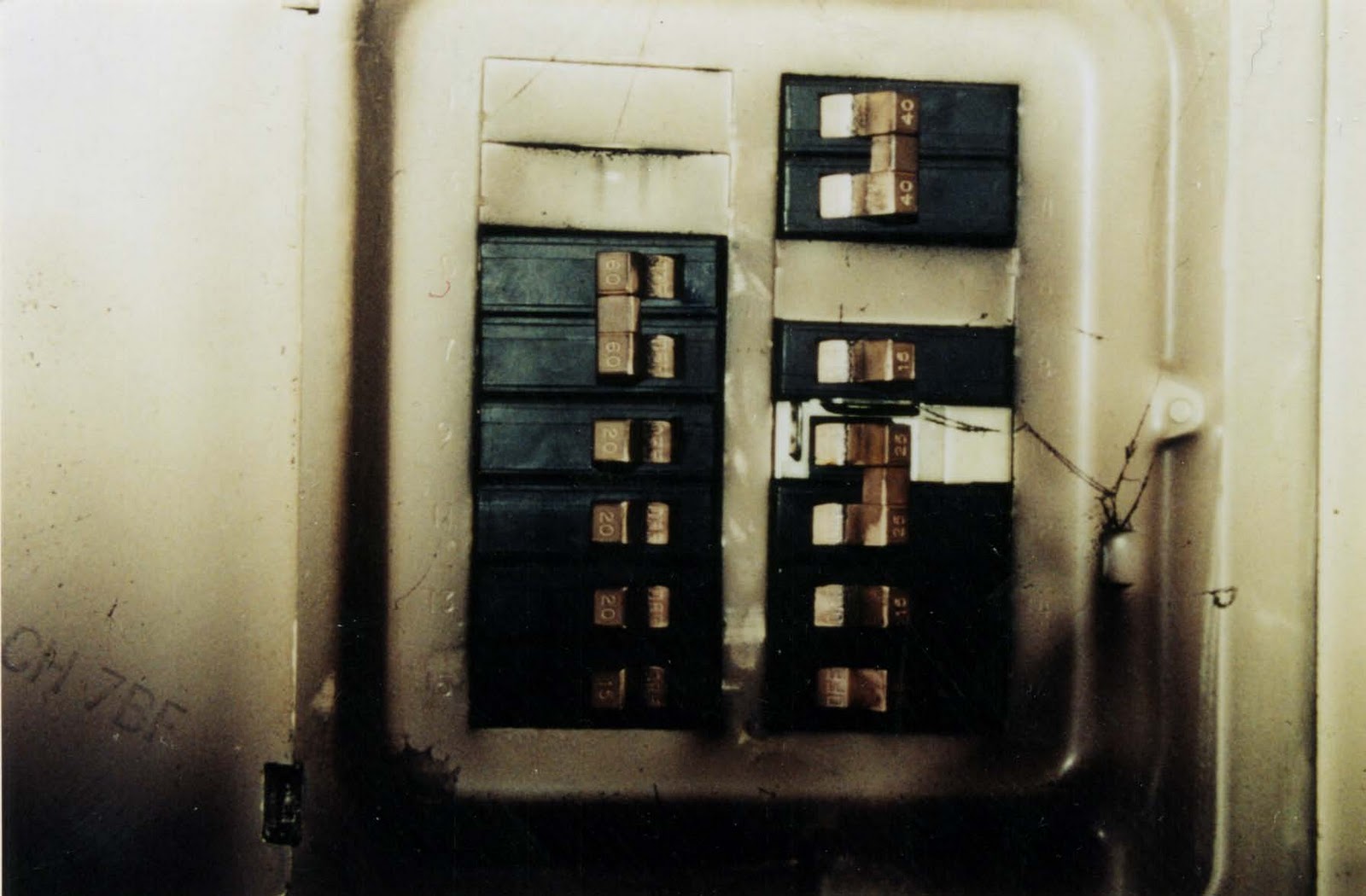
The electrical service panel was located in the master bedroom, well removed from the fire in the living room. The bedroom suffered light-to-moderate smoke damage. I present the service panel and the surrounding smoke damage below. I have cropped the picture to preserve (to the extent possible) the privacy of those people I hope to help.


Below, I provide a closeup of the same service panel, this time with the panel door closed. You can see that soot has settled along the upward facing surface above the door.


There are, however, streaks of soot projecting from the bottom of the panel door and faceplate, particularly at the lower right corner. These streaks are suggestive of smoke being expelled under pressure from within the panel.

It's time to look inside.


The soot inside the panel is considerably denser than outside the panel, though the panel door was presumably closed during the fire. Even if the door had not been closed, the more intense deposition of smoke inside the panel cannot be explained by a living room fire alone.

The police and insurance investigators should have pulled the panel faceplate. They should have examined the circuit breakers. They make no report that they did. Something burned behind the faceplate. Something burned with sufficient intensity to deposit the smoke you see above, and burned with sufficient intensity to eject smoke from the lower corners of the panel door.

Though Virginia Police Agent James Watson and insurance investigator Gary Toler profess to be experts in fire investigation, and though I make no such profession, I am adamant nonetheless that they should have examined and photographed each circuit breaker in detail.

The smoke inside the electrical service panel is evidence of an electrical fire at the Ledford residence. The smoke inside the electrical service panel was not caused by a candle thrown into a chair in the living room. The smoke in the service panel disproves Michael Ledford's confession.

Confession Falsified by Mirror Images

In the picture above, notice the text "CH 7BF" impressed on the back of the panel door. Though I have been working on this case for more than five months now, only recently have I made a serious effort to determine if that text is significant. I spent many hours prowling the internet researching that text in particular and circuit breakers in general. The text was a stone I did not want to leave unturned.

As it turns out, the first two letters of the text are of great significance. Here was the big discovery.
All circuit breakers do not trip to the center position. The following circuit breakers do not have a center position, and they trip to the "off" position: Cutler Hammer, Bryant and Murray.
It hit me that the CH stands for Cutler Hammer. I confirmed this by comparing images from the fire scene with images from Amazon. The panel from the Ledford apartment is on the left. A typical Cutler Hammer residential panel from Amazon is on the right.


The models are not identical, but the similarity of design is obvious. Most obvious are the vertical lines on the door bounding a raised region, possibly added for ventilation purposes. One noticeable difference is that the Ledford panel is missing its pull handle. I don't know if that is significant.

Most circuit breaker handles move only slightly (to a "middle" position) when they pop. For those breakers, you have to look carefully to distinguish which breaker just popped and needs to be reset. To reset it, you have to move it first to the fully "off" (fully open) position and only then can you move it back to the "on" (fully closed) position.

This understanding of the Ledford breaker manufacturer and operation confirms what I had suspected. All the circuit breakers on the left hand side of the panel (plus the bottom circuit breaker on the right hand side) popped sometime during the fire. They popped from their fully "on" position to their mirror image fully "off" position.  You will see that if you will look at the picture once again. I therefore provide the picture once again. Click on the image to see it enlarged and clear.
When the switches popped, the handles moved away from the center. Because these are Cutler Hammer breakers, the handles moved a relatively long distance, all the way to the fully "off" position. In doing so, new and noticeable portions of the breakers were exposed to the smoke. The breakers that popped during the fire had the newly exposed portions sooted by the smoke. Those which were manually thrown after the fire show the white region that was protected from the smoke during the fire. Those breakers stayed on during the fire.

To understand the significance of this, you need to understand how a circuit breaker works. I quote from the same reference as above.
A temperature sensitive bimetal strip ... bends and releases the spring mechanism at a calibrated temperature. Usually, the temperature of the bimetal strip is proportional to the amount of current passing through the circuit breaker. However, the bimetal strip will react and bend to any rise in temperature. The rise in temperature may be due to a loose wire connection, misalignment of the circuit breaker contacts, or the heat from a fire. 
In other words, a circuit breaker is designed to trip when it becomes hot, usually due to excess current flowing through it. Excess current flows when there is too little resistance in the circuit protected by the breaker. When a line shorts, when two wires touch without a lamp or a heater or a microwave in between, excess current flows through the circuit. This causes the bimetal strip in the circuit breaker to heat, bend, and thereby release a spring mechanism which pops the switch. In a Cutler Hammer circuit breaker, the switch movement is unequivocal.

A circuit breaker will also pop open if the bimetal switch is heated by any means other than excess current.  If one breaker in the panel overheats but fails to pop open as designed, the heat from that switch will begin to burn the surrounding material and will begin to heat the other breakers. If the faulty breaker generates sufficient heat, smoke will be expelled from the breaker box and the other breakers will begin to pop.

That's what happened in the Ledford apartment. The evidence you see in the photos is evidence of a short in a circuit elsewhere in the Ledford apartment. It is evidence also of a circuit breaker that failed to open as it heated up.

Now what?

I'm not done. Not by a long shot. I set out to find the origin of the fire. The breaker box in the master bedroom is not the origin of the fire in the living room. The breaker box in the master bedroom is but a glaring symptom of an electrical short elsewhere in the house.

I set out to find the short, and find how that short set fire to the living room. What I learned along the way has shaken me to my core.