Tuesday, October 26, 2010

SCOTUS Reads The Skeptical Juror

Working with the resident jailhouse attorney, Byron Case petitioned the U.S. Supreme Court to issue a writ of certiorari. Recall from a previous post that certiorari is Latin (of course) meaning "to be more fully informed." Meanings change over time, but currently, here in the United States, a writ of certiorari is an instruction from a higher court to a lower court to hear a case. Typically it means the Supreme Court instructs a lower court to hear a case.

The issue in Byron Case's case was the admissability of a tacit admission used as evidence against him. Amidst a long haranging dithyramb during a surrepticiously recorded phone call, an embittered ex-girlfriend accused Byron of killing a common friend. Byron did not explicitly deny the charge, and in Missouri that counts as a tacit admission of guilt. The so-called tacit admission was instrumental in Byron's conviction and his resulting life sentence.

(Byron claimed he can't even remember the late night call, explaining he had strep throat and a high fever at the time. He introduced a medical report from the next day to confirm his point. An acoustic analysis of the phone call I conducted for the book shows that the transcript was falsified and the volume was manipulated on the girlfriend's side of the call.)

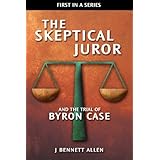
I addressed the issue of tacit admission in The Skeptical Juror and The Trial of Byron Case. Without my knowledge, Bryon included the segment from my book in his petition to the Supreme Court. While it's unlikely any of the nine justices read it, it's possible one of the clerks may have. Hence my claim that SCOTUS reads The Skeptical Juror.

I include the purloined segment below.
With respect to the tape, the appeals court agreed with the prosecution that the conversation constituted a tacit admission. The tape was therefore not excluded by hearsay rules.
A defendant makes a tacit admission of guilt when the defendant fails to respond to or significantly acquiesces in the import of an inculpatory statement by making an equivocal, ambivalent, or evasive response when the inculpatory statement was made in the presence and hearing of the accused, and was sufficiently direct, as would naturally call for a reply.
If someone asked you why you felt the need to kill John Kennedy, and you simply stared at them, that would clearly fit within Missouri’s definition of a tacit admission. You failed to respond. 
If instead of remaining silent you told the person to “Shut the fuck up,” that too would be a tacit admission. That exact response has already been judged as a tacit admission by the State of Missouri. “We shouldn’t talk about this” would also be a tacit admission, since that’s what Byron allegedly said. “Maybe I did, maybe I didn’t” would certainly be a tacit admission, since it’s equivocal. 
It’s difficult to determine how eloquent one might have to be to avoid tacitly admitting to the assassination. I’m guessing “Have a nice day” might be insufficient, since it’s ambivalent. “Bite me” is not much different than “Shut the fuck up.” “I don’t know what you’re talking about” might be ruled evasive, as could “I’ve got to be getting home.” 
I suggest something along the line of: “I did not kill John Kennedy, nor did I have any agent act in my stead, nor did I have any role whatsoever in his assassination, either before or afterwards, nor do I know of anyone who actually participated in or contemplated his assassination.” Think quickly though. If you try something such as “I’ll need to check with my attorney before responding to your statement,” that will almost certainly qualify as tacit admission in Missouri.
Byron and his jailhouse attorney wrestled with including the profane language as is or masking it. They decided to include it exactly as I wrote it. I included the profane language because it was in the court decision that established tacit admissions as case law in Missouri.

By comparison, the state of Texas refuses to this day to put the complete text of Cameron Todd Willingham's last words online, because Willingham used profane language just before they killed him. I find it sadly comical that the same state that straps its citizens to a gurney and pumps them full of lethal chemicals suddenly gets the vapors when it comes to printing coarse language.

Antonin Scalia's decision to consider Hank Skinner's petition for a writ of certiorari resulted in a stay of Hank's execution just 45 minutes before Texas pumped him full of chemicals. That's rare. The Supreme Court dismisses 99% of the petitions without comment.

In Byron's case, the Supreme Court dismissed his petition without comment on the first day of their new session. Another door closed on a wrongfully convicted man.

Byron and his jailhouse attorney have formally asked the Supreme Court to reconsider their rejection. The chance for success is slim, but when you are serving life for a crime you did not commit, you have to take the few chances available to you. Hopefully, the nine justices will someday soon indeed read The Skeptical Juror.

Monday, October 25, 2010

The Grainy Case of Kia Levoy Johnson

Three people claimed they knew the man on the grainy security camera video. A San Antonio police officer identified the robber by his distinctive clothing. Two others identified their long time friend / recent acquaintance as the man who shot and killed the store clerk. Coupled with a matching shoe print and a court-appointed attorney who met with his client for only three minutes before trial, those three video witnesses were more than enough to convict Kia Levoy Johnson of capital murder.

Throw in Kia's criminal record and the death penalty was a done deal. Add a pinch of rubber-stamp appellate system and a dollop of incurious Rick Perry, and Texas had another notch in its handle. At 6:18 PM on June 11, 2003, Kia Levoy Johnson would become the 305th person executed by Texas in the modern era.

Rick Perry's Attorney General, Greg Abbott, provided the following description of the crime and the evidence against Johnson.
In the early morning hours of Oct. 29, 1993, Kia Levoy Johnson entered a Stop 'N Go convenience store and approached the counter. When store clerk William Matthew Rains came to the counter, Johnson pulled a gun from his waistband and fired one shot. Rains fell on the floor. Johnson then demanded that Rains give him the register key. Rains threw a key to Johnson who attempted to use it to open the cash register. When the key broke, Johnson took the contents portion of the register and exited the store. For approximately 45 minutes after the robbery Rains attempted to reach a phone but was unable to do so because he had lost his motor skills. Rains' body was discovered in the early morning hours of Oct. 29, 1993, when another customer entered the Stop 'N Go. 
The details of the offense were captured on a store security camera. When the local news broadcast the video, a longtime friend identified Johnson and called Crime Stoppers. An officer of the San Antonio Police Department and another of Johnson's acquaintances also recognized Johnson from the videotape. The videotape was admitted into evidence and played for the jury.
Abbott’s summary of the three people who recognized Johnson on the video is at odds with most other reports. The witnesses are more frequently described as the uncle of Johnson’s common law wife (who admitted his loathing for Johnson while on the stand), a drug addict who had not seen Johnson in fifteen years, and a jailhouse snitch who had previously testified for Texas for reduced sentences. Apparently, the uncle must have been a San Antonio Police officer, though not involved in the case in any official capacity. Apparently Abbott chose to describe a drug addict that Johnson had not seen for fifteen years as “a longtime friend.” And apparently Abbott chose to describe a serial jailhouse snitch as an “acquaintance.”

Abbott apparently believed the case was sufficiently strong that he did not need to mention that a sneaker found in Johnson's closet matched a shoe print left on cash register receipt paper that had fallen on the convenience store floor. Perhaps Abbot felt that if he mentioned the discovery of the shoe, he would be obliged to mention that the police failed to find the murder weapon, or similar ammunition, or  even the cash register the shooter took from the store. The police found a shoe that allegedly matched a partial print, but they couldn't find a cash register, and they couldn't find the murder weapon.

Abbott’s summary does not mention that the FBI was unable to match Johnson’s photo with the person on the videotape. Nor did Abbott mention that the video was of such poor quality that  even Johnson's common-law uncle identified him by his clothing rather than his facial features.

The video, however, was clear enough to definitively show that the shooter placed his hands on the counter when he entered the store. And while the police were able to match a sneaker found in Johnson's closet with a partial shoe print left at the store, they were not able to match any prints from the counter with Johnson's fingers or palms.

To justify and expedite the killing of Kia Levoy Johnston, Texas Attorney General Greg Abbott mis-characterized the primary witnesses and excluded compelling exculpatory evidence. In Texas, that's close enough for government work.

Johnson would be the 65th person executed during Rick Perry's 903 days in office. For those of you undaunted by long division, that's one person every two weeks.

<<>>

I've completed an Actual Innocence Scorecard for this case. I scored Johnson at 87. That means I estimate there is an 87% chance that Johnson was factually innocent compared to a 13% chance he was factually guilty.

Click on the scorecard to view it enlarged. Once the image appears, click again to view it in a still larger, more clear format.

I've included Johnson in the list of those executed by Texas that I have already scored. I include the current list below.

The addition of Kia Levoy Johnson brings the current total to 10.6 people wrongfully executed by Texas.

And counting.

Saturday, October 23, 2010

The Untold Story of Cameron Todd Willingham

Until now, no one has written of The Trial of Cameron Todd Willingham. Many have written about the discredited arson evidence used against him, but no one has written on the trial. Few writers have noted that the jurors maintain still today that they would have convicted Willingham even in the absence of the arson evidence.

There are multiple tragedies in this story. One of them is that had the jury deliberated more carefully and more skeptically, Willingham might not have been even convicted, much less executed.

The defense put on almost no case of its own. A babysitter testifed that Todd would never have done such a thing, An inmate was called to rebut the State's snitch, but was not allowed to testify. Other than those two less-than-impressive witnesses, Willingham's defense called no one to testify in his defense.

Despite the lack of an affirmative defense, and despite inadequate confrontation of the State's witnesses, the trial testimony still had buried within it an explanation of the fire that undermined the State's case. The jurors failed to see it. 

Will you, as a skeptical juror, see what they missed? 

<<>>

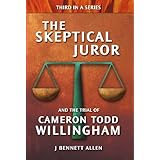
Thank you for your patience while I was distracted by the writing The Skeptical Juror and The Trial of Cameron Todd Willingham. The book is now available on Kindle. It will soon be available in print, hopefully this week. Click the book cover at the upper right purchase from Amazon.

Regular blogging will resume on Monday. Learn why Kia Levoy Johnson may be another person wrongfully executed under the watchful eye of James Richard "Rick" Perry.

Tuesday, October 19, 2010

Death By Fire

The Skeptical Spouse / Editor / Publisher and I just watched the Frontline presentation of Death By Fire. It told the story of Cameron Todd Willingham's conviction and execution for an arson / murder that never happened. Well done, but short. They had only an hour. Anyone who would like to watch it online can do so here.

We finished proofing our book The Skeptical Juror and the Trial of Cameron Todd Willingham just hours earlier. We were watching the show with special interest to see if the book was solid or if it contained a factual error. We both decided the book was good to go.

It will be off to our printing firm and to Kindle first thing in the morning. The Skeptical Spouse / Editor / Publisher believes the Kindle version may be available as early as this weekend and the print version may be available as early as next Wednesday.

Our work is definitely not a rehash of the Frontline show. The show barely touched on the primary focus of the book. As a reader, you'll have a chance to see if you, as a juror, could have stopped the tragedy before it began. No fire experts were needed to see that the State's case was simply not possible.

So it looks as if we can turn out a book in four weeks from first keystroke to availability on Amazon. I probably won't be trying it again any time soon, though. It's pretty hard on everyone involved. Tomorrow, I can start digging through the backlog of things left undone.

Good night.

Learn From Rob

Brandi Grissom of The Texas Tribune has a good interview with Hank Skinner's attorney. You can pick up some tips on how you might prepare for your next case before the U.S. Supreme Court. You can learn a little constitutional law. You might even learn something about the death sentence.

It's quite a good interview, actually. View it on YouTube if you wish, or on the Texas Tribune site.