Monday, February 25, 2013

_______ Welcome To The Skeptical Juror ________

Tuesday, February 12, 2013

The Strangulation of Melissa Trotter

Two seemingly insignificant incidents intersected recently in surprising fashion. The surprise, to me at least, is that I have long overlooked a powerful argument of Larry Swearingen's innocence. I have overlooked a gaping hole in the State's theory of the crime.

The first incident occurred as I was working my way through the Numb3rs episodes on Netflix. I was watching Season 1, Episode 8.  From TV.com:
A man wanted for stock fraud is found garroted in his apartment, and the crime is eerily similar to a murder committed a year earlier, a case in which Don closed when an ex-con confessed. Now, Don must re-investigate the old case to determine if he put an innocent man in jail. He asks Charlie to go over the evidence to see if he missed anything the first time around.
As part of his review, Charlie finds that "according to the FBI's crime stats, in the entire country, three or four people are killed with a garrote every year."

Holy Rarity, Batman!

I had become so used to reading / researching cases of strangulation that I simply presumed they were frequent. Melissa Trotter was strangled with one leg of a pantyhose, and Texas wants to execute Larry Swearingen as her murderer.

I've been writing about Anthony Allen Shore who acknowledges strangling four other young women to death. Shore is far more likely the one who murdered Melissa Trotter than is Swearingen, particularly since Swearingen was in jail when Trotter was murdered.

I've looked a little into the case of Boston Strangler (who almost certainly was not Albert DeSalvo), and  I'm aware of the Hillside Strangler (who was actually two people working in concert).

JonBenet Ramsey was also strangled.

I really could go on and on, so the number of 3 to 4 strangulations per year seemed way too low. I therefore assumed the show's writers meant a particular type of ligature. I also thought a garrote was a ligature with a handle at each end, used as per the sketch below.


The murder weapon used in the Numb3rs episode only reinforced my belief. Here's a portion of the garrote from that episode. If those gloves had a length of wire between them, then they would fit my understanding of a garrote. If, on the other hand, those gloves were bound tightly together by the wiring, they would not fit my understanding of a garrote.


Here's a portion of the murder weapon used in the JonBenet Ramsey case. The FBI referred to it as a garrote. If there was another similar handle on the other end, it would fit my notion of a garrote.


Here's the device Anthony Allen Shore used to kill Carmen Estrada: There was only one handle, and Shore used it to tighten the ligature by twisting it.


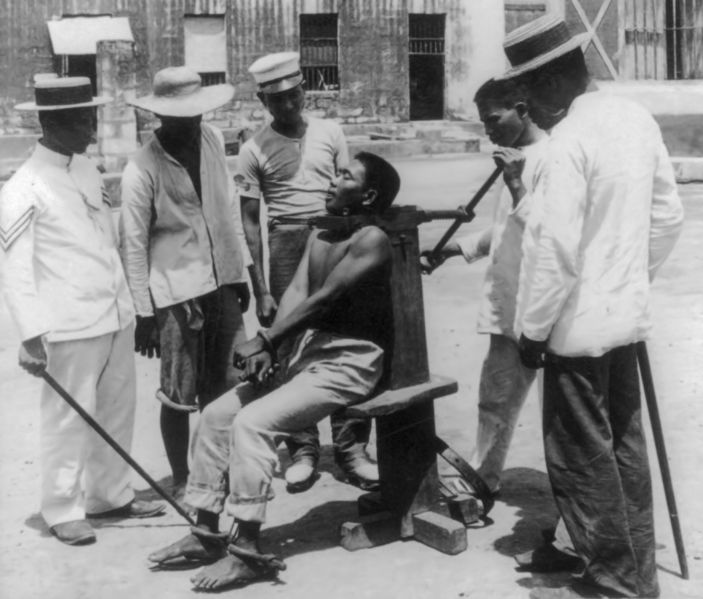
When I begin checking definitions, however, I find only modest support for my thought that a garrote must include two handles, or even one. Instead I find that many sources define garrote as simply a synonym for a ligature. From Wikipedia:
A stick may be used to tighten the garrote (the Spanish word actually refers to the stick itself) so it is a pars pro toto where the eponymous component may actually be absent. In Spanish, the term may also refer to a rope and stick used to constrict a limb as a torture device.
From that article, here's a photo of someone being executed by means of a garrote (Manila, 1901):


A method of execution formerly practiced in Spain, in which a tightened iron collar is used to strangle or break the neck of a condemned person. ... A cord or wire used for strangling.
A method of execution by strangulation ... the apparatus used ... an implement (as a wire with a handle at each end) for strangulation
A method of capital punishment of Spanish origin in which an iron collar is tightened around a condemned person's neck until death occurs by strangulation or by injury to the spinal column at the base of the brain ... the collarlike instrument used for this method of execution ... an instrument, usually a cord or wire with handles attached at the ends, used for strangling a victim.
From  Lexic:
An iron collar formerly used in Spain to execute people by strangulation ... something, especially a cord or wire, used for strangulation
A weapon consisting of a wire or cord with handles at each end, used in strangulation ... an iron band placed around the neck and tightened in order to execute somebody
I realized recently that I'm beginning to prefer Bing Maps to Goggle Maps for some applications. Now I realize that I prefer Bing Dictionary to the some of the other online dictionaries, since it reinforces my preconceived notion of what constitutes a garrote.

Even if the Numb3rs episode was correct in that there are only 3 or 4 garrote murders each year in the U.S., that number is of no use to me because it was not accompanied by a definition of garrote. Even if it had been accompanied by a definition, it would have been meaningless in the case of Melissa Trotter since no object (other than the murderer's hands) were used to tighten the pantyhose leg around her neck. I therefore let the number just rattle around in my head.

Later it struck me that I should try and find out how frequently someone is strangled. Perhaps such an occurrence is less common than I assumed. If it was sufficiently rare, it would suggest that Melissa Trotter was more likely murdered by someone known to use a ligature (such as Shore) than someone who had no history of using a ligature (such as Swearingen).

It took me a while, but I finally found this document. Click to enlarge.


Averaging the data for the four years, I get 123.5 strangulations per year out of 14,085 murders per year. That's 0.9%. That includes manual as well as ligature strangulations.

Then I found this document.


This document breaks the data down not only by weapon, but by the age of the victim. Melissa Trotter was only 19 years old when she was murdered. According to the data, in 2002, 1,184 people between the ages of 17 and 19 were murdered. Of those, only 6 were strangled. That's only 0.5%.

This article provides data indicating that the ratio of manual strangulation to ligature strangulation is 10 to 8. The sample size, however, was small.

This article provides data indicating that the ratio of manual strangulation to ligature strangulation is 46 to 23. The mean age of the victims, however, was 78 years.

Assuming ligature strangulations constitute 40% of all strangulations, they constitute only 0.2% of all homicides.

Whatever the final, more precise numbers may be, it is exceptionally unlikely that Melissa Trotter was murdered by anyone other than a person who has demonstrated a propensity for ligature strangulation. Larry Swearingen is not such a person. Anthony Allen Shore is.

So much for the first of two intersecting incidents in this already overly-long post. I'll have to pick up the pace for the second of the two intersecting incidents.

Three days ago I received a comment to my post Spectacular News in the Swearingen Case from astute reader Matthew Faler.
TSJ - I largely agree with the science in this matter regarding how long Trotter had been dead when her body was found. However, a few lingering questions bother me (1) was she wearing the same clothes when they found her as she was last seen in? and (2) if she was alive for several weeks after she went missing, where was she?
I responded with:
Matthew, 
You ask two $1,000,000 questions. I have a couple 10 cent answers. 
First, I've wondered myself about the clothes. I've never seen that discussed. It seems as if the police could have clarified that point reasonably easily. A number of people saw her shortly before she disappeared. Was she wearing the same clothes or not? If the clothes were different, where did she change? If the clothes were the same, had she worn them continuously or had they been cleaned? 
I suspect the police / prosecutor must know the answer. I suspect that since it is a secret, it doesn't help their case. My guess is that information about the clothing would tend to further exonerate Swearingen. 
Regarding where she might have been, I speculated in my series Who Killed Melissa Trotter: Anthony Allen Shore.
His comment and my reply, coupled with the infrequency with which people kill via ligature strangulation, caused me to do what I should have done early on. If I had been a juror in the case and if I had failed as I had just failed as a blogger, I would have difficulty living with myself. That task is challenging enough as it is.

Here's what I didn't do. I didn't attempt to recreate the crime, even in my mind. I never walked through the State's case step-by-step to see if it made sense, to see if they proved the critical elements beyond a reasonable doubt. I was so focused (initially) on the post-conviction science and (later) on the possibility that Shore killed Trotter that I failed to carefully walk through the State's case. It wouldn't have been hard. It wouldn't have taken very long.

I'll do it now, at least the portion immediately surrounding the murder. The State claimed that Swearingen and Trotter had recently met and had arranged to have lunch the next day. Swearingen told some friends that he had met a young woman named Melissa and that if things went well, he would "have Melissa for lunch."

Swearingen picked up Melissa at the community college where Melissa went to school. After a delay no greater than an hour and a half, the two arrived at Swearingen's mobile home. While there, the two had a sexual encounter that left a bruise on the wall of Trotter's vagina. At some point, there was a struggle that left Swearingen's home in disarray. Swearingen strangled Trotter with one leg of his wife's pantyhose, put Trotter in his truck, drove to the Sam Houston National Forest, dumped Trotter's body, then returned home.

Here's where the State's case makes absolutely no sense. After having sex, Swearingen decided to kill Trotter, for whatever reason. To kill his victim, he didn't use a firearm, as do 70% of the murderers in this country. Perhaps he didn't own a firearm, or have it at the ready, or feared the noise.

Nor did Swearingen stab his victim to death, as do 13% of the murderers in this country. Surely he had a knife or pair of scissors in his home. He must have had something of the sort in order to cut one leg from his wife's pantyhose.

Nor did Swearingen asphyxiate his victim, as do 6.4% of all murderers in this country. There must have been a pillow nearby.

Nor did Swearingen pummel or kick or stomp his victim to death, with his hands or feet, as do 6.2% of murderers in this country. I know that those makeshift weapons were handy.

Nor did Swearingen bludgeon his victim with a blunt object, as do 4.4% of murderers in this country. Surely he had a frying pan or a hammer laying around.

Nor did Swearingen strangle his victim with his bare hands, as do 0.6% of murderers in this country. Once again, I'm confident those makeshift weapons were readily available.

Instead, according to the State, Swearingen elected to strangle his victim with a ligature, as do only 0.2% of the murderers in this country. Only 1 in 500 murders is committed by ligature strangulation, and the State's case is even more unlikely than that, more unlikely than 1 in 500.

In a moment of passion and panic, Swearingen did not just grab a nearby object to strangle his victim. He did not use any of the victim's clothing, such as a sweater arm, or a brassiere, or a belt. Nor did he use a pillowcase or a lamp cord. According to the State, Swearingen decided to use his wife's pantyhose.

But the State's case is still more unlikely than described so far.

Swearingen took time to manufacture a ligature from his wife's pantyhose. Instead of stabbing or cutting his victim with a knife or scissors, he used a knife or scissors to stab or cut his wife's pantyhose. The State offers no explanation why Swearingen would do such a thing in such a frantic moment, nor does it explain what Melissa Trotter may have been doing while Swearingen manufactured the ligature that would be used to kill her.

And still it is worse than all this.

According to the State, Swearingen left the remainder her of his wife's pantyhose behind when he took Melissa's body to Sam Houston National Forest. He presumably removed the body from his home so that his crime would not be discovered, but he left the obvious remnant of the murder weapon behind.

He couldn't have left it behind carelessly or unconsciously. It must have been deliberate, because he hid the remnant of his hastily crafted murder weapon so well that the police were unable to find it on either of two thorough searches. Swearingen hid it so well that it would not be discovered for three weeks, in the garbage outside his home, after the police finally knew which murder weapon was used to kill Melissa Trotter.

Saturday, February 9, 2013

The Impending Execution of Paul Howell

Paul Augustus Howell sits on death row awaiting execution by the people of Florida on 26 February 2013. I offer the following details of the crime from the appellate decision of Howell v. State (2004):
In January of 1992, Howell constructed a bomb for the specific purpose of killing Tammie Bailey at her home in Marianna, Florida. Bailey, Howell, and Howell's brother, Patrick, were part of a drug ring involving a number of other individuals in which drugs were obtained in Fort Lauderdale and then sold in Marianna, Florida. Howell intended to eliminate Bailey as a witness because she had knowledge that could link Howell and his brother to a prior murder. The bomb was placed inside a microwave oven and then the oven was gift-wrapped. Howell paid Lester Watson to drive and deliver the microwave to Bailey. Although he knew that Howell had often made pipe bombs, Watson testified that he thought the microwave contained drugs. Howell rented a car for Watson to use for the trip. Watson was accompanied on the trip by Curtis Williams. 
While traveling on I-10 toward Marianna, Watson was stopped by Trooper Jimmy Fulford for speeding. Fulford ran a registration check on the car and a license check on Watson, who gave the trooper a false name and birth date because he did not have a valid driver's license. The radio dispatcher contacted the car rental company and was informed that Howell had rented the car. The dispatcher contacted Howell at his home in Fort Lauderdale, Florida, to determine whether the rental car had been stolen from him. Howell told the dispatcher that he had loaned the car to Watson but did not know that Watson would be traveling so far with the vehicle. Howell was informed by the dispatcher that Watson was going to be taken to the Jefferson County Jail. Howell did not give any warning to the dispatcher regarding the bomb. 
Deputies Harrell and Blount of the Jefferson County Sheriff's Department arrived at the scene and Watson gave them permission to search the vehicle. Trooper Fulford and the deputies observed the gift-wrapped microwave in the trunk of the car. Watson was arrested for speeding and driving without a valid driver's license and was transported, along with Williams, to the jail by Deputy Blount. Deputy Harrell also proceeded to the jail, leaving Trooper Fulford alone with the rental car. Shortly thereafter, a massive explosion took place at the scene. Testimony presented at Howell's trial by the State's explosives expert indicated that Trooper Fulford had been holding the microwave in his hands when the bomb went off. Trooper Fulford died instantly due to the massive trauma caused by the explosion.
I oppose the execution of any person who may be innocent of the crime for which he is to be executed. In all other cases, I stand mute regarding the propriety or wisdom of the execution. In the case of Paul Augustus Howell, I stand mute.

The Impending Execution of Andrew Allen Cook

Andrew Allen Cook sits on death row awaiting execution by the people of Georgia sometime during the week of 21-28 February. I present the details of his crime as presented in the adverse appellate decision Cook v. State (1999):
The evidence adduced at trial shows the following: at approximately midnight on January 2, 1995, Mercer University students Hendrickson and Cartagena were parked on a small peninsula known as "the Point," which juts into Lake Juliette in Monroe County, north of Macon. Cook drove onto the Point, parked his Honda CRX near Hendrickson's and Cartagena's car, and shot them. Cook fired fourteen times with an AR-15 rifle from a distance of about forty feet and then moved closer and fired five times with a nine millimeter Ruger handgun. Hendrickson and Cartagena were each hit multiple times and killed. Cook then went to the passenger side of the victims' car, removed Cartagena, and dragged her about 40 feet. He partially undressed her, knelt between her legs, and spit on her. Cook then drove away. The murders were completely random: Cook did not know the victims and there was no interaction between Cook and the victims before he killed them. 
Several people parking or camping around Lake Juliette heard the shots, and the murders were reported to the police the next morning when some campers found the bodies. A couple parked near the Point when the shots were fired said they saw a 1980s-model Honda CRX parked near the entrance to Lake Juliette. Later, they saw headlights going onto the Point, heard shots, and observed the CRX speeding away from the Point. The police recovered .223 caliber and nine millimeter bullets and shell casings from the crime scene, and the State Crime Lab reported that the weapons used in the murders were probably an AR-15 rifle and a nine millimeter Ruger handgun. There was saliva mixed with tobacco dried on Cartagena's leg, and the Crime Lab extracted DNA from the saliva. The police began looking for suspects who chewed tobacco, matched the DNA taken from the saliva, and owned or had access to a Honda CRX, an AR-15 rifle, and a nine millimeter Ruger pistol. 
The investigation lasted almost two years. Many people were interviewed and dozens of suspects were excluded after they submitted blood or saliva samples to the Crime Lab, or allowed their weapons to be examined by a state firearms expert. In the fall of 1996, GBI Agent Randy Upton began tracking the purchasers of AR-15 rifles in the Macon area. He obtained a list of 108 people who bought AR-15 rifles from 1985 to 1995 from one of Macon's most popular gun stores, and he started calling them and asking if they would give saliva samples and allow examinations of their rifles. On November 27, 1996, Agent Upton contacted Cook. Agent Upton told Cook he was conducting an investigation into the Lake Juliette murders and that Cook owned an AR-15 rifle in 1994 and 1995. Cook replied that he had "gotten rid of" his AR-15 in April 1994. Agent Upton stated that that was not possible because the records show that Cook did not buy his AR-15 until August 1994. Cook then became defensive and stated that his father was an FBI agent, and he did not have to cooperate. Agent Upton asked for a saliva sample, and Cook said he needed to talk with his father before giving a saliva sample. The conversation ended. 
Agent Upton learned that Cook pawned his AR-15 rifle back to the gun store in May 1995, five months after the murders. The police also discovered that Cook had an acquaintance purchase a nine millimeter Ruger handgun for him in December 1993 at the same gun store, because Cook was too young to buy it himself. Cook sold the Ruger to a friend in July 1995. The police sought to obtain these weapons from their current owners. They also learned that Cook owned a 1987 Honda CRX at the time of the murders. 
One of Cook's friends, who worked with Cook at a diaper factory, testified that in late November 1996 he and Cook had a conversation about "the worst thing you ever did." Cook said he had killed someone with an AR-15. The friend did not believe Cook, but asked why he did it. Cook replied that he did it "to see if I could do it and get away with it." Cook refused to provide any more details. The friend testified that the following day at work, Cook received a call on his pager, and left his work area to return the call. Cook returned 15 minutes later and was "as white as a ghost." Cook said "I got to go," and spit the tobacco he had been chewing into a trash can. Cook said it was the GBI who had called and they wanted to question him about what he and the friend had talked about the day before, and test his saliva. He said, regarding the saliva, "that's a DNA test right there, so they got my ass." Another friend testified that Cook told him in late November 1996 that he needed to leave town because it was "getting hot." 
After going to Cook's home and not finding him, Agent Upton called Cook's father, John Cook, on December 4, 1996. John Cook was an FBI agent and had been an FBI agent for 29 years. Agent Upton said he needed to ask Cook a few questions regarding the Lake Juliette murders, and asked John Cook for assistance in locating him.[2] John Cook said he could probably contact his son. John Cook, who knew about the case from the media but had not worked on it, testified that he did not think his son was a suspect. 
John Cook paged his son several times and at 11:00 p.m. Cook returned his calls. John Cook told his son the GBI was looking for him concerning the Lake Juliette murders and asked him if he knew anything about them. Cook replied, "Daddy, I can't tell you, you're one of them ... you're a cop." John Cook said he was his father first and, believing his son may have been a witness, asked Cook if he was there during the shooting. Cook said yes. John Cook asked his son if he saw who shot them, and Cook replied yes. Although he still thought "maybe he was just there and saw who shot them," John Cook asked his son if he shot them. After a pause, Cook said yes. Cook told his father he was fishing at Lake Juliette and had an argument with the male victim. The male victim threatened him with a gun, and Cook shot the victims in self-defense. Cook realized that the male victim had only threatened him with a pellet gun, and he threw the pellet gun into the woods. John Cook urged his son to go to the authorities but Cook said he was going to run and "just disappear." John Cook was worried that his son was going to kill himself. 
John Cook was stunned by what his son had told him. After speaking with his wife, he called his friend and FBI supervisor, Tom Benson, who was at a conference in New Orleans. He and Benson decided that Benson would fly back to Georgia the next day and the two men would go to Monroe County Sheriff John Bittick, and John Cook would tell the sheriff what his son had told him. They arrived at the Monroe County sheriff's office at about 4:00 p.m. on December 5, 1996. 
At about 11:45 a.m. on December 5, 1996, Cook was arrested by a game warden for shooting deer and turkeys out of season and giving a false name. He was taken to the Jones County sheriff's office. Agent Upton, who did not know about Cook's admission to his father, learned that Cook was being held in Jones County for game violations. He drove to Jones County to question Cook about the Lake Juliette murders. When Agent Upton introduced himself and asked to speak with him about the murders, Cook blurted, "it's been two years since the murders and you guys don't have anything; I had a CRX; I had an AR-15; I had a Ruger P89; you guys are going to try to frame me." Cook added, "get my father and get me [a] lawyer and I'll tell you what you want to hear." The interview terminated. Agent Upton subsequently learned from Sheriff Bittick that John Cook was in Monroe County, and that Cook had made an admission to his father the night before. Agent Upton transported Cook to Monroe County. 
After Cook arrived at the Monroe County sheriff's office, John Cook asked Sheriff Bittick if he could speak with his son, and the sheriff agreed. Cook and his father had a private meeting. Both men were crying and John Cook hugged his son. John Cook told his son he did not believe that he told the whole truth on the phone. Cook replied that there was no pellet gun, that "I pulled in, the car was already there, and I just stopped and shot them." Cook then dragged the female victim from the car to make it look like an assault or robbery. John Cook testified at trial about his son's admissions. 
The police recovered from the current owners the AR-15 rifle and nine millimeter Ruger handgun that Cook owned in January 1995. Ballistics testing revealed that they were the murder weapons. Cook's DNA matched the DNA extracted from the saliva on Cartagena's leg; the state DNA expert testified that only one in twenty thousand Caucasians would exhibit the same DNA profile. 
The evidence was sufficient to enable a rational trier of fact to find Cook guilty of two counts of malice murder and two counts of felony murder beyond a reasonable doubt. The evidence was also sufficient to enable the jury to find the existence of the statutory aggravating circumstance beyond a reasonable doubt.
I oppose the execution of any person who might be innocent of the crime for which they are to be executed. In all other cases, I stand mute with respect to the propriety or wisdom of the execution. In the case of Andrew Allen Cook, I stand mute.

Friday, February 8, 2013

The Impending Execution of Carl Blue

Carl Henry Blue sits on death row awaiting execution by the people of Texas on 21 February 2013. From the decision in Blue v. Thaler (2010):
Blue left his College Station apartment in the early morning hours of August 19, 1994.He walked seven miles to Bryan where the victim, his ex-girlfriend Carmen Richards-Sanders, lived.Blue entered a convenience store across the street from her apartment complex three times: once to purchase a beer, once to pay for fifty cents worth of gasoline, and once to obtain a  soda cup.
  
At the same time, the victim readied herself for work.  She was not alone in the apartment; Lawrence Williams was an eyewitness to the events that would unfold.  A few minutes before eight o’clock, the victim prepared to leave.  As Mr. Williams wished her goodbye, she unlocked the door.  Blue’s eligibility for a death sentence depended on the events transpiring in the next few seconds.  At trial, the State of Texas argued that, after the victim unlocked the door but before she could open it, Blue threw the door open from the outside. 
Blue has never disputed his identity as the killer.  In fact, only hours after the crime Blue turned himself into the police and confessed.  During closing arguments at trial, his attorneys emphatically stated: “We’re not going to suggest to you that Carl Blue did not murder Carmen Richards. He did. And I agree, it would be ridiculous for us to suggest that he did not.” 
Blue’s defense in the 1995 trial of his guilt instead focused on whether his crime amounted to a capital, rather than simple, murder.  In essence, the defense argued that “he did not murder her in the course of a burglary.” ... 
The defense did not seriously question the events that transpired once Blue opened the door. Blue entered the apartment, doused the victim with gasoline, and set her on fire with a lighter. As Mr. Williams stepped out of the kitchen, Blue threw gasoline on him and also lit him on fire. Blue then turned to the victim, emptied the last bit of gasoline from his cup, and said “I told you I’m gonna get you.” 
Blue “threw the cup down on the ... floor and left.” Mr. Williams rolled on the floor, but could not entirely put out the flames.  He struggled  to the bathroom shower and extinguished the remaining sparks. The victim, still burning, stumbled into the bathroom. Mr. Williams helped her into the shower.  Because Blue’s assault had also set the room aflame, Mr. Williams and the victim staggered from the apartment. Mr. Williams spent two weeks in the hospital recovering.  Blue’s assault caused second degree burns on 40% of the victim’s body. She died 19 days later from multi-system organ failure resulting from her burns.
   
A jury convicted Blue of capital murder. After a separate punishment hearing, he received a death sentence.
I oppose the execution of any person who might be innocent of the crime for which he is to die. In all other cases, I stand mute regarding the propriety and wisdom of the execution. In the case of Carl Blue, I stand mute.