Tuesday, December 7, 2010

Death Penalty on Trial for Its Life: Day 2

Well, that was brief. The Texas Court of Criminal Appeals has ordered Judge Kevin Fine to halt his hearing into the constitutionality of the Texas' death penalty. Story is here.

I repeat my position here for clarity. If I believed the death penalty could be implemented without executing the innocent, I would stand mute on the issue. However, given that it is obvious to me that innocent people have been executed, and given that it is likely innocent people will be executed, I oppose the death penalty and hope for its elimination.

Be not too downhearted, those of you who wished Judge Fine would bring an end to the death penalty. And be not too elated, those of you who hope that executions will proceed apace. The death penalty is an anachronism whose time will come.

Death Penalty on Trial for Its Life: Day 1

I'm sure you're all wondering what happened at Judge Fine's hearing into the constitutionality of Texas' death penalty. Yesterday, the State elected to stand mute, to ask no questions of the witnesses. They expect Judge Fine's ruling, should it go against them, to be overturned. More details here.

Thursday, December 2, 2010

New Trial For Cory Maye!

Rather than use all caps in the title, I used an exclamation mark. It is indeed good news. The Mississippi Supreme Court has ordered that Cory Maye be granted a new trial. I'm ecstatic.

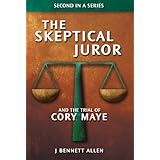
Cory Maye, the subject of Book 2 in The Skeptical Juror series, was convicted and sentenced to death for the fatal shooting of Prentiss Police Officer Ron Jones during a late night drug raid in which only traces of marijuana were discovered. The other officers involved in the raid testified that Maye must have known the police were attempting to enter his half of the duplex. Maye claimed, however, that he never heard anyone identifying themselves as police or otherwise, that he shot at an intruder breaking through the rear door to defend himself and his infant daugther.

(In the book, I present a case that the police and other state actors may have conspired to use perjured testimony to extract their revenge on Cory Maye. I cannot prove that they did so, and I do not claim that they did so. I merely discuss the possibility. I leave it to the readers to decide whether the state witnesses were truthful with their testimony.)

During the appellate process, the death penalty was overturned and the state declined to retry the penalty phase. A new trial was later ordered on narrow grounds over a somewhat complicated change of venue issue. Both the defense and the prosecution appealed that decision to the Mississippi Supreme Court. The Mississippi Supremes ordered a new trial based not on venue, but on jury instructions.

Once again the grounds for reversal were narrow. The vote, however, was not. It's a bit confusing, but by my counting the vote seems to have been 5 to 2 for reversal. The complete ruling is here.

The question is what happens now. I anticipated a new trial and have already pre-speculated about it. I'll simply quote from the Postlude of The Skeptical Juror and The Trial of Cory Maye.
Not much has changed in Prentiss in the nine years since the shooting at the Mary Street duplex. Drugs are still a problem, the economy is still a basket case, and racial issues continue to divide the citizenry. The already sparse population has dropped by more than ten percent as people leave for greener, less troubled pastures.

Some things of course have changed, though their importance pales in comparison to all that Prentiss has lost. A memorial for Ron Jones sits in front of Prentiss Town Hall, and a portion of nearby U.S. Highway 84 is named in his honor. Road signs proclaim to those who pass that they are traveling on the Officer Ronald Wayne Jones Memorial Highway. It is small consolation for the loss of a dedicated police officer, a decent man, and a beloved son.

Perhaps next year, a new trial for Cory Maye will take place in the Jefferson Davis County Courthouse on Columbia Avenue, right in the heart of Prentiss. If so, the populace will divide again along racial lines, as they always have. The prosecution will attempt to to exclude blacks from the jury and the defense will try to stop them from doing so. Everyone will behave outwardly, at least, as if race isn't an issue. In some regards, things will be as they have always been in Prentiss.

In the new trial, however, Cory Maye wll be represented by a well-funded, well-prepared team of talented attorneys. The State of Mississippi, on the other hand, will attempt to hold together a bruised and battered prosecution theory that has been unraveling ever since Judge Eubanks passed sentence.
"All right. Then based upon the jury's verdict, I will sentence you to suffer death by lethal injection. All right. That will be the sentence of the Court."
This time Cory Maye's defense team will take the offense. The State of Mississippi will mount a vigorous fighting retreat. It's not clear either side will be able to secure a unanimous vote from the divided citizenry of Jefferson Davis County, Mississippi.

The two factions may instead elect to call a truce under terms that will allow each side to claim victory. I predict the State of Mississippi will offer Cory Maye a sentence of time served in exchange for a guilty plea to the crime of manslaughter. I predict Cory Maye will accept, and will walk free.

And I predict, sadly, that not much else will change in Prentiss, or Jefferson Davis County, or Mississippi.
Credit as always goes to Radley Balko (aka The Agitator) for being the writer who brought Cory Maye to national attention. I learned of the case from his writing. More significantly, Cory Maye's defense team learned of the case from his writing.

Credit also to Robert Evans, who lost his job as public defender because he agreed  to act as Cory Maye's appellate attorney.

Credit as well to Abraham Pafford, Benjamin Vernia, the law firm of Covington and Burling, and the many other talented and dedicated professionals who provided valuable, pro bono representation. As is the norm in such cases, the state actors will be fully paid for their efforts, paid out of the public treasury. The money needed to free someone wrongfully behind bars will come from private funds if it comes at all.

Credit finally for the folks at Reason Magazine for their support of Radley Balko and for their award winning documentary Mississippi Drug War Blues. This is a case worth understanding. It speaks to a number of problems we have in this country. You can come up to speed quickly by watching the video, narrated nicely by none other than Drew Carey. Great video.

Wednesday, December 1, 2010

Clarence Bekker, Grandpa Elliot, Kevin Fine, and The Change That 's Gonna Come

Next Monday, on the 6th of December 2010, Judge Kevin Fine (here and here) is scheduled to hold a hearing in the case of John Edward Green to decide if the death penalty in Texas is unconstitutional. I doubt that the hearing will be the end of the death penalty, and I doubt that our country is likely to do so anytime soon. But it is inevitable. 

A Change is Gonna Come. 

Start the music video below, then listen as you read the Huffington Post column I've pasted below.


WASHINGTON -- At a hearing scheduled for Monday, December 6, a district court in Texas will decide whether the death penalty is unconstitutional in the state based on the disproportionately high risk of wrongful convictions in Texas. This is the first time in the state's history that a court will examine the problem of innocent people being executed in a Texas capital trial.

John Edward Green, Jr., the defendant in Texas v. Green, is charged in the fatal shooting of a 34-year-old Houston woman during a 2008 robbery. According to legal documents obtained by HuffPost, Green's defense attorneys will be arguing on Monday that a number of factors in Texas's legal system increase the risk of wrongful executions there, including a lack of safeguards to protect against mistaken eyewitness identification, faulty forensic evidence, incompetent lawyers at the appellate level, failures to guard against false confessions and a history of racial discrimination in jury selection.

The death penalty in Texas came under fire earlier this month when a DNA test conducted on a single hair undermined the evidence that convicted a Texas man of capital murder over ten years ago. The hair had been the only piece of evidence linking Claude Jones to the crime scene, but the new test results revealed that the hair likely belonged to the murder victim instead of Jones.

Maurie Levin, a law professor at the University of Texas and an expert on capital punishment, said she would not be surprised if Judge Kevin Fine ruled the death penalty to be unconstitutional in Texas on Monday.

"I would think that Judge Fine would have substantial basis in the evidence that I'm aware of that would lead to a conclusion that the Texas death penalty is unconstitutional as applied," she told HuffPost.

Since 1976, twelve people have been exonerated from death row in Texas out of 139 nationwide, and four study commissions set up by the Texas government have formally recognized the serious risks of wrongful convictions there. Out of the 464 people that have been executed in Texas, about 70 percent have been minorities, according to the Texas Department of Criminal Justice.

Andrea Keilen, executive director of Texas Defender Service, said it is clear to her that the death penalty is handed down unfairly and erratically in Texas.

"It is my opinion and the opinion of many people close to this issue that the Texas system is wholly incapable of carrying out the death penalty in a fair and reliable way," she told HuffPost. "Texas is remarkably out of step with the rest of the country and certainly out of step with what the average Texan would expect when dealing with capital punishment. We're seeing in case after case that the system is just inherently prone to the risk of wrongful convictions and has a complete inability to correct its mistakes."

Keilen said that while the state has a history of strong popular support for capital punishment, she thinks Texans would feel differently about the practice if they knew all the facts.

"I think there is support for the idea of the death penalty among the average Texan, but that if the average Texan were to get a closeup view of how the system actually operates, that support would significantly wane," she said. "It's an abstract concept to most people, but if they saw how abysmal the quality of representation can be, how the system is biased racially, how prosecutors can not disclose evidence, or how DNA testing can be wrong, my opinion is that they as reasonable people would find it unacceptable."

Ref: The Huffington Post

ADDENDUM:
For a more thorough article, see Brandi Grissom's work at The Texas Tribune.

Tuesday, November 30, 2010

Judges Gone Wild: Revised

I want to revise my previous post, Judges Gone Wild. First, the numbers are in error. I left out a term in my calculation. That term was near unity, so it won't make a huge difference. That term belonged in the denominator, however, so the corrected answer I will soon present below is actually more distressing.

I also decided that I tried to do too much with a single plot. I've therefore created two to replace the one. I now present them below, one for the judges ... 

 ... and one for the juries.

Before I started this, I would have been appalled by the thought of an innocent person having more than a 25% chance of wrongful conviction. I'm still appalled, but I'm now admittedly distracted by calculations that suggest an innocent person has substantially more than a 50% chance of of being convicted during a bench trial. The odds range from a "low" of 50% for forcible rape to nearly 84% for muder/manslaughter. Since judges convict 86% of all defendants in the murder/manslaughter category, the number indicates that judges are incapable of distinguishing cases of innocence from cases of guilt.

WARNING: Mathematical Addendum

At least with respect to the plot for the juries, Spencer and I agree reasonably well on the overall chance of being convicted by a jury despite being innocent. He calculates 25% for all trials combined. I calculate 28%. 

We disagree substantially, however, with respect to the overall chance of being convicted by a judge despite being innocent. He calculates 37% for all trials. I calculate 62%. The discrepancy can be understood by looking at the terms that go into the calculation.

The first term is the convictions per trial. We extract that number directly from the judge / jury agreement table. For Spencer and the NCSC data, that number was 80%.  For my work and the Kalven-Zeisel data, the number was 83%.  The two sets of data were close on this number, despite being separated in time by half a decade. 

The second term was the percentage of innocent defendants. Spencer calculated 28%. I calculated 26%. Again we are close. 

The third term was the wrongful conviction rate. Recall that the wrongful conviction rate is the number of wrongful convictions divided by the number of convictions. It is one of the primary results from our analysis of the judge / jury agreement data.  Spencer calculated 13% for judges from the NCSC data, using his methods. I calculated 20% for judges from the Kalven-Zeisel  using my methods. That's our largest discrepancy. The comparison is not great, but not terrible.

When we perform the final calculation, however, the differences combine in such a fashion as to amplify the difference of the results.

Using Spencer's numbers:  0.80 x 0.13 / 0.28  =  .37  =  37%

Using my numbers:  0.83 x 0.196 / 0.26  =  0.64  =  64%

As it turned out, when my numbers were larger, they were in the numerator. When my number was smaller, it was in the denominator. The result was a substantial difference between our calculated values for the chance of being convicted by a judge despite being innocent.